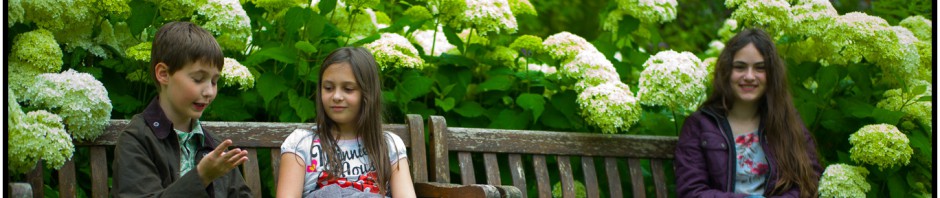
The flight from Atlanta to Japan is 14 hours.
From one standpoint, this flight went as smoothly as possible. The TSA people in Atlanta’s International Terminal were all in good moods, we sailed through all the security points with yellow cards (don’t have to remove shoes!), the flight was on time and non-stop to Tokyo. Nobody lost a suitcase.
However. Our seats were such that all three kids got to sit together in one row, but Adam and I had to share a row with a stranger. That means I got stuck in the middle seat, which is a lousy seat even on short flights. In this case, Adam was on the aisle, I had middle, and the stranger had the window seat. The man seated next to me looked like Michael Rapaport’s uglier, pudgier, nerdier younger brother.
He ordered a glass of white wine less than five minutes after we took off. I didn’t think much of it, aside from being surprised he ordered a white wine because men usually don’t order white. He drained that one quickly and flagged down the stewardess for another one. And then another one. By 2 hours into this 14 hour flight, I was starting to get a little worried. This guy was swilling glass after glass of white wine the way a little kid goes after grape juice. He was watching The Hobbit, which he’d clearly seen many times because he was whispering dialogue under his breath.
My big anxiety-provoking fear is puke. Nothing will trigger a panic attack like thinking I’m trapped with someone who may blow chunks at any moment. It’s the main driver of my secondary fear of boats — people get seasick and puke. And here I was, trapped in the cramped middle seat of an airplane on a 14 hour flight next to a guy on his 8th glass of wine.
These weren’t short pours, either. They were being served in those plastic cups the airlines use. They hold a paltry serving of coke or water (which is always mostly ice) but that translates to a nice big 8 oz glass of wine. (And in wine, 5 oz is considered a serving.) After his 6th or 7th glass, the stewardess started offering him water, but he kept refusing it. Then he opened a huge bag of beef jerky and ate the entire thing. The high altitude of planes contributes to dehydration, too. Have you ever poured salt on a slug? That’s what must have been going on with this guy’s internal organs.
Normally I don’t pay much attention to strangers, but in this case I couldn’t help myself. He didn’t touch a single vegetable or fruit on any of the meals served. He ate the chicken and rice, but threw away the salad and fruit, so he wasn’t even getting some moisture from those. How can a guy throw away all that fruit and then eat a 3 pound bag of beef jerky? His follow-up snack was a big bag of peanut M&Ms. These weren’t the snacks they sell at the airport, either … they were the industrial Costco sized bags, so he had to have planned ahead.
I also couldn’t believe he stayed awake. I kept hoping that he’d fall asleep. Nope.
I have never worried about a stranger’s health more than I did this guy. He finally stopped drinking at his 10th cup of white wine and accepted a small sprite with his breakfast, served about 40 minutes before we landed. I am thankful he didn’t throw up all over me, but it was a very nerve-wracking flight for me. Those of you who suffer from panic attacks will understand how something can trigger one, and how difficult it is not to lose your shit in a public place.
Now, I do understand that this guy, technically, did nothing wrong. He just sat in his seat minding his own business, watching his Lord of the Rings/Hobbit marathon enjoying his snacks and beverages. I was the one with the psychological problem. I get it. I really do.
BUT … for those of you who have never had one, a panic attack is a very unpleasant thing to experience. Adam kept whispering to me “You just need to calm down,” but that’s like telling a depressed person “You just need to be happier” or telling someone having a migraine “You just need to take a Tylenol and push through it.” It doesn’t work that way. You develop an intense hatred for any person, place, or thing that triggers an attack. And boy oh boy did I hate this guy. When I was 16, I took a flight by myself (first time flying alone) and got seated next to a man with a briefcase full of porn. He read porn magazines all the way from Seattle to Dallas. Until today, Porn Guy was responsible for the worst flight I’ve ever been on. White Wine Guy has surpassed him.
Everything went just fine after we got off the plane. Japan does a very efficient job at customs, finding the bus was easy, and figuring out the subway system was actually pretty easy, too. Things are clearly marked and most of the public services have English labels underneath the Japanese characters. Everything is very clean.
The airport is more than an hour outside of Tokyo, so you have to take a bus into the city. It dropped people off at various hotels, but we’re staying in an AirBnB apartment. We figured out which hotel was near the subway line we needed and got off there. It was right across the street from the subway station, and then we had a very short train ride to our stop. Our apartment is very close.
The apartment is TINY. It has three bedrooms, a toilet, a shower, and a kitchen, but it’s all crammed into about 600 sq ft.
The time difference between Atlanta and Tokyo is 13 hours. We arrived at our apartment around 4 p.m Tokyo time, which gave us enough time to find a grocery store within walking distance and get a little bit of food before it got dark. Then we went to bed. We were exhausted.
June 5, Friday
The two girls are staying in the living room on futon mattresses on tatami mats on the floor. Holden scored one of the real beds and his own room; Adam and I have the biggest bed in the place, which is a full-size, sort-of-real-bed-but-not-quite from Ikea.
Last night around 1:30 a.m. Adam woke up with a leg cramp and walked it off in the kitchen — and then broke the bed getting back into it. So, at 1:45 a.m. we had the bed upside down trying to figure out how to either fix the broken leg or take off the other three … with no tools. Luckily (I guess) the legs were so loose we were able to pry the bolts off with our fingers and get the other three legs off. We put the rest of the frame (with the mattress bolted to it) on the floor.
We never did succeed in getting back to sleep after that.
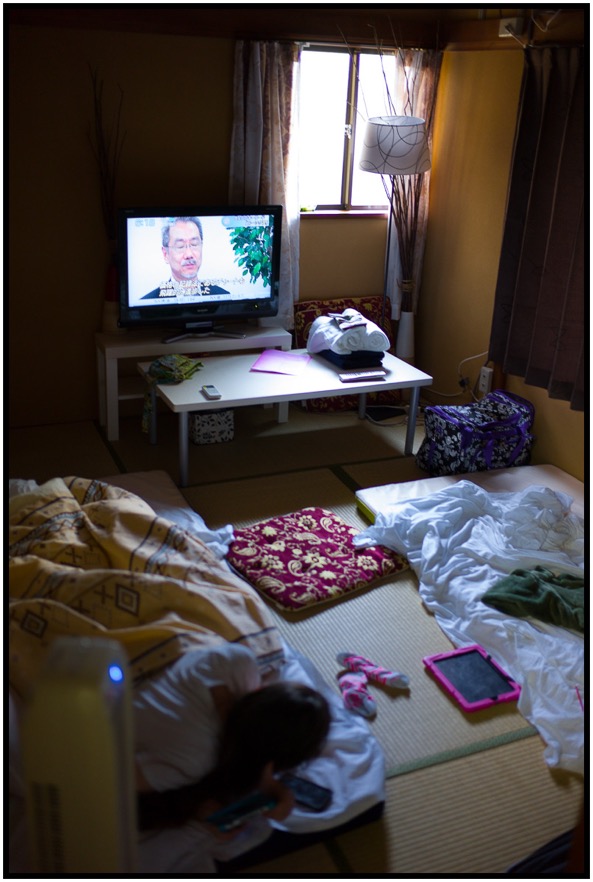
Above: Isabella and Josie on their futons. They have the only TV in the apartment, but there aren’t any shows in English so nobody is fighting over it. The kids have been enjoying watching Japanese cartoons, though.
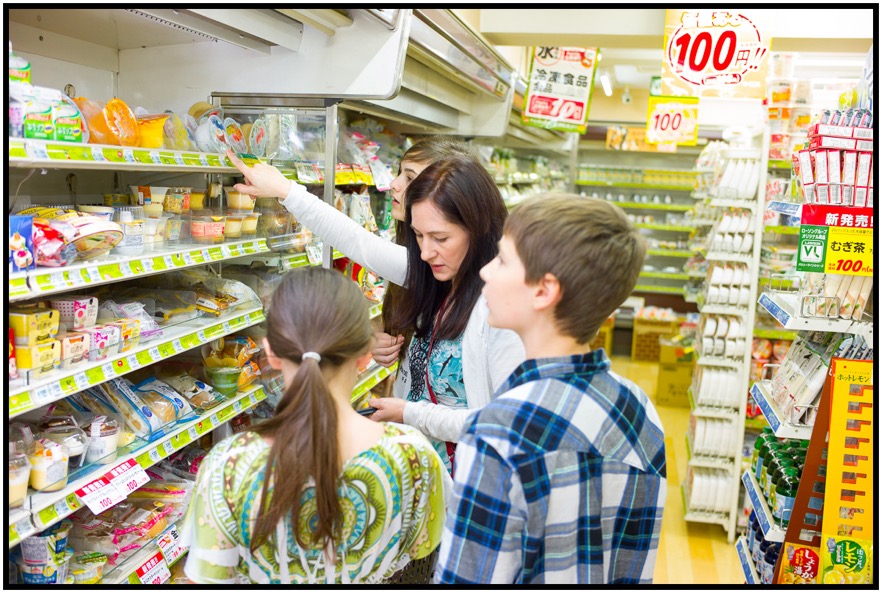
We waited until 6 a.m. and then headed out to the grocery store. Food here is very cheap. It’s kind of hard to tell what some things are since very few of the packages have English on them, but almost everything has pictures of the product on it. That turns out to be very helpful when you’re illiterate.
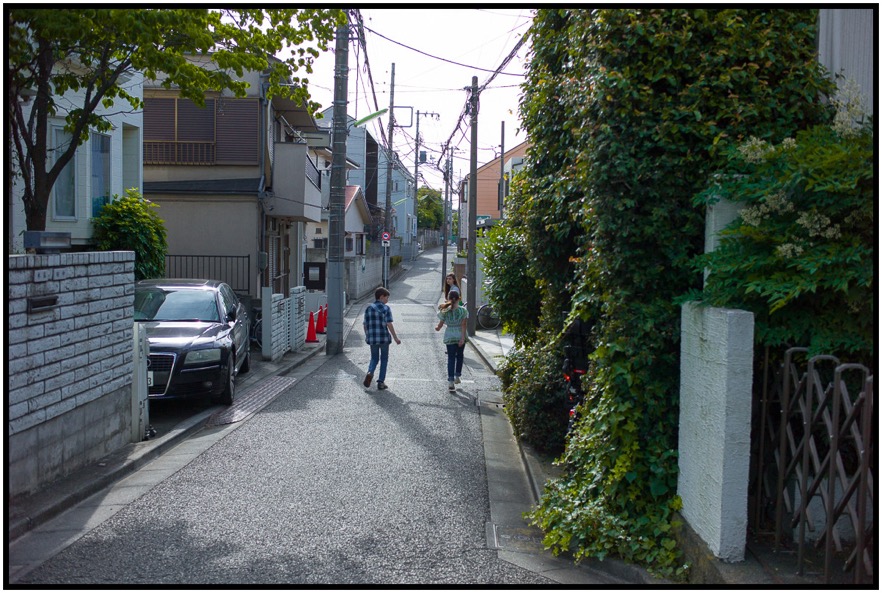
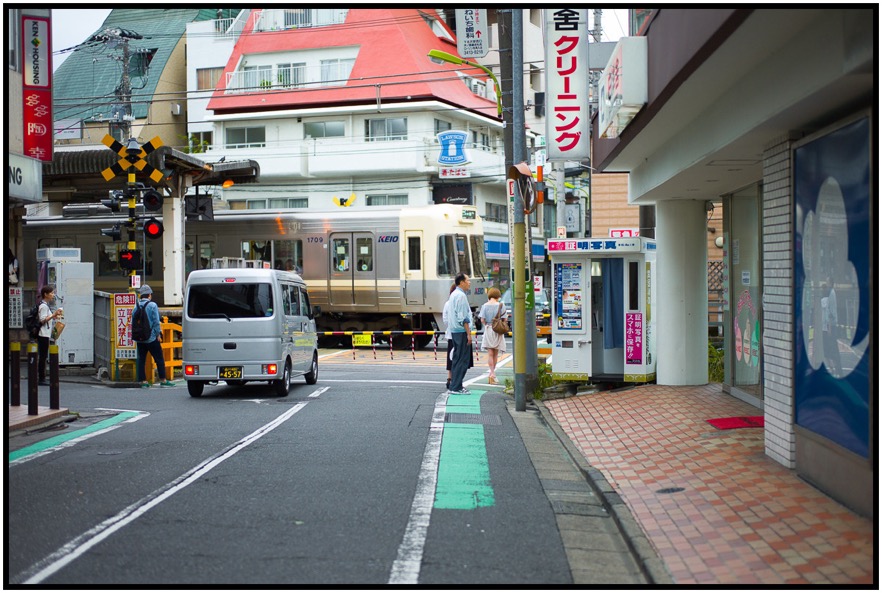
Back to our apartment. This is a quiet, nice neighborhood. Everything in Japan, so far, is exceptionally clean, organized, and quiet. It’s pretty much the exact opposite of any South American city.
The nearest “big” area to our apartment is the Shibuya district. It’s five stops on the subway.
The Tokyo subway system rivals London’s, if not surpasses it. It’s hard for me to say that because I love London so much, I don’t like admitting somewhere else may be better at something. But the Tokyo system is one of the best we’ve seen, and by far the cleanest. The floors and seats of the train cars are so clean you actually notice them because it’s kind of freaky to see a public utility that spotless. At one point, Holden sat down on the train station floor to tie his shoe, and I didn’t immediately say, “Oh, get up! That’s so dirty!” In fact, you could sit down and have a picnic in there and feel perfectly good about eating off the floor. I don’t know how they do it.
We were already tired since we’d been up at 1:30 a.m., so we decided to have a very laid-back, easy day. We explored the Shibuya area a little bit, but nothing opened until 10:00 a.m. We were expecting to find a place to eat breakfast, but nothing was open except for a Starbucks. That wasn’t what we had in mind since we wanted something more authentically Japanese, but realized after a bit that Starbucks was the only option. We were surprised that we couldn’t find a single Japanese restaurant open for breakfast. I guess they don’t eat breakfast?
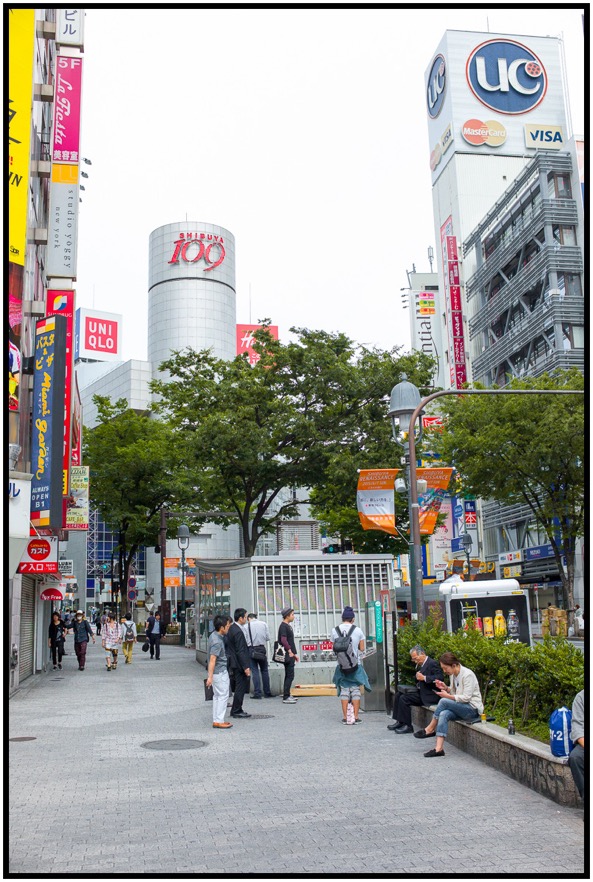
After our Starbucks break, we decided to go to another area of town that was famous for anime and manga. It’s the one place Isabella was dying to see. She and her friends are big manga geeks. 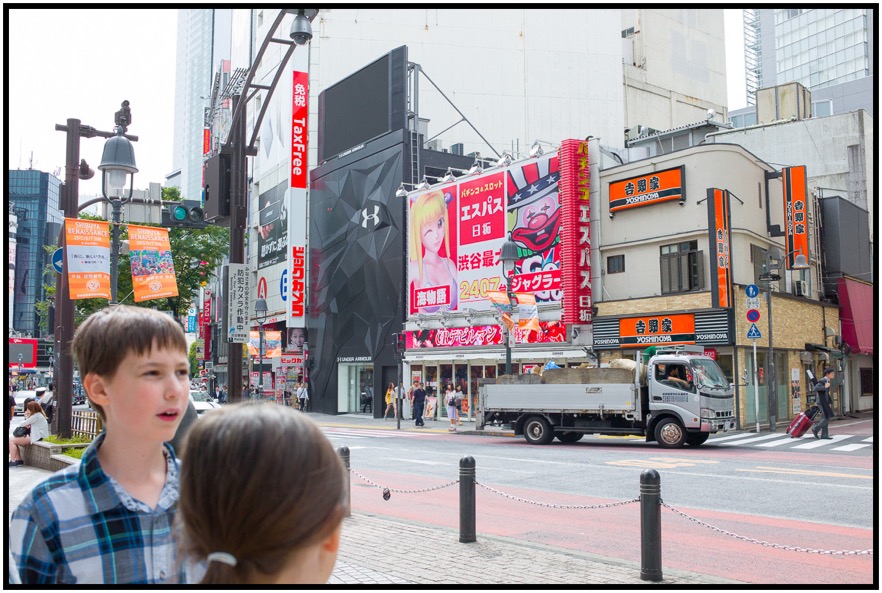
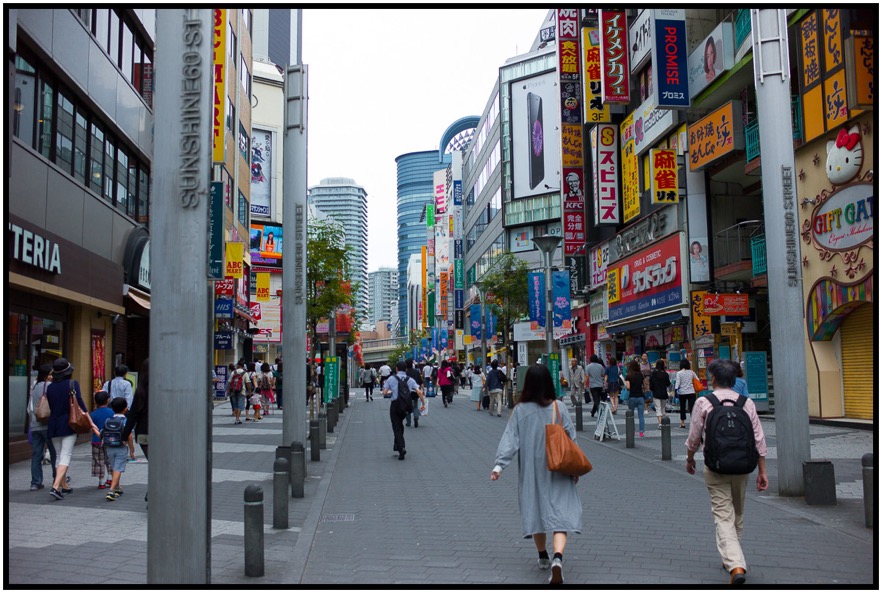
One of Tokyo’s two Pokemon stores. This place was enormous and had a lot of things for sale that are only available in Japan. The kids spent nearly an hour in here. Between the three of them, they dropped about US$60. 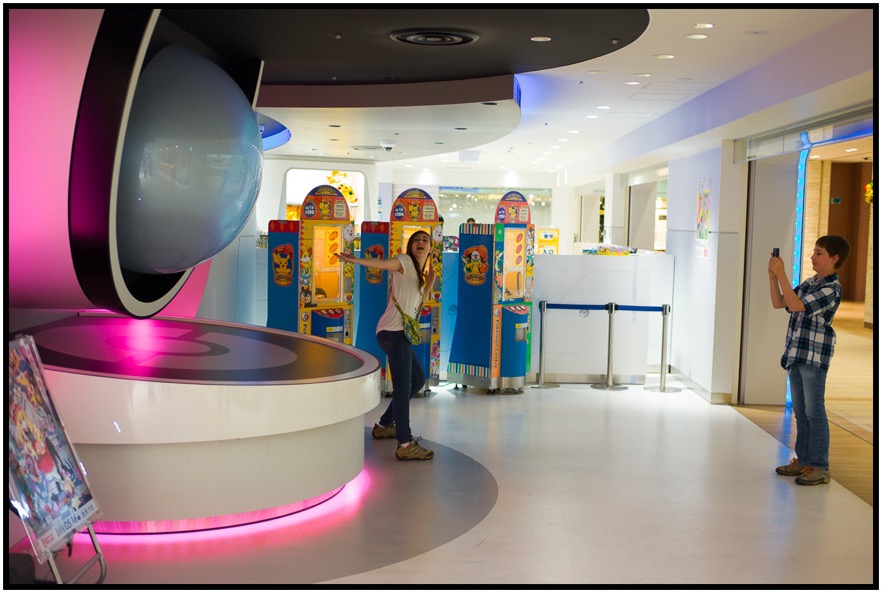
By now it was lunchtime and Japanese restaurants were starting to open. We found a noodle shop. It was down a weird little alley at the bottom of a long, narrow staircase. It was definitely not a tourist place.
Once nice thing (so far, anyway) is that the Japanese put a picture of every dish on the menu. You can just point at the picture to order. This noodle place had only chopsticks, so that’s what we used. Even though it’s soup, you still eat it with chopsticks. No spoons. 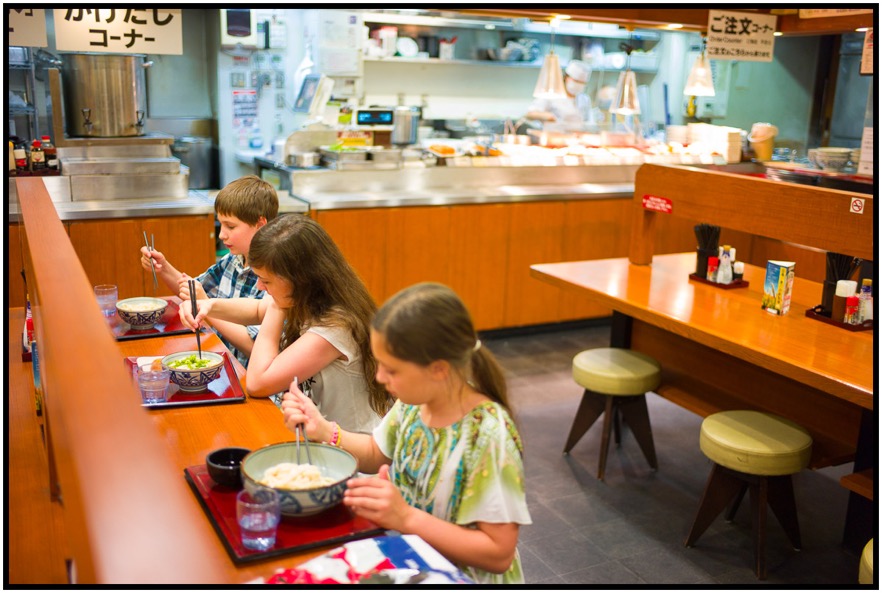
By 1:30 p.m. we were wiped out and decided to go back to the apartment. We ended up staying in the rest of the day. Isabella was really disappointed that we were wasting precious time, but Adam and I made an executive decision that pushing ourselves too hard at the beginning was a good way to end up with someone sick. That would potentially ruin the whole trip. Better to rest now so we’re in good shape later.
Photo: on the train back to our apartment. You can see Adam and Isabella in the window reflection. 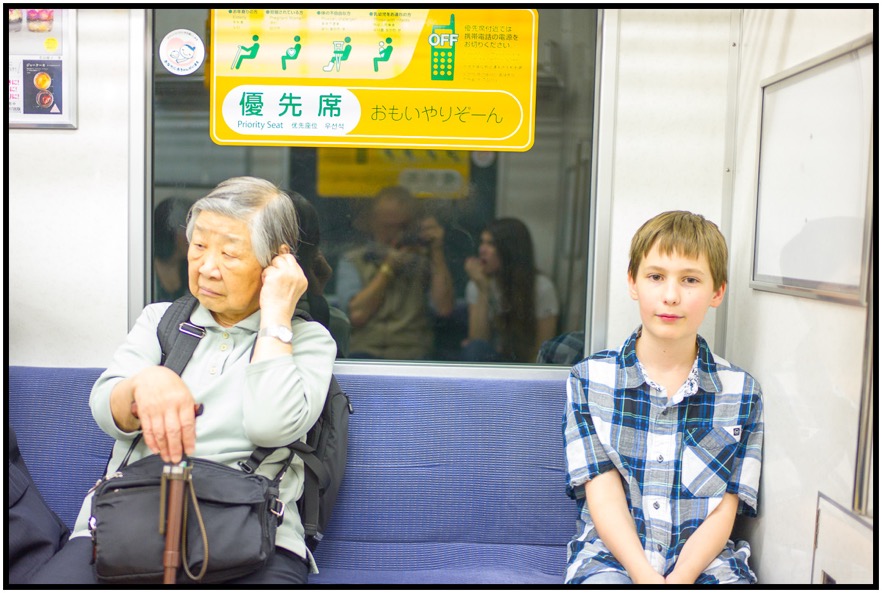
June 6, Saturday
It rained all night long. We woke up at 3:30 a.m., which is two hours better than yesterday. Adam got online to check the weather forecast and learned that the rain was supposed to stop by 9:00 a.m. or so. Then, in bold red text, came an urgent update: “Rain will stop in 3 minutes.” It was the weirdest and most precise weather report of all time. Indeed, it DID stop raining in about three minutes. That’s some serious sci-fi novel territory.
So, we sat in bed at 4 a.m. and watched episode 2 of “True Detective” on Adam’s computer. We anticipated not having any English programming in Japan, so before we left home Adam loaded a few shows for us to watch when we got desperate. We’ve got the entire first season of True Detective and all 5 seasons of Jerry Seinfeld’s “Comics in Cars Getting Coffee.”
Once it was late enough to go out, we headed to Kappabashi Dori near Tawaramachi. This place has block after block of kitchen supply stores – both residential and industrial. I’d researched this district before we left home. Japan is famous for their world-class knives and one of the things I wanted to buy in Japan was a really good knife. There are still stores here who make high-end kitchen knives on site – places that have been in the business since the Feudal ages.
This kitchen district is unbelievable. They have store after store of restaurant supplies. If it’s used for making food or running a restaurant, it’s for sale here. Dishes, bamboo steaming baskets, sushi serving sets, pottery, cutlery, pots and pans — all the usual stuff — plus signs, menus, plastic food (restaurants use plastic food to advertise what they sell), chopsticks. We even saw a 4 foot diameter paella pan.
I ended up buying a vegetable knife at a famous knife store called Kamata. I also bought some bamboo steamers (way better price here than at home) and several sets of chopsticks.
The chopstick store was incredible. Sadly, Adam didn’t get a photo. They had hand-made sets of chopsticks selling for US$200 per pair, and they were works of art worthy of hanging on a wall in a display case. They also had a huge selection of the wooden 100-for-$3 that you get in restaurants. We each picked out a set of chopsticks to take home that were beautifully decorated and sold for around US$4 per pair. Isabella and Josie both bought sets for their friends as gifts, too.
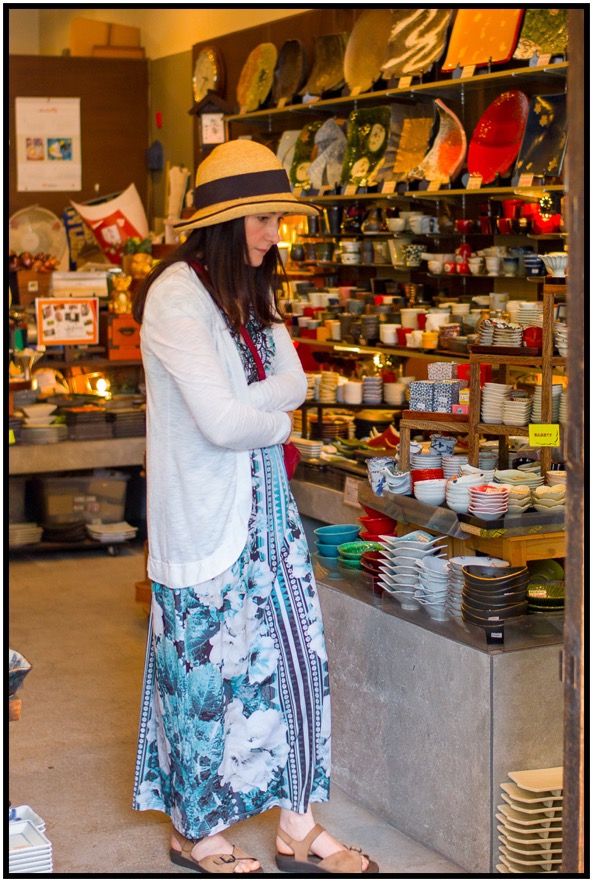
Below: one of the many pottery shops.
This early in the morning not too many people were out and about.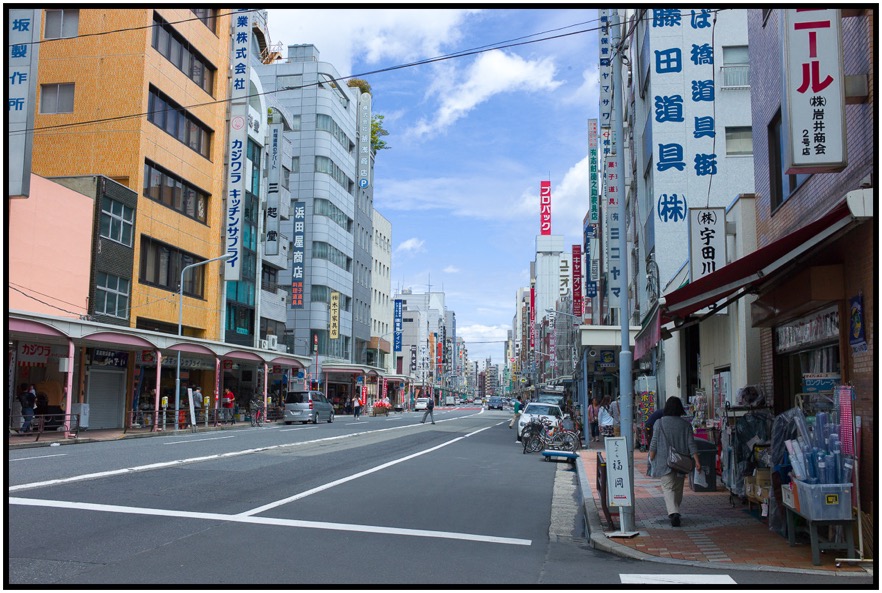
One of the street vending machines. You can buy a tiny squareish bottle of coke.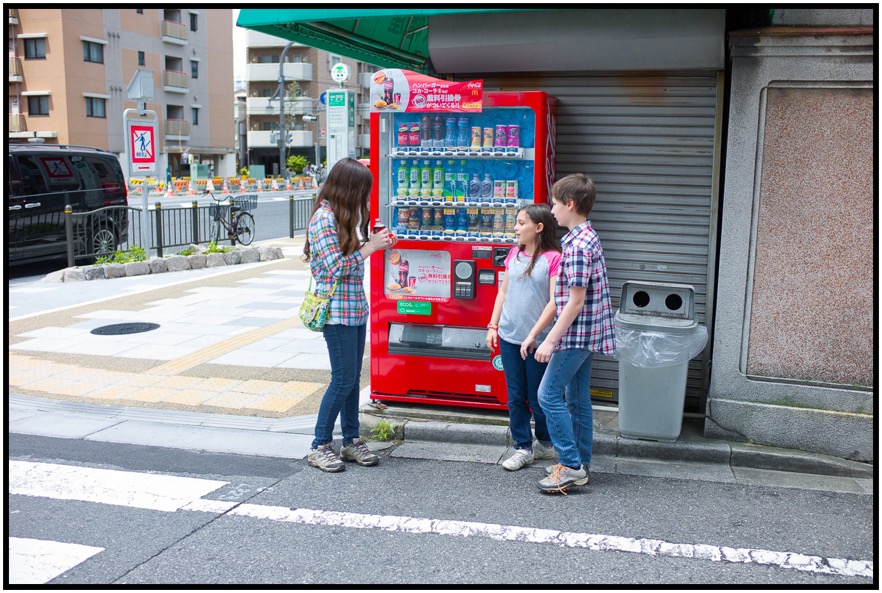
The kids got tired of shopping for kitchenware (I could have stayed all day!) so we headed to another district called Harajuku. It is known internationally as a center of Japanese youth culture and fashion. Shopping and dining options include many small, youth oriented, independent boutiques and cafés.
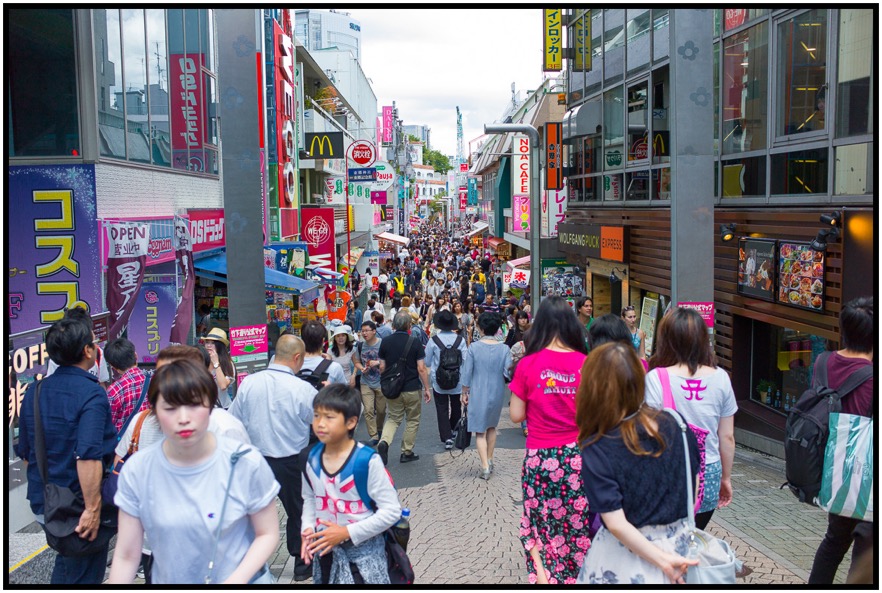
Takeshita Street in Harajuku. This is where the girls all go to dress “GothLola” (goth Lolitas). Isabella went nuts here … this stuff is her “aesthetic.” You can buy freaky stuff with skulls all over it, costume dresses that look like something Alice wore in Wonderland, tiny feathered hats, combat boots, blue and pink pigtail wigs, etc. There were actually quite a few men dressed that way, too. One guy walked by dressed as Marilyn Monroe.
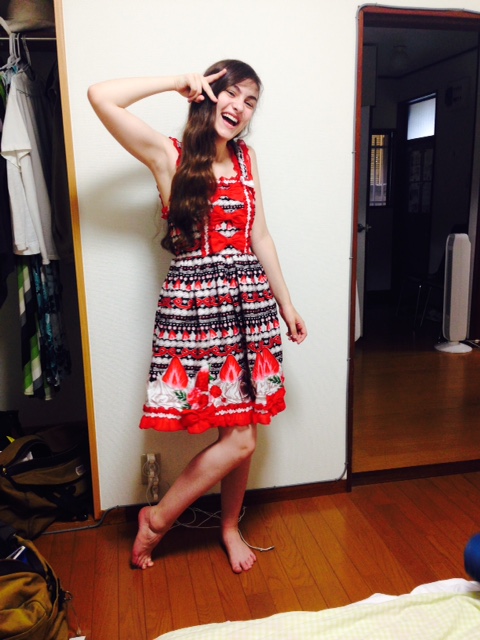
Isabella ended up buying a cute little dress with Strawberry Shortcake all over it. She’s going to wear it for Halloween this year. Now all she needs is a pink pigtail wig and some Doc Martens.
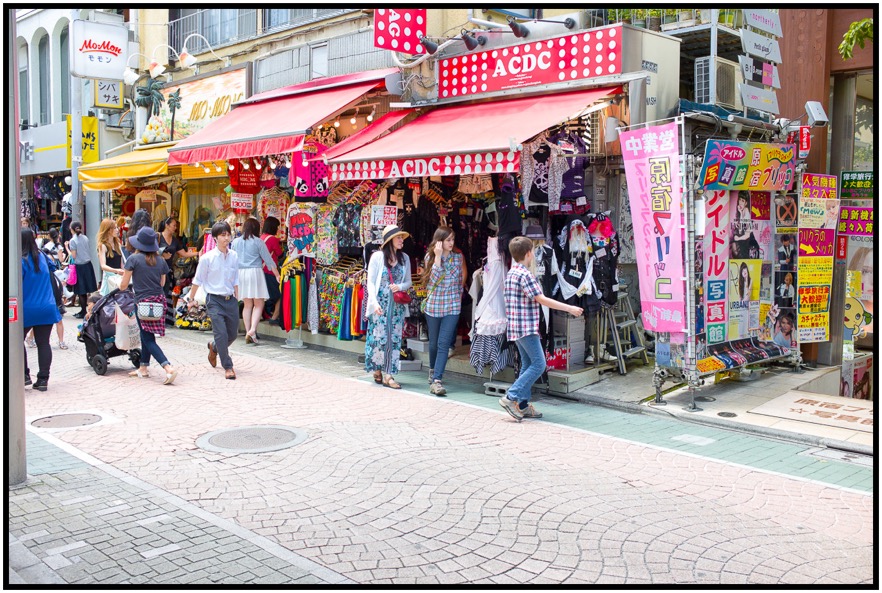
This area is a tourist attraction. We saw more Westerners here in half an hour than we have since we landed in the Tokyo airport. 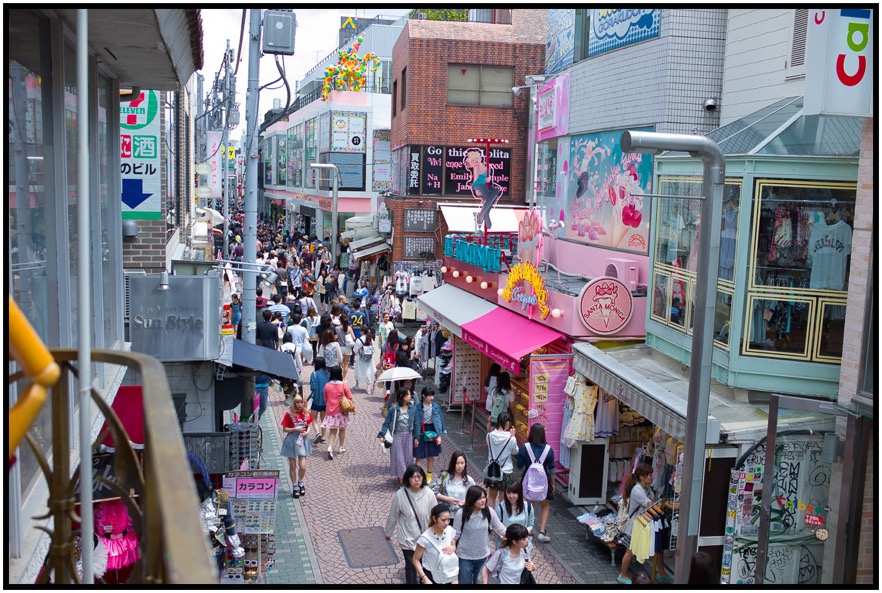
Still, we stand out like sore thumbs everywhere we go. Here is a little kid checking out Holden. 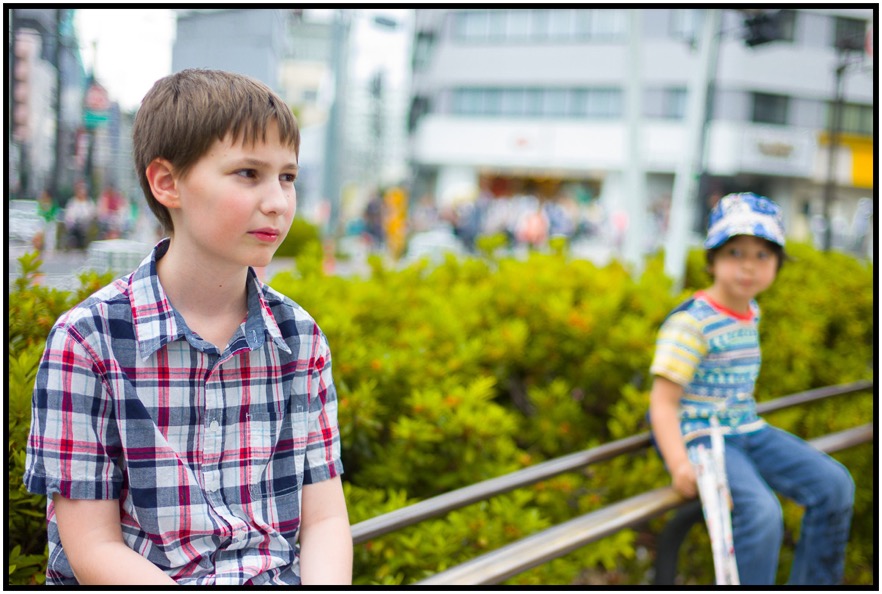
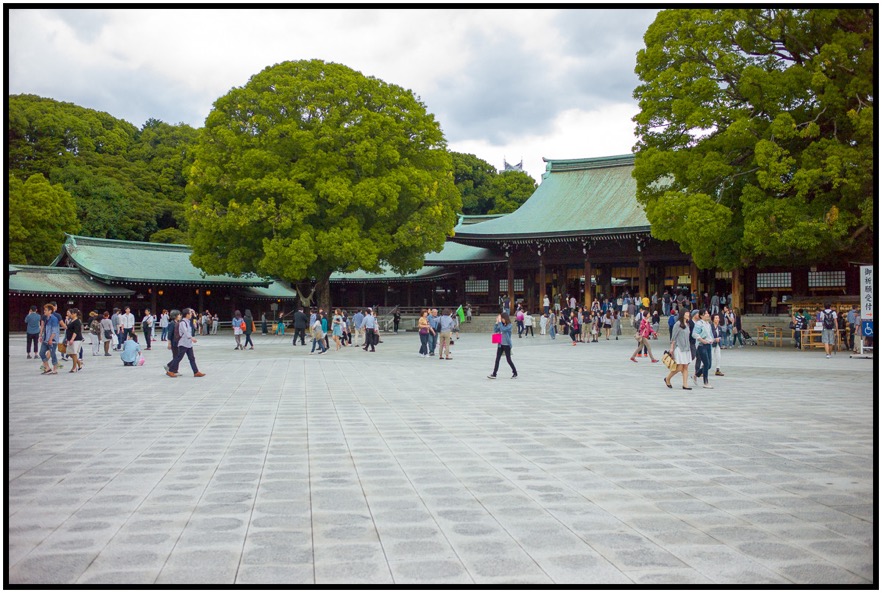
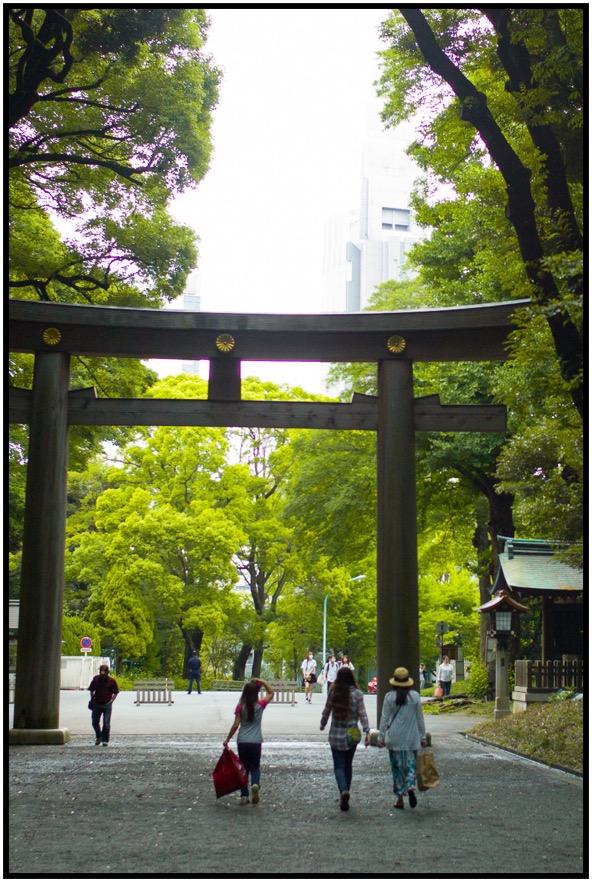
A short walk from the Takeshita Street (and yes, we made the jokes and giggled at the name, too) is the Meiji Temple. Photos are not allowed on the Temple grounds, so these are all taken on the long walk through the woods to get to it.
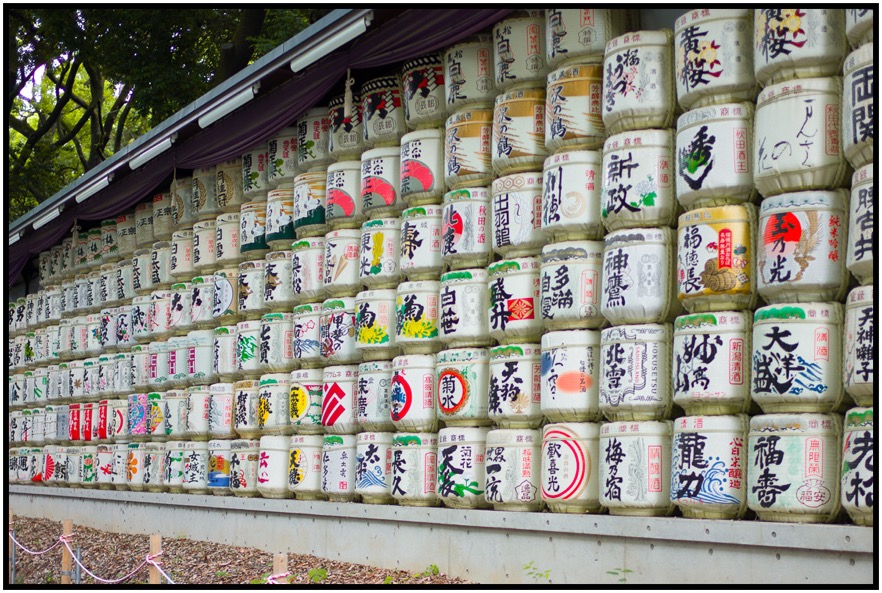
Photo below: huge drums/barrels of sake; these are offerings from the various sake companies in Japan to the Meiji temple. This temple honors Emperor Meiji (1852-1912) who is famous for opening up Japan to western influence just before WWI. A barrel of sake is ceremoniously donated to honor the soul of the Emperor each year.
For context, Josie was about as tall as two of the drums.
One of the gates leading to the Temple. These are made of 1500 year old wood. 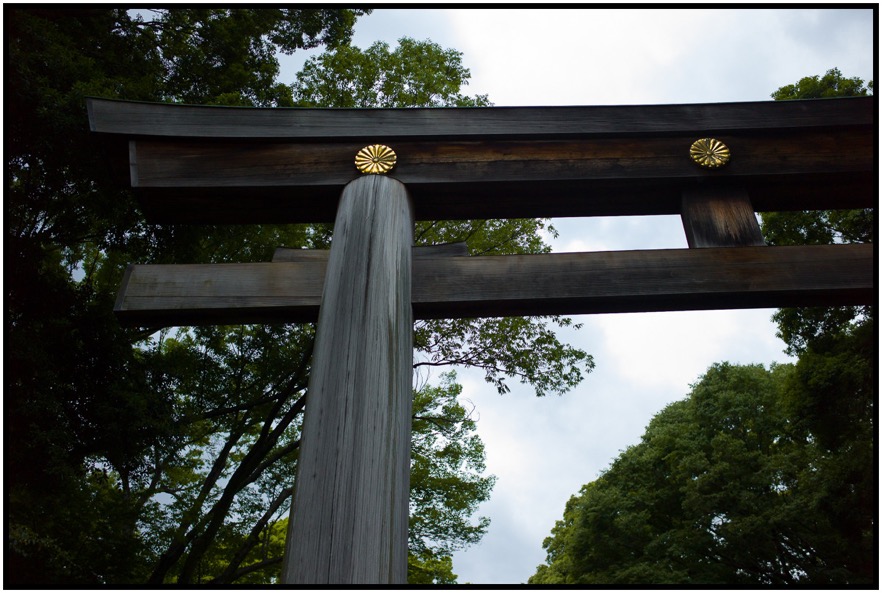
The temple itself was destroyed by US bombers in WWII and re-built shortly thereafter. We couldn’t take photos up close at the main shrine, where Shinto devotees made offerings, bowed twice, clapped twice, and bowed again during each prayer.
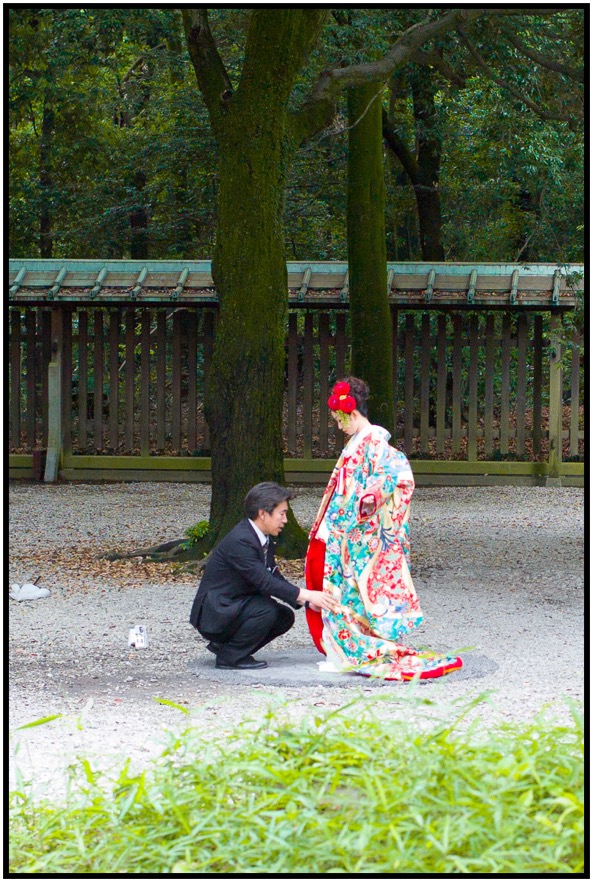
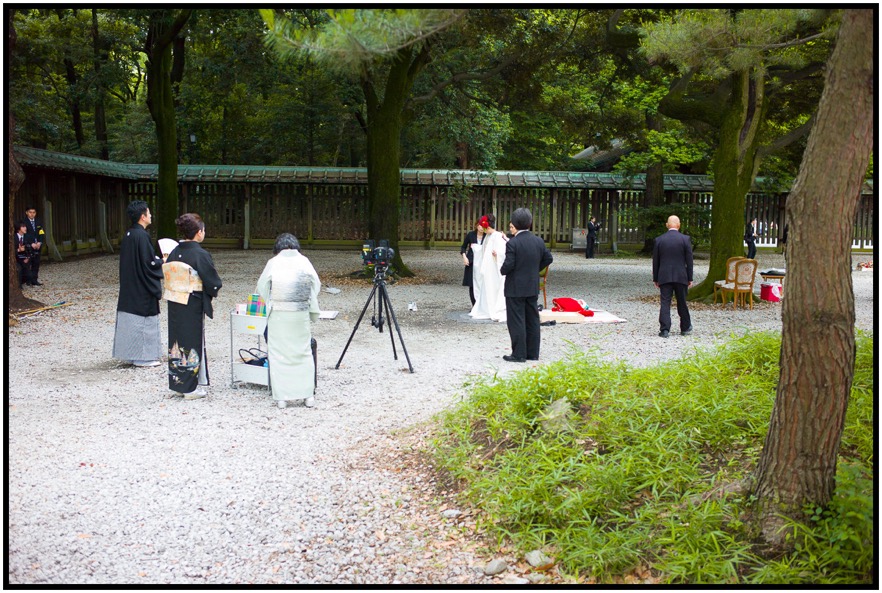
Lots of weddings take place at the temple on weekends. We saw 3 or 4 separate parties all going through their paces. Here is one bride setting up for outdoor photographs.
From Adam:
Below: Girls have bags of stuff ready to take home. We brought an extra, empty suitcase with us just for this purpose.
Tokyo is the largest city in the world. I’ve been to many other mega cities (Sao Paulo, Mexico City, London, NYC, Shangai, Guangzhou, etc) – Tokyo is easily the best organized and cleanest. However, it doesn’t have “charm” or a history/brand recognition that we can appreciate. I’m more interested in visiting upcoming Kyoto, which is apparently more representative of “real” or “authentic” Japan.
Some more statistical context: Japan has about 130MM citizens. Twice as many as the UK, about 40% of that of the US. Japan is smaller than Oregon and Washington combined, but has about 12x as many people.
June 7, Sunday
From Adam:
Within the first two days, we’ve worked out the transit system to be comfortable enough to get around the city. The ticket machines do have an “English” button – very necessary. I’ve worked up to about a 200 word vocabulary to grunt through just about any basic situation, but we can’t read a single symbol. What’s worse, Japanese has 3 different alphabets, so we’re not even making an effort. Most signs near big intersections and points of interest have English equivalents, so it’s not too bad.
I’ve been pleasantly surprised about how far a $ goes here. I’ve been paying a lot of attention to the exchange rate and even sent out some articles how the US$ has been the strongest against the Yen (¥) in more than 20 years. Prices are darned reasonable here, which is a welcome change from the real beating we’ve taken the last several summers with the UK pound and Euro.
Food has been good, but without a great deal of variety. Each day we’re hitting the local grocery store 2 times to load up on what we need in the Apartment. We usually eat lunches out. They’ve got noodles covered in 1000 different varieties. They’ve also got a lot of very strange things in bags without much identification that we purchase on a lark to try out together. Some has been good, some pretty awful.
There is an active fat tax in Japan – both on high fat foods and on actual waist lines. There are NO fat people in Japan. People here are taller than we expected – I’ve seen a lot of men pushing 6’ tall. I weight 180# and I’m just about the largest (fattest) guy around. That doesn’t help my self esteem here one bit.
Fun day today. After hitting the closest Starbucks we could find, we headed across town to visit Akihabara – known for electronics, video games and all sorts of nerdy/collectible merchants.
Akihabara gained fame shortly after World War II for being a major shopping center for household electronic goods and the post-war black market. Nowadays, Akihabara is considered by many to be an otaku (Japanese geek/nerd) cultural center and a shopping district for video games, anime, manga, and computer goods. Icons from popular anime and manga are displayed prominently on the shops in the area, and numerous maid cafés are found throughout the district.
We visited one multi-story building dedicated solely to old-school video game consoles and cartridges. There are many video arcades with machines that we could barely recognize. Some of the most modern were the size of Apollo 11 landing module – you would get in and get a complete video experience with screens positioned 360 degrees around you. They would not allow photography in most of the places we visited, which is a shame, because the sights and sounds are really something to take in.
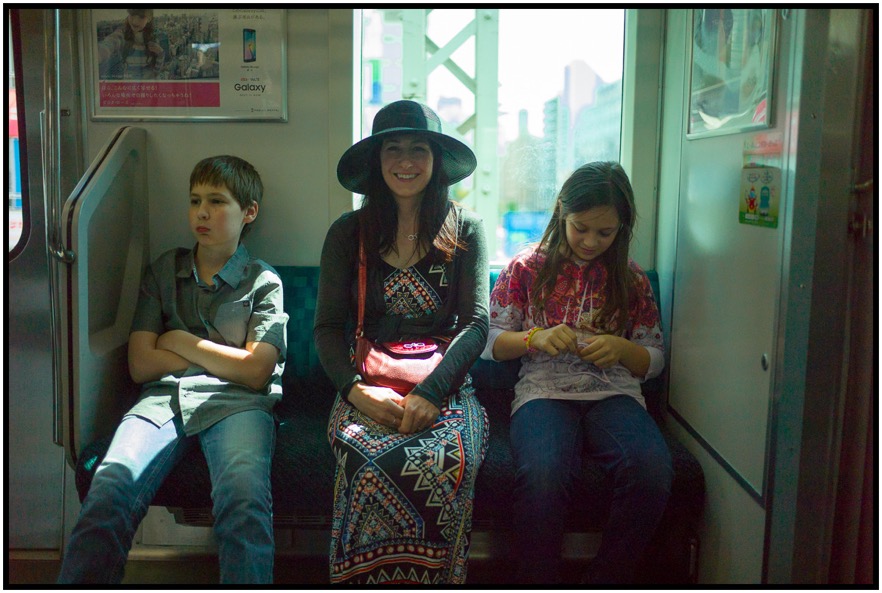
Below: 30 minute train ride to Akihabara.
Note the lady in traditional outfit.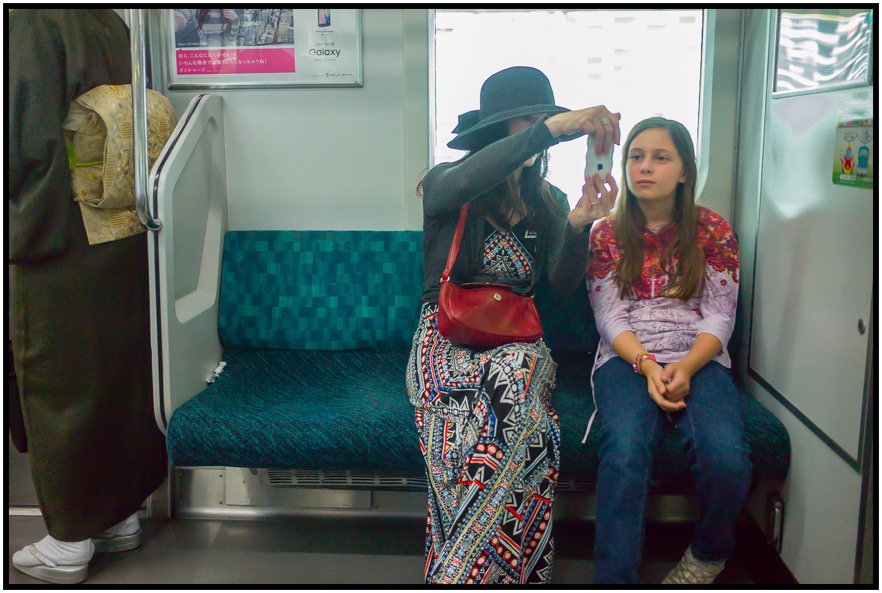
Akihabara is our first experience with the loud, nerve-jangling overstimulation aspect of Japanese culture we see on TV. Being their geek district, it skews young and almost exclusively male. Most of the women we saw in this district were working there, not hanging out for fun. It’s an entire district filled with 100,000 Japanese versions of Captain Sweatpants (The Big Bang Theory reference).
We got off the train about 30 minutes before everything opened up. People were already lined up waiting for doors to open. This place is directly across from the subway station exit and the first thing you see when you step outside. I think it’s a pachinko parlor. Men were lined up around the side of the building.
We came by here later when we were leaving and walked in to see why it was so popular. A girl manning the front door politely but very firmly turned us away and pointed to a sign (in Japanese, of course) we hadn’t seen with 18+ written in the corner …. it’s one of the adult-themed places and children are not allowed inside.
Adam: I did take the kids into another Pachinko parlor to show them what all the fuss was about. Inside, scores of men all smoking cigarettes one after the other jam coins into the machines and watch the balls fall randomly over the pattern of pins. Gambling is illegal in Japan, so what you win by playing Pachinko comes out as tickets that you can redeem for prizes at the front counter. One of the most popular prizes are more packs of cigarettes.
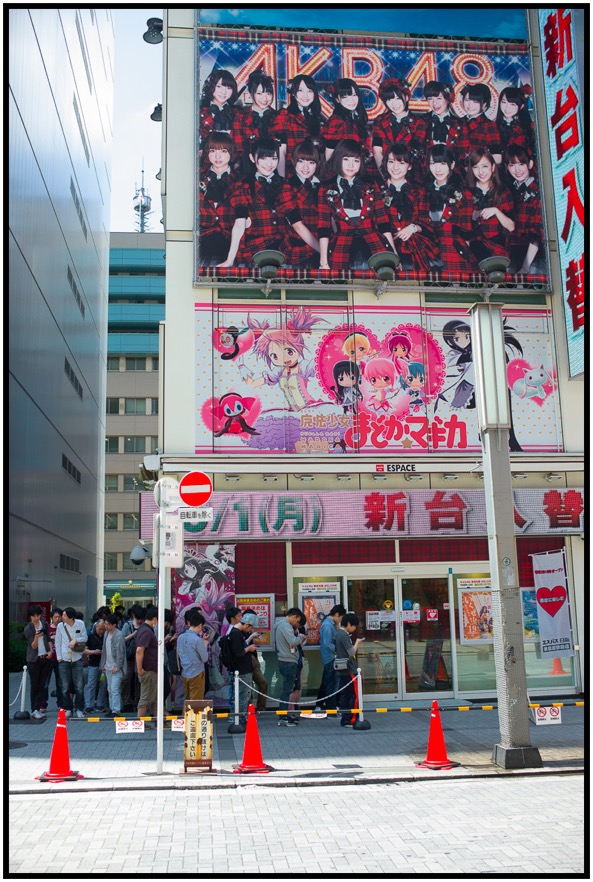
This district is hard to describe. It’s simply overwhelming. The buildings are all chintzy looking on the inside, kind of like a 3rd-rate mall in a place like Mexico. The goods for sale, though, were very high-end and surprisingly expensive. One shop was selling pearl earrings with a US$65,000 price tag.
The buildings have small footprints, but go straight up for as many as 8 or 9 floors. You can ride an escalator up to each floor, but they only go one way — you have to walk back down by the stairs or take the elevator. Photography wasn’t allowed inside any of the buildings, so unfortunately we don’t have pictures.
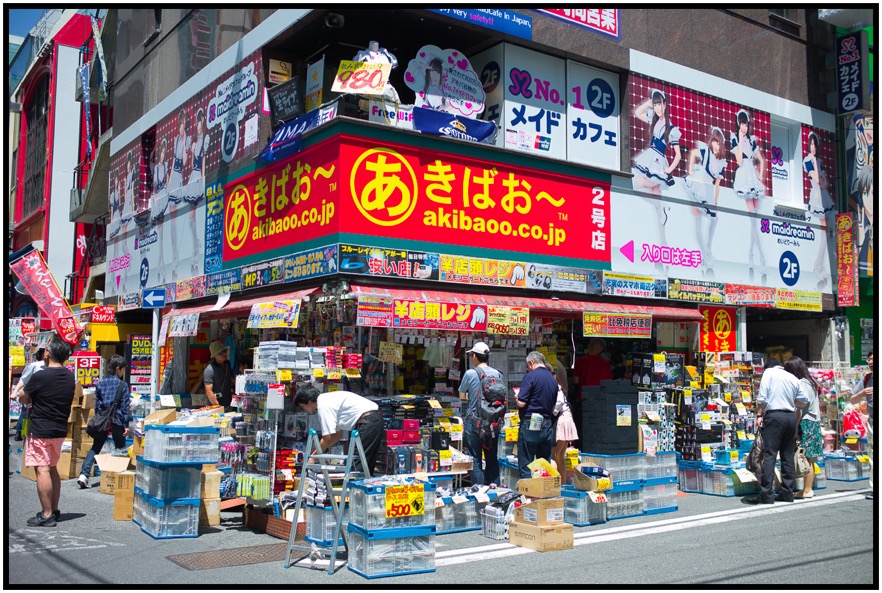
Adam: Once lunchtime came around, we thought we might try out one of the famous Maid Cafes. These restaurants are tucked into the higher floors of a number of buildings. We took a cramped elevator up to the 7th floor and stepped out to the restaurant’s entry way. We could look into the restaurant to see numerous patrons being served by Japanese women all dressed up in French maid outfits, squeaking and flirting in cloying, high-pitched voices.
The hostess gave to us a menu to explain how the system works (cover fee plus prix fixe, coming to about $20 a head).
The whole maid cafe schtick comes off quite creepy. There is a not-too-subtle degree of misogyny (if not outright pedophilia) that emits from a great deal of this aspect of the Japanese culture’s objectification of girls/women. This goes above and beyond the Geisha, cover-your-mouth when you smile, walk 2 paces behind, “in Japan, men come first” stereotypes. In Akihabara, you get a real whiff of something not quite naughty, just… weird.
At any rate, as adventurous as I wanted to be, we quickly decided this place wasn’t probably the best joint for lunch for a family of 5. In reality, these cafes are probably a good equivalent to how we view a Hooter’s restaurant and just as innocent (children are welcome at both), but then we don’t hang out at Hooter’s either when our kids are hungry.
I will note that the menu came with rules of conduct spelled out — no photographing the maids, no sexual innuendo, “no touching the Babies” (yes … they called the maids “babies” which grossed me out big time) and a few others I can’t remember.
We found a more suitable restaurant a few blocks away. The Japanese aren’t big on sitting — many of the noodle joints have standing tables where people stand at a counter, single-file, and wolf down their food as quickly as possible. It seems the goal is speed rather than enjoying the food or the company of your companions. Our feet were tired and we wanted a sit-down place.
Below: an example of the plastic food all restaurants have in their windows representing what is on their menus.
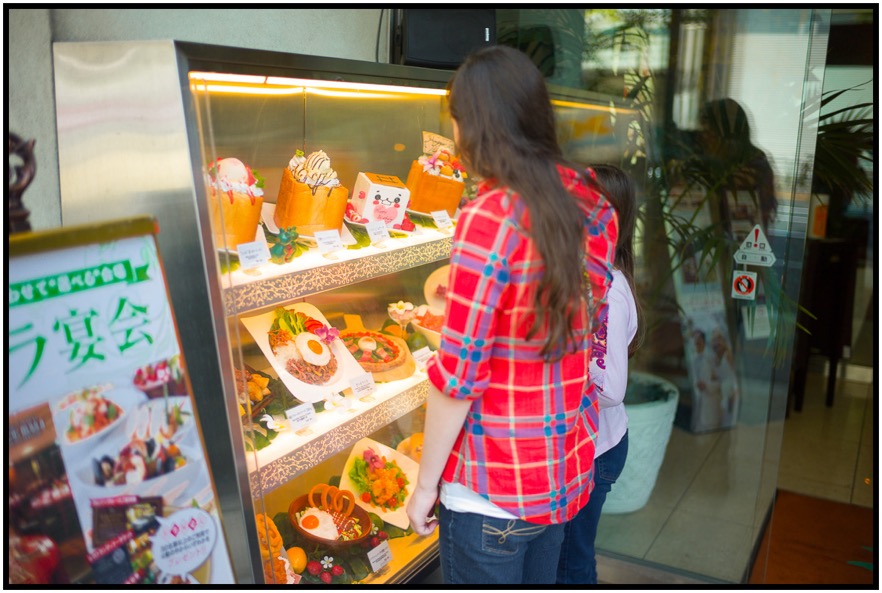
This restaurant looked rather fancy, but we had a lot of trouble getting service. The girl who seated us gave us some menus, but then never came back. Adam flagged her down when she came to tend the table next to ours. We ordered, but that didn’t end up going well, either. We didn’t adequately communicate what we wanted, so I ended up not getting a meal at all. Isabella and Josie both ordered a fondue plate that was quite large, so I did get to eat their leftovers.
We also wanted to order a dessert. This place was called the Honey Toast Cafe and their specialty is a large sweet bread loaf hollowed out and filled with ice cream, fruit, and chocolate sauce. (You can see an example of it in the above photo on the top row.) The menu specified that it takes about 15 minutes for them to make it.
The server never came back. We sat there for a very long time after we were done eating, getting frustrated. We decided not to order the dessert after all because we were sick of sitting there by this point. It was then that Josie noticed a doorbell-like electronic thing sitting on the table next to the condiments. “What’s this?” she asked. We had no idea. I pushed the button to see what would happen and a waiter practically materialized out of thin air at our table. Ah ha! We felt really dumb. Oh well … now we know.
Below: the kids browsing in one of the manga action figurine stores.
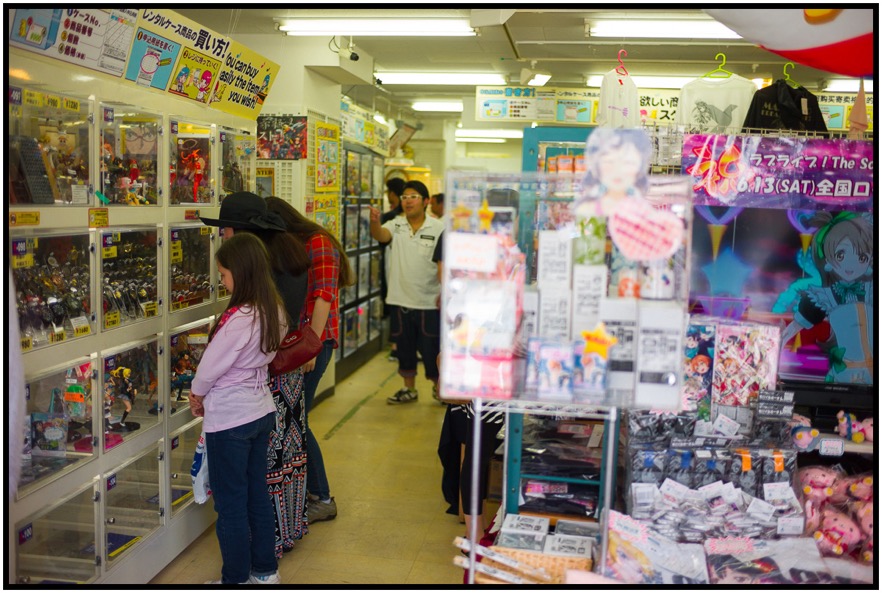
This district is a sensory overload during the daytime … I can’t even imagine what it must be like at night when all these signs are lit up and flashing.
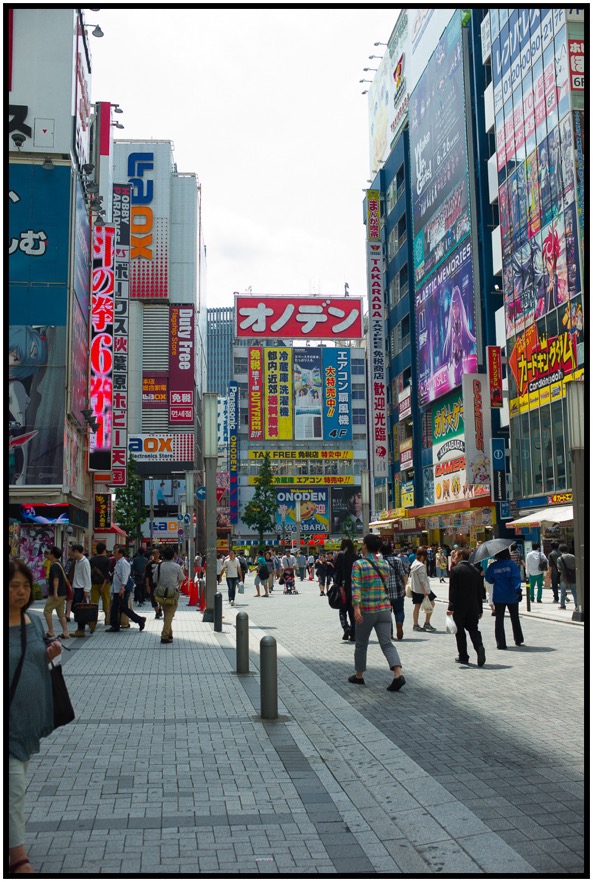
Isabella considers herself “into” anime and manga. The sheer volume of this stuff here is mind-boggling. Wandering through Akihabara, with store after store after store of it, she said, “I thought I knew a lot about manga but this …. I don’t even recognize any of it. I had no idea this stuff even existed.”
We couldn’t pull her out of these stores. She bought 4 large books, all in Japanese. She downloaded this fantastic app for her phone that lets you take a photo of something with Japanese characters written on it (like street signs or menus). It then scans the photos, isolates the characters, and translates them into English for you in just a couple of seconds. She can scan each page of her books and get a translation. It takes a long time to read, but then with no TV on this trip she doesn’t have anything better to do when we’re back at the apartment for the evening.
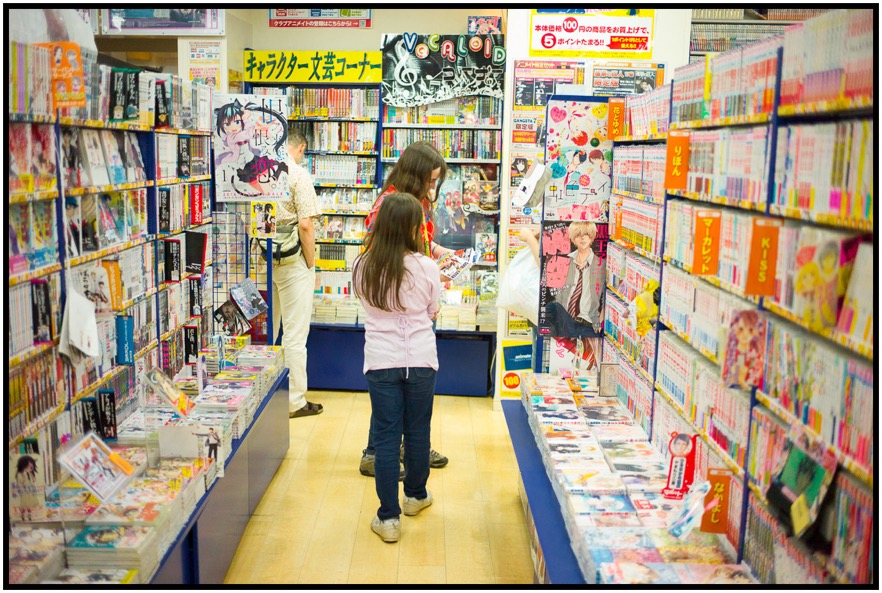
Adam remarked that in Latin America, nobody reads. It’s hard to even find a bookstore; when you do the selection is terrible and the books are really expensive. Those cultures just don’t value reading for pleasure. In Japan, bookstores are absolutely everywhere, and they are PACKED with kids. The books are cheap and unbelievably popular. You can hardly walk around to browse. Adam waited until people had moved out of the way to take the photo below. The Japanese really value reading and education.
A side note: today is Sunday but apparently it’s a regular school day. The students all wear uniforms here and the trains were full of kids with book bags and such, going to school. They don’t seem to view weekends the same way we do. Most of the shops are closed on two days a week, but never in a row. Many are closed Tuesday and Friday, for example, or Sunday and Wednesday. Maybe staggering everybody’s days off helps with crowd control or something. I’ll have to look that up later.
The kids are in heaven. They keep saying “This is the best trip we’ve ever done!” I think part of it (if not all) is that the whole city looks like the inside of a theme park. Everything is SPOTLESS. I don’t know how they keep the entire city so clean. 37 million people live here. There are cartoons and toys for sale everywhere too. The Japanese love them some toys. Adults buy anime and manga action figures and stuff like that in droves.
The kids are blowing through their money like crazy. It also helps that there are not quite 125 yen to the dollar, so figuring out how much money something costs in dollars is pretty easy. If the price is ¥400, that’s a tad less than $4.00. The dollar is really strong against the yen right now, so prices are pretty cheap, too. The past few years we’ve gone to Europe when the dollar was weak, so everything was really expensive and we couldn’t afford to go nuts with souvenirs. This time the kids can buy Pokemon cards and things like that for about 1/3rd the price they have to pay at home. Everything feels like such a great deal.
A word about the toilets: they are every bit as strange as you have probably been led to believe. The toilet seats in public restrooms are heated, more often than not. They have a special button with a musical note on it that you can push that masks any embarrassing noise you might make whilst doing your business.
The hardest thing to get used to is the “butt wash” feature. I was expecting water to spout up like a shower head fountain, but it doesn’t … it’s more like the blast from a water pick aimed directly at your posterior bullseye. It feels a little like a violation, but you are indeed fresh and squeaky clean afterwards.
A few other observations: nobody chains up their bikes or motorcycles. Crime rates in Japan are so low they are practically nonexistent. We saw one girl eating by herself, and when she got up to go to the bathroom she left her purse and her cell phone laying on the table unattended.
We’ve felt very safe everywhere we’ve gone. Even the 18+ Adults Only places look like Chuck E. Cheese franchises. All the porn we’ve glimpsed in these places (Adam and I went in for a quick peek) is in cartoon or plastic doll form. They don’t have pictures of real humans. As Adam noted before, the vibe from places like the Maid Cafes is incredibly creepy, but they just might be the socially acceptable outlet men need for all their gross fantasies. When the object of the fantasy is a cartoon or a plastic figurine, perhaps that makes real live women safer.
The money: Adam has noticed that none of their paper money is wrinkled or beat up. Every bill is in nearly pristine condition. The money given out by ATMs look like virgin bills, and even the money already in circulation given out as change during transactions looks practically brand new. There is no shabby cash in Tokyo.
Portion sizes: they are wee. At Starbucks, for example, I always order a Venti black unsweetened iced tea. Here, I placed my order and received what was, at best, a Tall. I initially thought the guy just misunderstood me (although he spoke English so well, and with an American accent, I assume he lived in the United States at some point) but once I started looking around, realized that their largest drink size is the same as the smallest drink size available in the US. And it costs US$3.50. (At home it’s $2.10 with tax for the Venti tea.)
We quit going to Japanese Starbucks because of this. I don’t know why the sizes are so small and the prices so high, unless it has something to do with their fat tax. Tea doesn’t have any fat (or even any calories, which is why I drink it) but perhaps they have a flat tax rate on Starbucks drinks in general because of the high calorie and sugar content of the majority of the options. I’m just speculating because I can’t find anything about it online. For now it will remain a mystery.
June 8, Monday
Adam: We started today with a visit to the Tsukiji fish market – the largest such in the world. This is the place where people like Anthony Bourdain set up to film their show.
The real action takes place somewhere around 4:30 to 5:30 each morning. The fresh catches are brought in and the dealing begins. Since fresh fish takes on religious reverence in Japan, this is big business. None of us felt like trying to find this place in the dark at 4:00am, so we headed out at a more reasonable 9:00.
By then, the real business has already been concluded and all that remained are the more touristy shops and Sushi restaurants. Down crowded aisles we got to see (and sample) a variety of animal bits that defied recognition. This district is also famous for being THE very best place to get good Sushi – huge slabs of raw fish served up with little garnish. Each restaurant can accommodate about 8 people and there were lines queued up in front of all of them – people wait hours for the pleasure of sitting on an uncomfortable bar stool to slurp up $20-$30 plates of sushi.
This brings me to an aside – Japan was not built for 5-people groups. Nothing here can take groups this large. I can see why families stop at 1 (and rarely 2) kids – there just isn’t enough room to get about. We only eat lunch out – and it can be a bit of a struggle to find somewhere for the 5 of us to be together.
Getting to the fish market is a chore. We took the subway to the nearest station, and then had to walk the rest of the way. We walked and walked and walked. The kids all started complaining. “Are we almost there?” NO. Not even close. Walk some more. Keep walking. Stop to check the GPS feature on our phones to see if we’re going the right way. Resume walking.
We finally arrived, and it was pretty much what you’d expect from an open-air fish market, although more clean and less stinky (just like everything else in Japan.)
I was surprised at how many things other than fish were being offered. This place is very much worth the long hike. If you come to Tokyo, I highly recommend making Tsukiji fish market a stop on your itinerary.
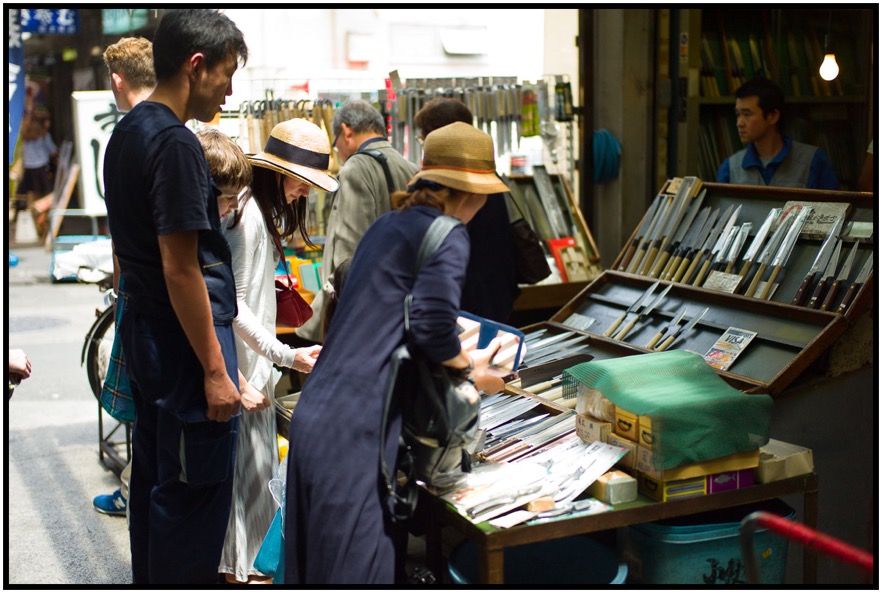
Below: more very high-end kitchen knives, being sold in open-air booths at the fish market.
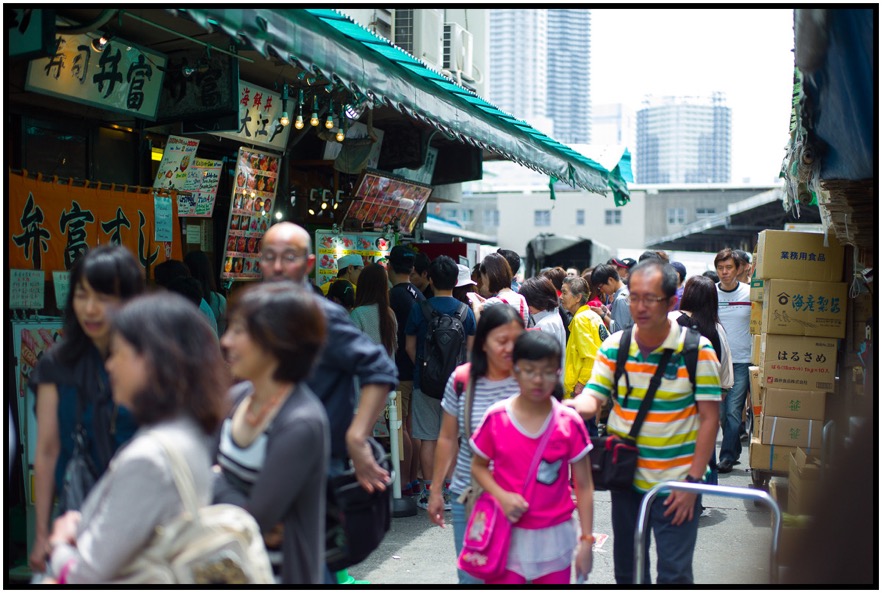
This place was crowded.
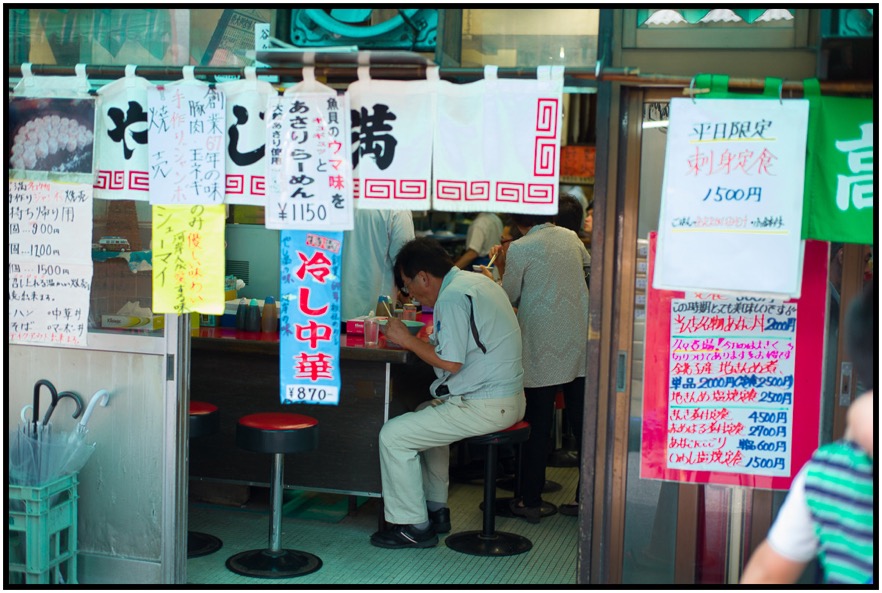
View inside one of the popular Tsukiji Sushi restaurants. Sit down, shut up, slurp it in, get out.
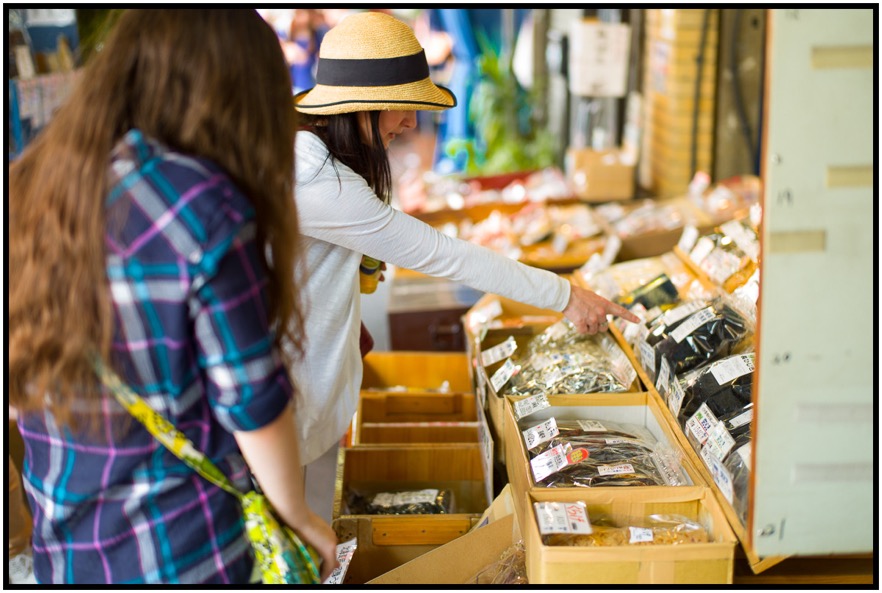
Bags of dried seaweed and dried baby sardines (niboshi). Several booths had niboshi out for sample tasting, but we didn’t try any … they had eyeballs.
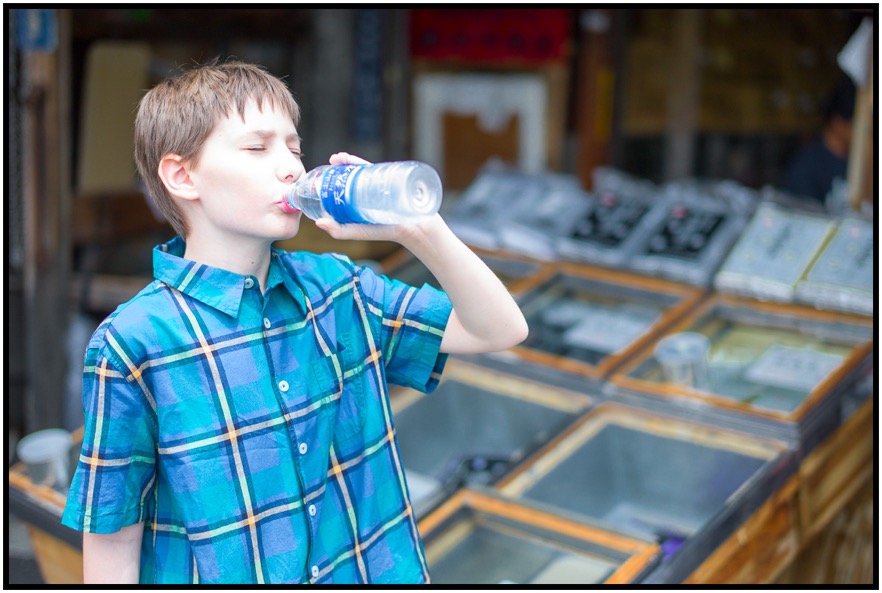
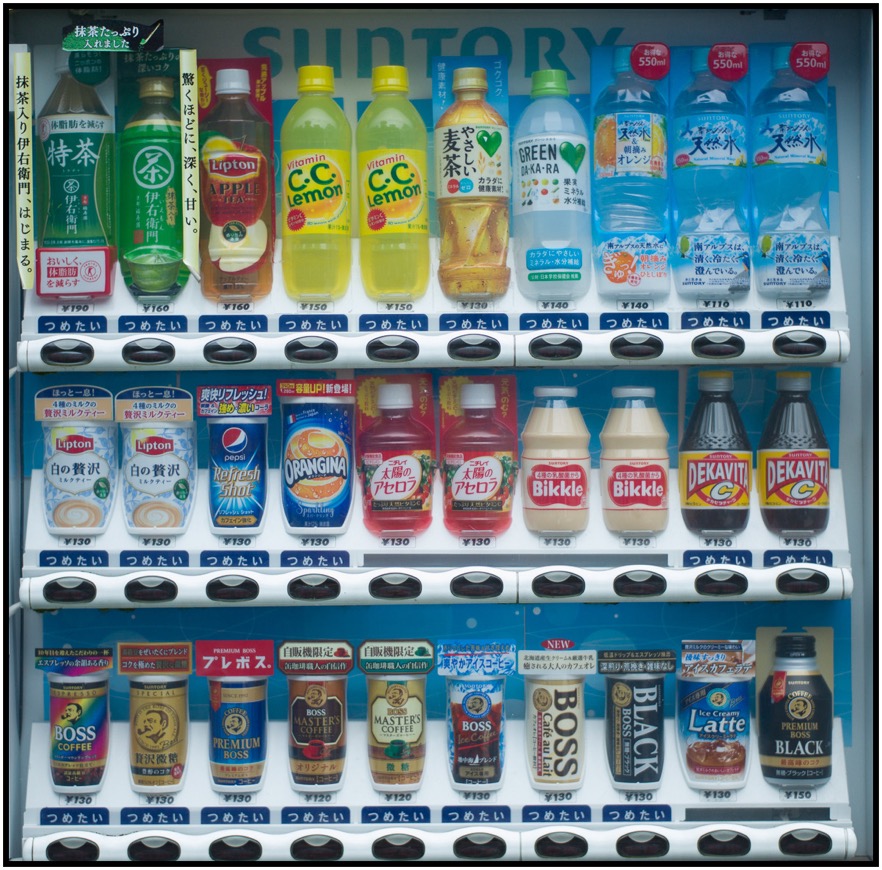
Hot day in the sun. We do like the ubiquitous liquid dispensing vending machines. Most only sell water, tea and cold coffee drinks. But they’re cheap (¥100) and handy when the kids start squawking for something to drink.
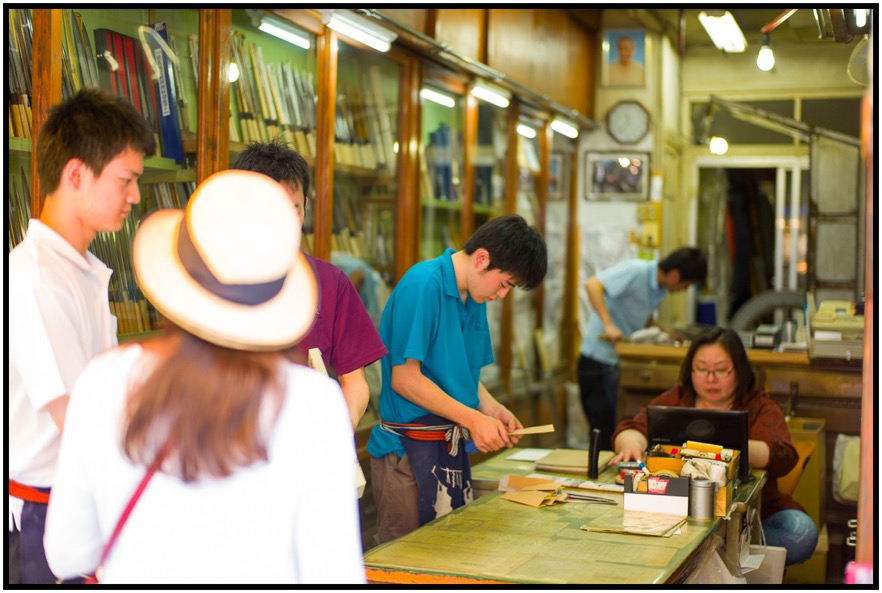
I bought another knife [photo below]. This one is the Japanese style — the one I bought the other day is Western style. The fundamental difference between Western style knives and their Japanese counterparts is the fact that the Western knife is sharpened on both sides of the blade. They have what is called a symmetrical bevel.
The Japanese knives are sharpened only on one side (a single bevel) and are generally made from harder steel. They are much sharper than a Western knife, lighter in weight, and hold a sharp edge much longer, but the harder steel also makes them more brittle. Accidentally running the blade into a bone or frozen spot in food can ruin the knife. They are also more difficult to sharpen.
We’ll see if I like it once I get it home and start cooking. I’m really excited about it… this was an impulse purchase (and not a cheap one, either — it was ¥24,700, or US$200 +/-) and I generally don’t impulse buy things this expensive. Normally I limit those types of purchases to things in the $15 range.
The guy in the far back has a whet stone and tools and sharpened up/finished up our knife in front of us. More ritual: every bit of service here is laden with calculated moves and presentation. Kind of fun the first couple of times, but gets old quick for Americans who just want to get their stuff and go.
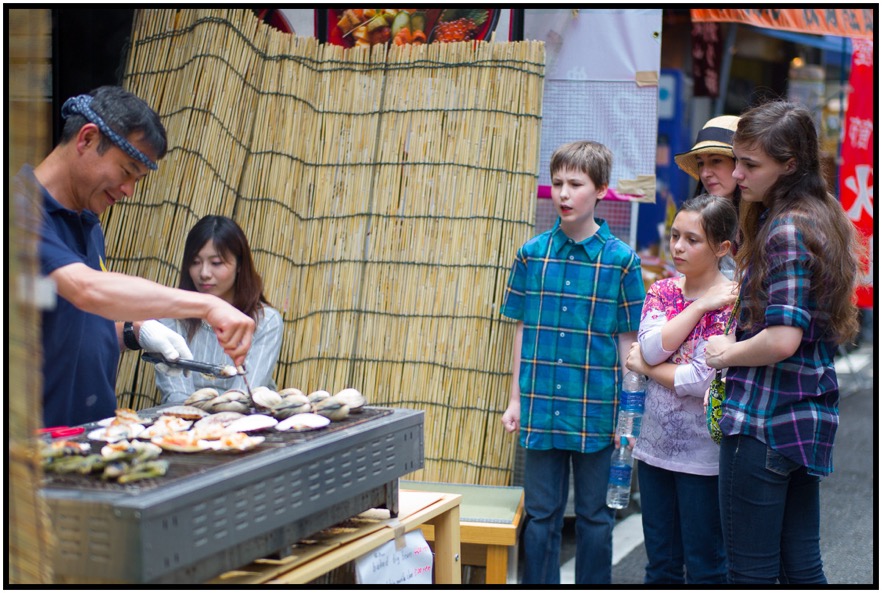
Below: a guy grilling live oysters and clams. Holden was fascinated by this process. We stood and watched for a long time, waiting for the clams to open up. The oysters opened first and the guy cut out the poop sacs (I don’t know what their official name is) with a pair of scissors and threw them away, then cut the oyster into 4 bite-sized pieces right in the shell. When we finally walked away, Holden said “Now, see, this is why I love traveling. You never know when you’ll run into something really cool that you didn’t expect to see.” He sounded like a mini Jim Jeffery.
None of us like seafood much, and I can’t stand the thought of eating raw animal meat. We unanimously elected not to eat any sushi, and nobody really wanted to try the grilled oysters or clams, either.
We hiked to a different train station and headed back to the Ikebukuro district. The kids were desperate to go back to the Pokemon Center. They’d been thinking for two days about the things they didn’t buy and wished they had, so back we went. We decided to eat lunch first.
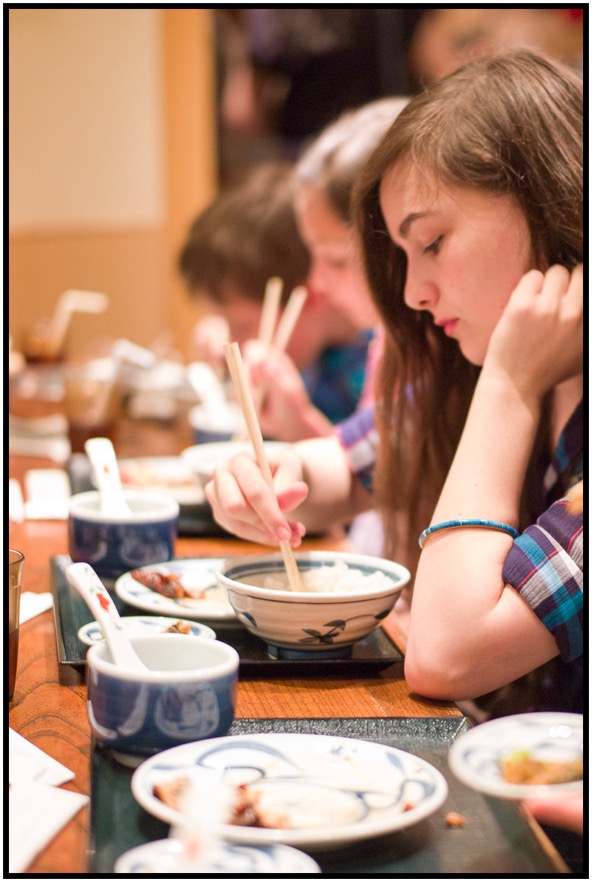
Below: better food to eat here (meaning not seafood). Most restaurants are very small and the seating is “bar style” with stools positioned to wrap around the grills where food is prepared and cooked. You can’t go wrong with rice, chicken, soup and salad. It’s something the kids can all eat and it does fill the belly. Adam had grilled cow tongue and a beer. The kids refused to taste the cow tongue.
Holden and Josie tearing into new packs of Pokemon cards. The kids collectively blew another $50 at the Pokemon Center. 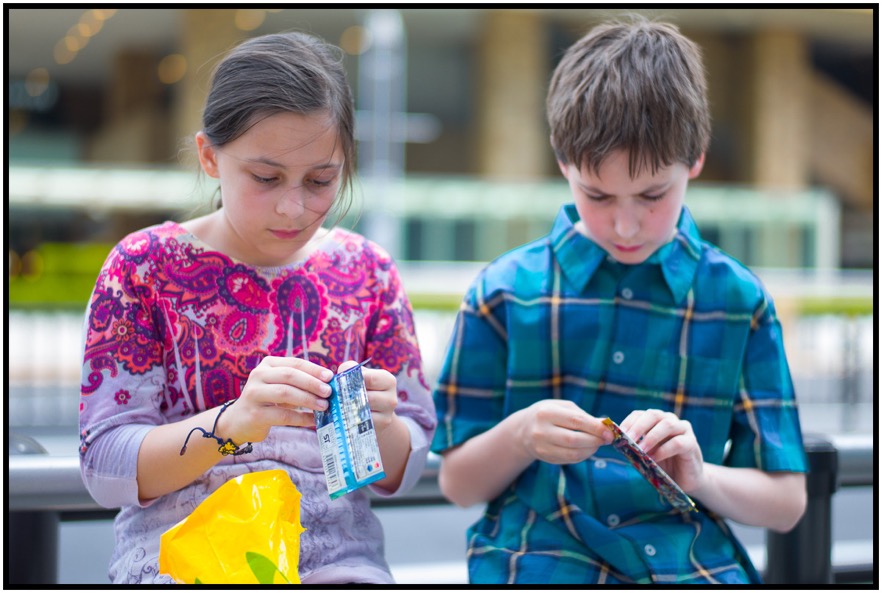
After not getting a fancy dessert at the Honey Toast Cafe yesterday, we had promised the kids we’d look for a fancy dessert place today. We ran into a Cat Cafe, which we’d all read about on the internet. That sounded like a lot of fun, so up we went … another one of these places you have to take a tiny elevator to reach, way up on the 4th floor of a building.
The Cat Cafe didn’t turn out to be what we thought it was going to be. They didn’t really serve food. It was basically a big room full of cats, couches, and high speed internet access. You pay ¥1100 per person for an hour (roughly $10) to sit in the room and quietly pet cats and surf the net. The people in there looked like office workers on their lunch break who wanted a quiet place to go hang out and pet some cats while they caught up on stuff. They had vending machines for small snacks and coffee (all included in the admission price) but it would have cost the five of us $50 to go sit in there for an hour. We decided not to go in.
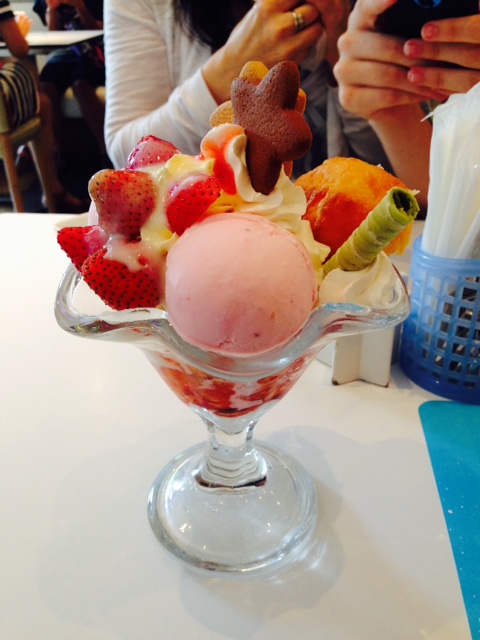
Instead, we found a place called The Milky Way Cafe. It looks kind of like a 1950s diner with a space theme, and it specializes in elaborate ice cream treats. We ordered three different selections and shared them.
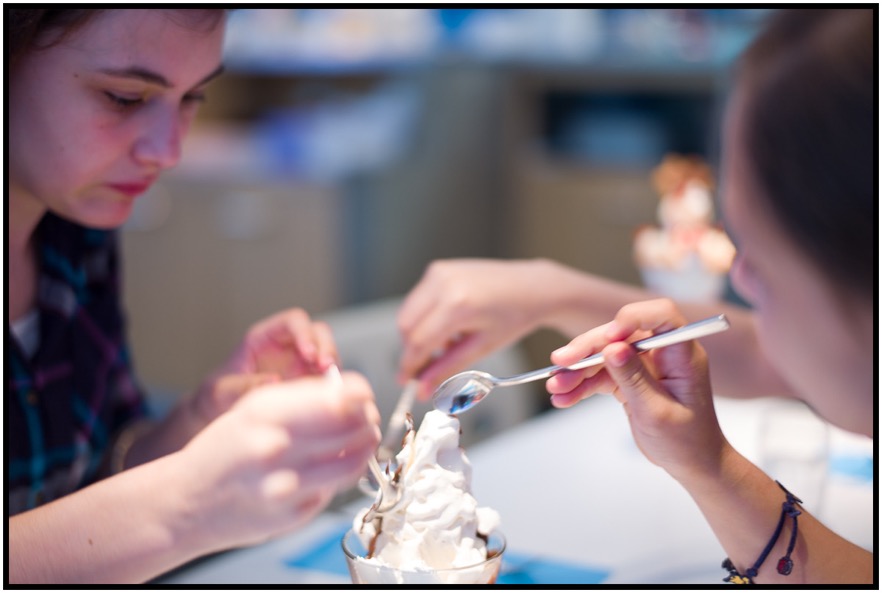
Below: Adam’s dessert.
I have a friend who recently wrote about the concept of convicts becoming “institutionalized” in prisons. Owing to some construction going on inside the prison grounds, prisoners were detoured through an area that’s normally off limits. Under normal circumstances, entering into the off-limits area is met with swift and harsh penalties. The importance of following rules was so ingrained into the prisoners’ minds that they were experiencing some pretty heavy anxiety over being in the “off-limits” section even though they were being told by guards to go that way.
I had to laugh at his description of “institutionalization” because it struck a nerve with how I’ve been feeling here in Japan. To some degree, every human on the planet is institutionalized to their own environment and rarely realizes it. They do things differently in Japan than we do in the West (I say “the West” because the Japanese have behaviors I’ve never seen anywhere else) and I cannot bring myself to do them.
For example: when someone is being polite, they don’t smile or give a little wave of recognition or call out “hey, thanks!”; they put both hands together and bow. I can’t do it because it feels racist. I feel like if I bow back, I’m making fun of their culture or mocking them as a people.
I also can’t bring myself to pronounce Japanese words correctly because it sounds/feels like I’m mocking their language. The name of the main subway hub we’ve been using is Shibuya. It’s pronounced shee-boo-YAAAH! with a nasaly vocal upswing at the end. Imagine every insulting, racist comedic depiction of a stereotypical Japanese character you’ve ever seen — that’s what it sounds like. And if you DON’T do the (seemingly) exaggerated accent, they will not understand you. In their minds, they are probably thinking, “How hard is it to pronounce Shibuya? Americans sound so stupid.”
Intellectually, I know how ridiculous it is to feel that way, but that doesn’t change my gut reactions one bit. We Americans have been so conditioned to spot racism/sexism (even when there is none) that it’s become an internalized part of our psyches. I can only imagine that to anyone else in the world we all seem a little bit psychologically damaged or crazy. When you are incapable of engaging in polite social exchanges in a new cultural environment because of pre-ingrained mental conditioning, then you have a problem.
June 9, Tuesday
We didn’t have much of a plan today. Several months ago we bought Japan Rail Passes for the bullet train system. These are tickets you can buy that allow you to ride the train, as much as you want, all over the entire country for a specified amount of time. In our case, once the tickets are activated we have two weeks of unlimited travel available to us.
Tomorrow we’re leaving Tokyo and heading over to Kyoto. (After a week in Kyoto, we’ll spend one final week in Osaka before heading back to Tokyo to fly home.) We needed to activate our rail passes, so that was our big chore for today. This can be accomplished at the main subway/train stations, but is a bit of a process.
Once that was done, we had nothing on our docket so we started wandering aimlessly around the Shibuya neighborhood. Holden and I were hungry, so we started looking for places to eat that had actual tables and not just the single stools available in most places.
Tokyo is set up for single people. Nobody seems to travel around in groups and most people eating in restaurants are dining alone. As Adam mentioned earlier, a group of 5 is rare here. We get lots of notice not only because we’re white, but because we’re wandering around with three kids. We’ve seen a handful of women carting two kids around (never dads) but the only family we’ve seen with three children live in this neighborhood near our apartment. In their case, it looks like they have a set of twin boys and a singleton.
Finding places to eat in Tokyo has proven to be a bit difficult for us. We need a place with tables for five, which is somewhat rare. We also learned the hard way that Italian food here is terrible; seriously …. it’s the worst. They call everything “spaghetti” even though it’s not, and have whole sections on the menu labeled “spaghetti with soy sauce base” that include “toppings” of raw fish or squid rings. It’s not Italian food, but it isn’t Japanese food, either. It’s a hideous fusion of the two cuisines that doesn’t work. AT ALL. With this in mind, we also ruled out Mexican restaurants and American hamburger joints. It’s just not worth the risk.
That leaves Japanese food, French food (there are a lot of French patisseries here that are excellent), and ice cream parlors.
This difficulty in finding restaurants always triggers a family fight. Hungry and unable to find a suitable place, we end up griping at each other in whisper-fights on the busy sidewalk: “Fine! YOU pick a place!” Then we angrily head into whatever open restaurant is closest and hope for the best.
Today, we reached that point in front of a literal hole-in-the-wall place. It was a tiny, unimpressive dive, but it did have a set of tables large enough to seat all of us. The girl standing by the door gave us a menu in English and then pointed at a vending machine on the wall. It’s pictured here:
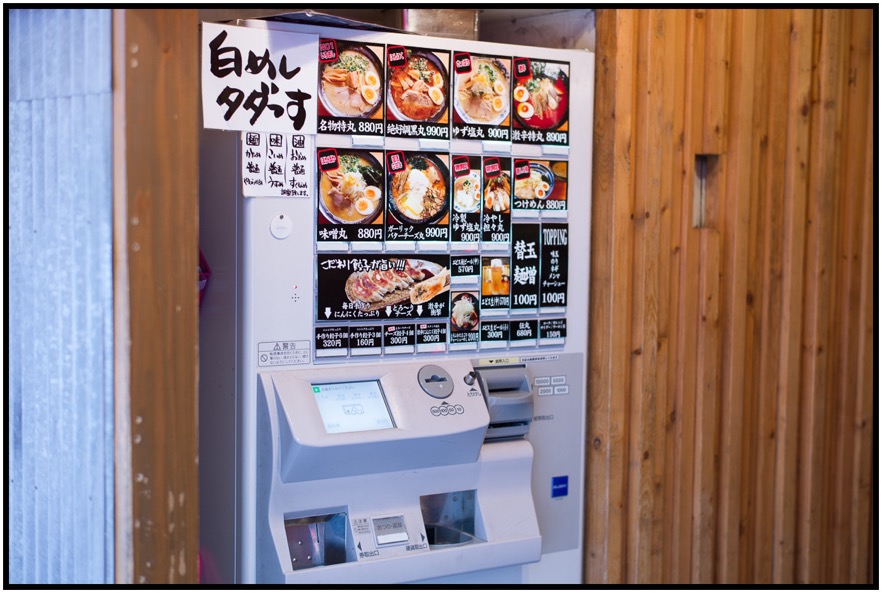
You put money in the money hole, then press the button for whichever dish you’ve chosen. A Chuck E. Cheese ticket squirts out the bottom, which you hand to the girl and she yells out the order to the chef. We were regretting our restaurant choice, but we’d spent so much time standing in the doorway with the menu we felt committed.
It turned out to be one of the best meals we’ve ever eaten. Not just the best meal we’ve eaten on Tokyo, but one of the best ever. The kids ordered dumplings and Adam and I each chose a different bowl of noodles. I don’t know what kind of magic they used to make a bowl of noodles that tasty — I could only identify a fraction of the ingredients used.
Below: at our table.
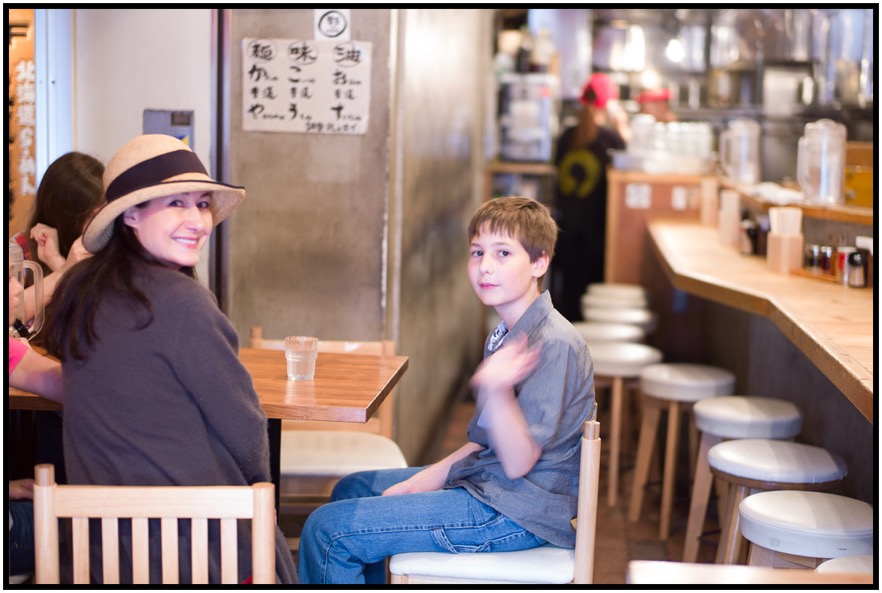
Restaurants here are different than anyplace else I’ve ever been, including China. I’ve already mentioned the single diner seating arrangements; what I haven’t mentioned is that in every single place the chefs are on full display.
In most cases, they are behind huge windows with seating all around the perimeter, so that diners are staring directly into the kitchen. Every chef in Japan has an audience. They cook in an incredibly controlled way — there is no rushing or sense of frantic in-the-weeds disorganization, and (like everything else in Japan) the cooking areas are spotless. The chefs all wear white coats and they never have stains on them — I can only assume they have several jackets ready to go and change into a fresh one if something gets on the one they’re wearing.
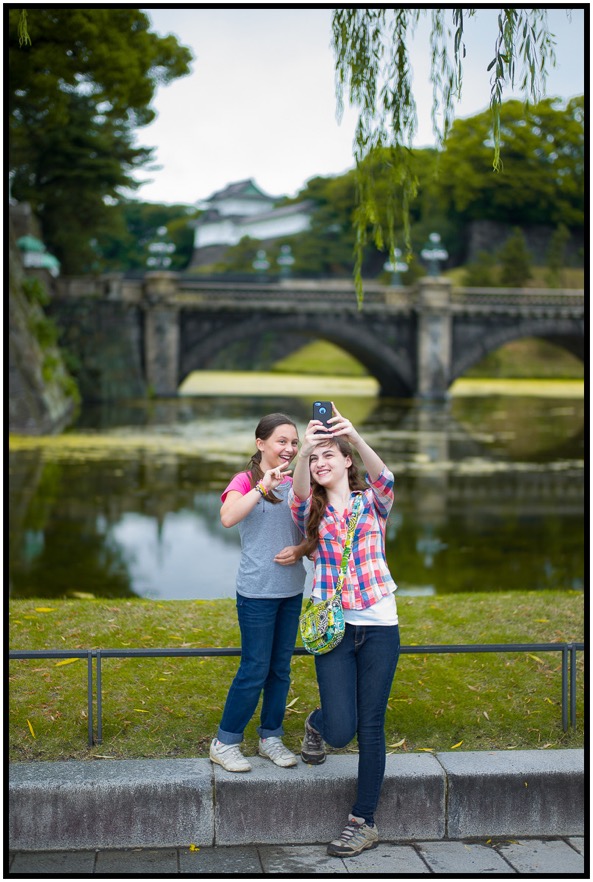
Adam: We then took the subway over to the area where the Imperial Palace is located – residence of the Japanese emperor. I can remember reading back in the 80s how, at that time and at the peak of the Japanese property bubble, the grounds surrounding the Imperial Palace (about 1.3 sq. miles) were valued in excess of the state of California and all that it contained. I was eager to see what all the hubbub was about.
Of course, those heady days when the Japanese were going to take over the world are now over (now it’s the Chinese..) The Imperial Palace is not open to the public, but we were welcome to walk around the perimeter.
The area surrounding the Palace is all gardens with impeccably maintained trees. It’s a beautiful little natural oasis in the middle of such a modern big city.
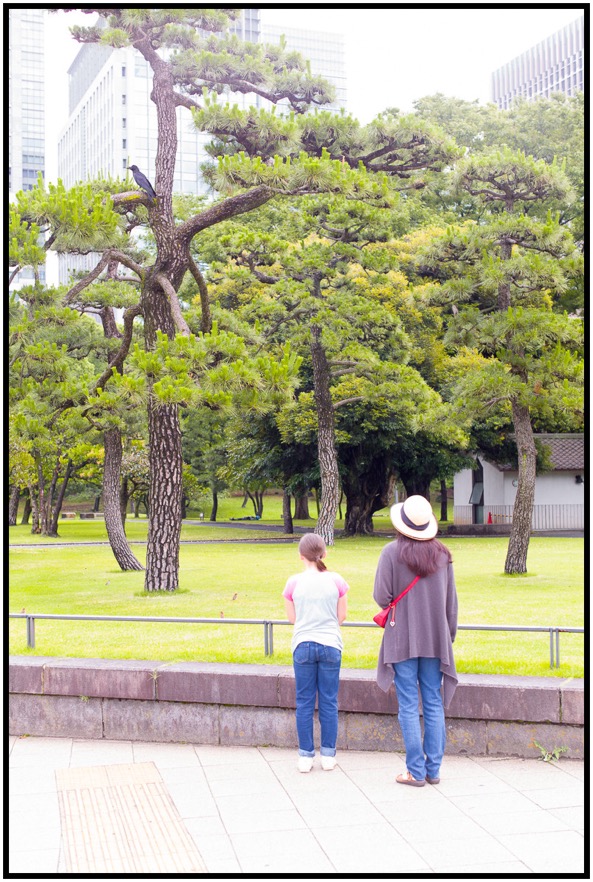
The Palace itself is so hidden you can’t see it. There is a huge moat surrounding the property. It had surprisingly few birds … in fact, most of Tokyo is bereft of birds. There are very few pigeons, which is remarkable because every other big city I can think of has lots and lots of them. There were only a couple of ducks on this large moat, too.
A few photos of the kids posing; we’ve taken relatively few pictures so far because it’s frowned upon in all of the shops. 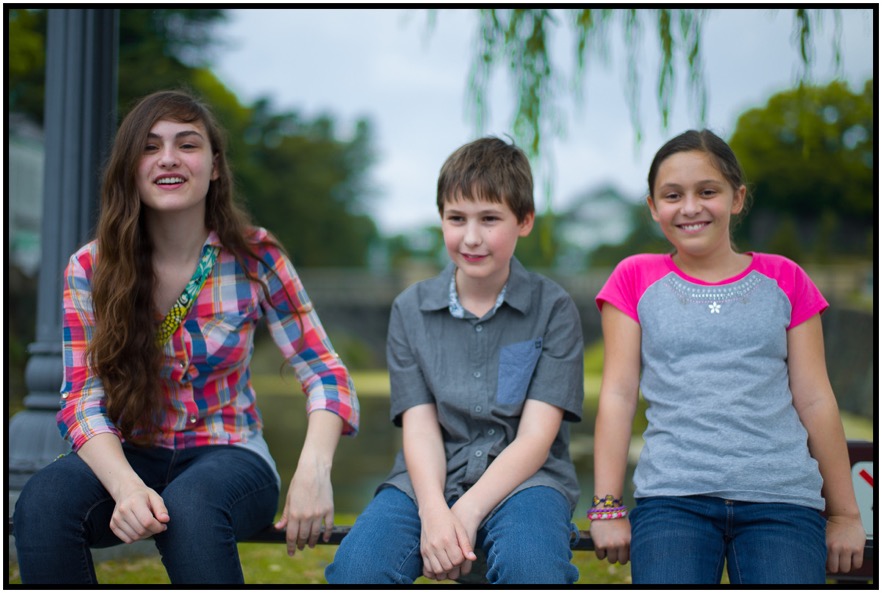
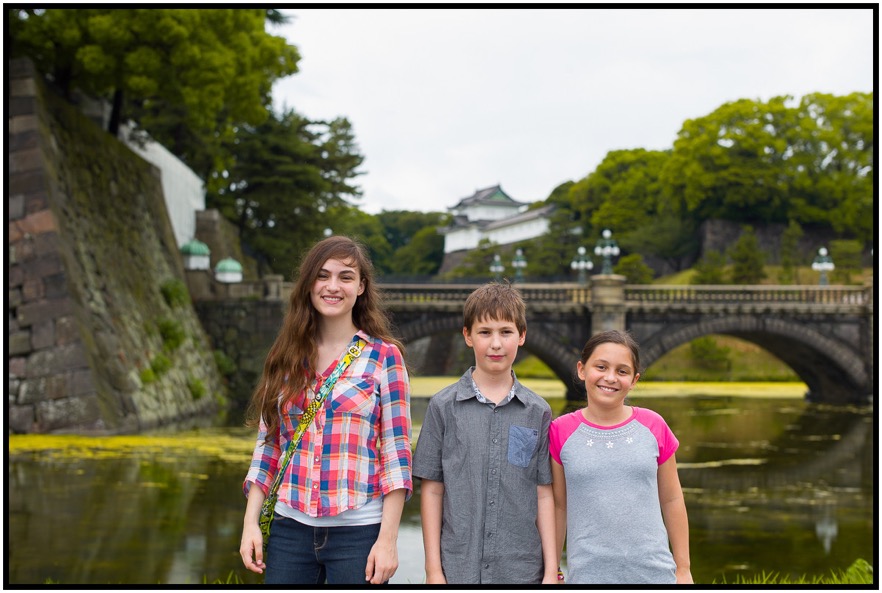
Below: Josie and Isabella taking a selfie.
Back home there is currently a parenting trend called “Free Range Kids” in which parents allow their children to do things like walk to the park by themselves. People call the cops on these parents and they get in trouble for child neglect and/or endangerment. It’s a whole stupid thing, and one of those issues where all you can do is scratch your head and say, “Only in America!”
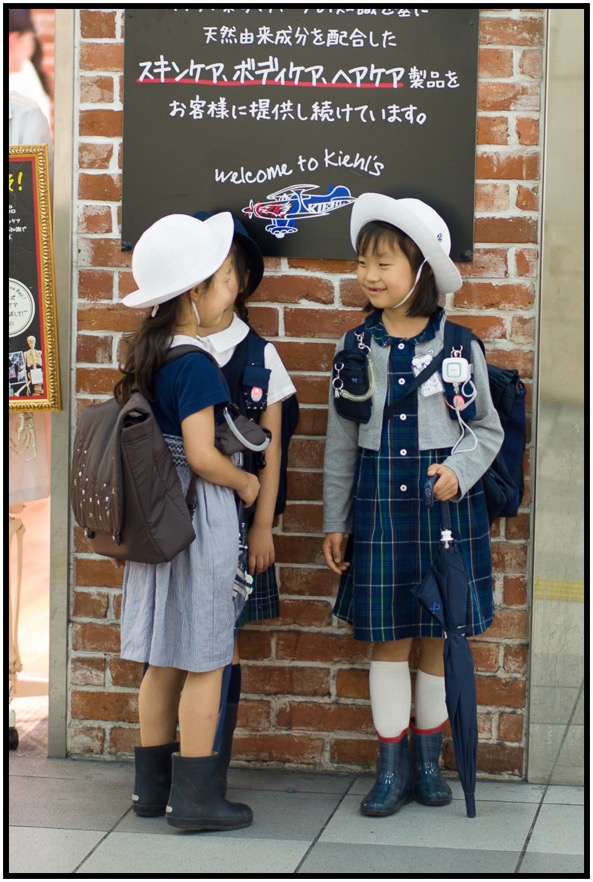
In Tokyo, little kids navigate the subway system all by themselves. We’ve already seen this phenomenon in every single other country we’ve ever visited, but I am blown away at how well these Tokyo kids manage.
Below: three little girls heading home after school.
To fully appreciate this, you need to realize just how big and busy this city is.
Tokyo is the biggest city in the world.
Tsukiji fish market is the biggest fish market in the world.
In Shibuya, we’ve walked through the busiest pedestrian intersection in the world. (10 lanes of automobile traffic and five major crosswalks converge, accommodating as many as 2,500 pedestrians with each traffic signal change.)
Tokyo Metro operates nine lines and 184 stations including Shinjuku Station, the busiest rail station in the world.
IN THE WORLD. And here are these little guys making their way through all this well-orchestrated chaos and doing a fantastic job. Nobody blinks and eye. 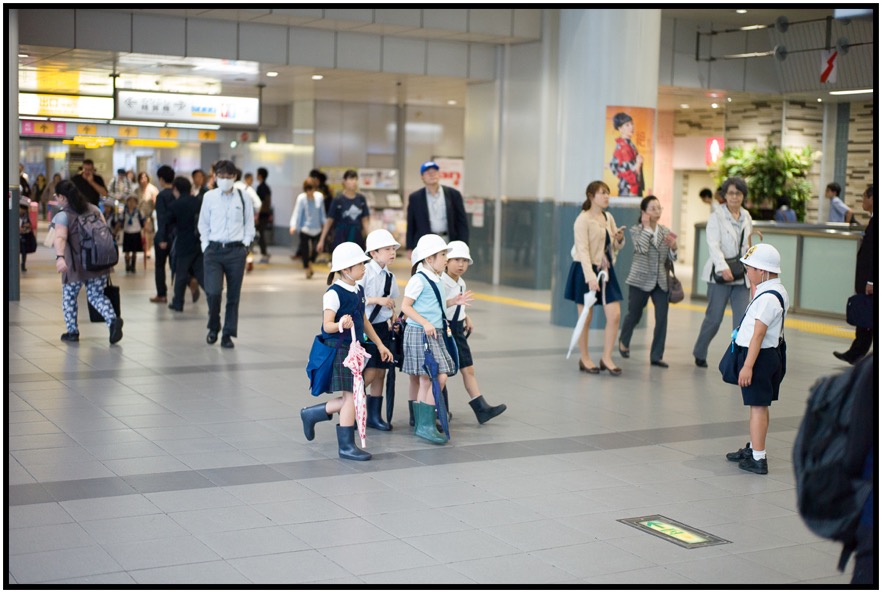
A shot of one of the vending machines all over the city. You’re never far from a refreshing beverage here.
A final shot from around our apartment’s neighborhood. Everything feels 3/4 scale in this country.
This morning we’re packing up and heading to Kyoto. I’ll post again next week!


a great post. I have traveled to Japan quite a few times over the last 50 years you real capture the essence of the place. If you are still in Tokyo, try to go to the world largest fish market. It’s a fascinating place at about 5:00 in the morning. You can see huge Tuna sold like it’s a livestock. Buyers are in trading for a couple of decades before they get to be buyers. It’s a great experience, but pretty strong smells. The kids will love it.