October 21, Tuesday
Today the vacation portion of the trip began. We met Sal and Ana in the lobby early in the morning and hired a car to drive us from Managua to Granada. It’s about a one-hour drive if you go straight through, but there are several places to stop along the way.
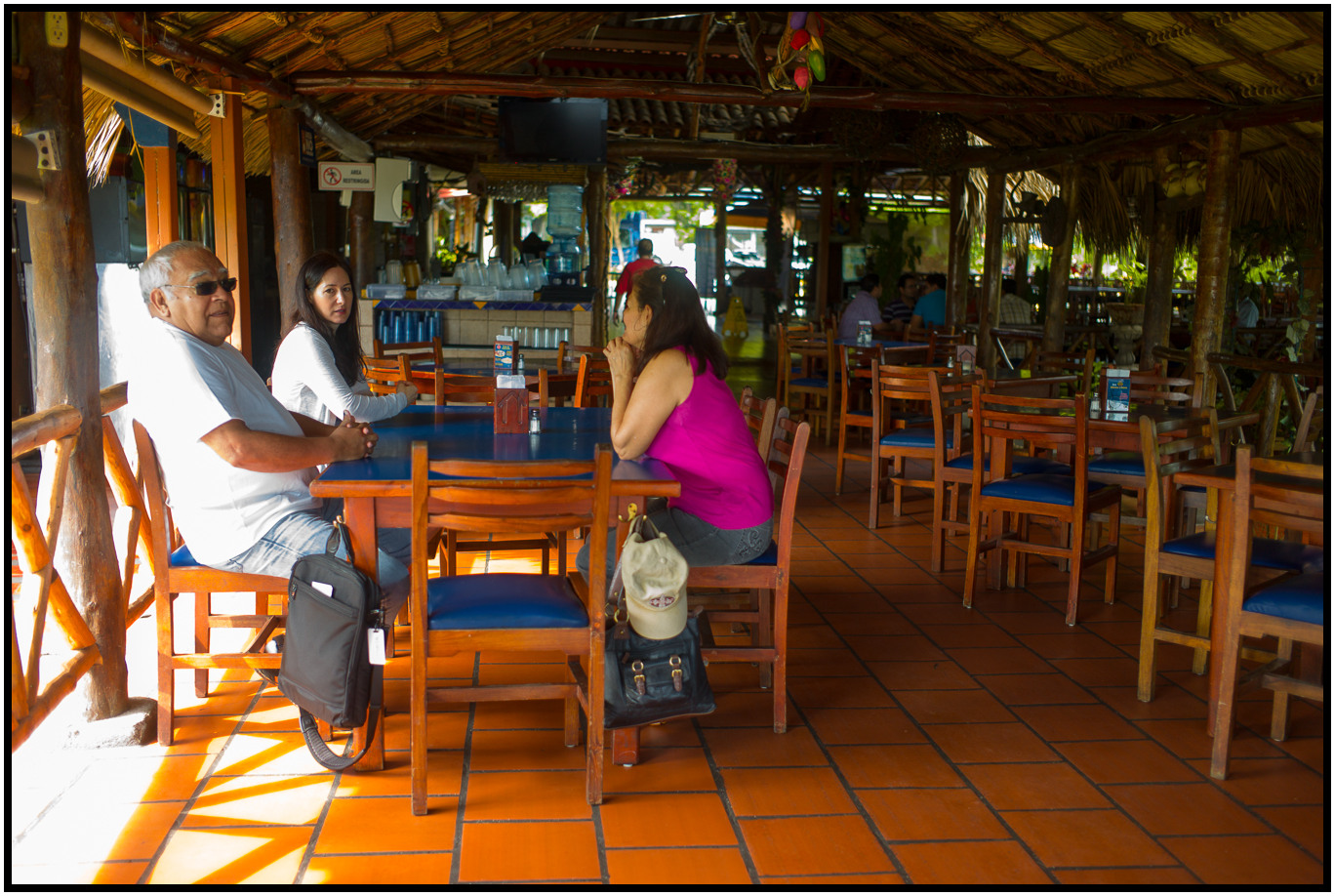
First, breakfast at Mi Viejo Ranchito for breakfast (km 17.5 on the carrera a Masaya).
There are several active volcanoes in the area. The one that’s still the most active is Volcan Masaya. It last erupted in 1772, but has been belching sulfur dioxide ever since. The gas is poisonous, and several species of animals have adapted over the years to tolerate living in it … one a special species of parrot. The benefit to the animals able to tolerate the sulfur dioxide is that the gas drives away other predators.
Before you get to see the volcano, you tour through the visitor’s center. They have done a pretty good job of explaining the geological history of the area, as well as explaining how the volcanic activity has shaped animal and human culture.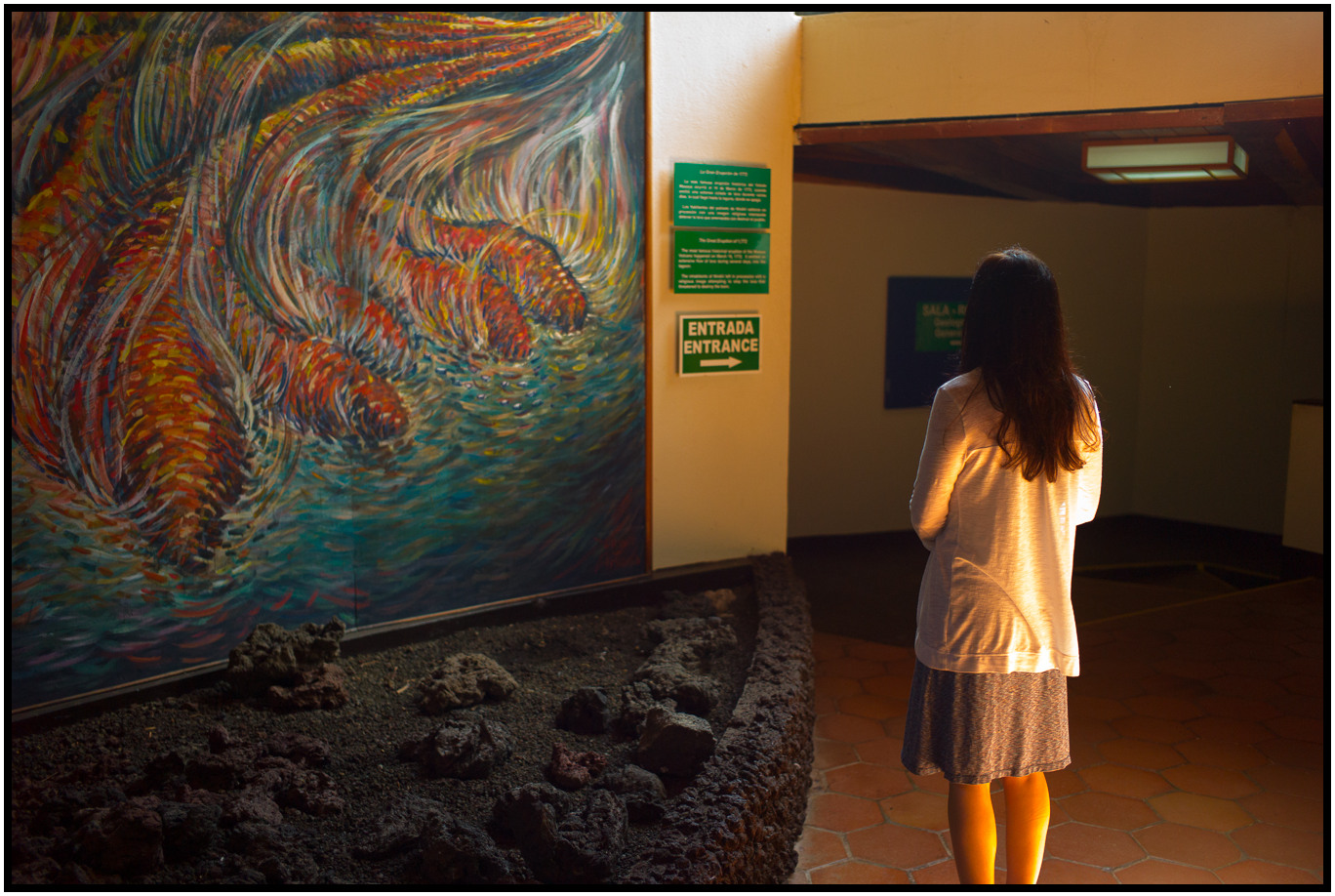
View of a lagoon from the rear of the visitors center. I wandered off by myself a little ways and ran straight into a 6 foot long snake. 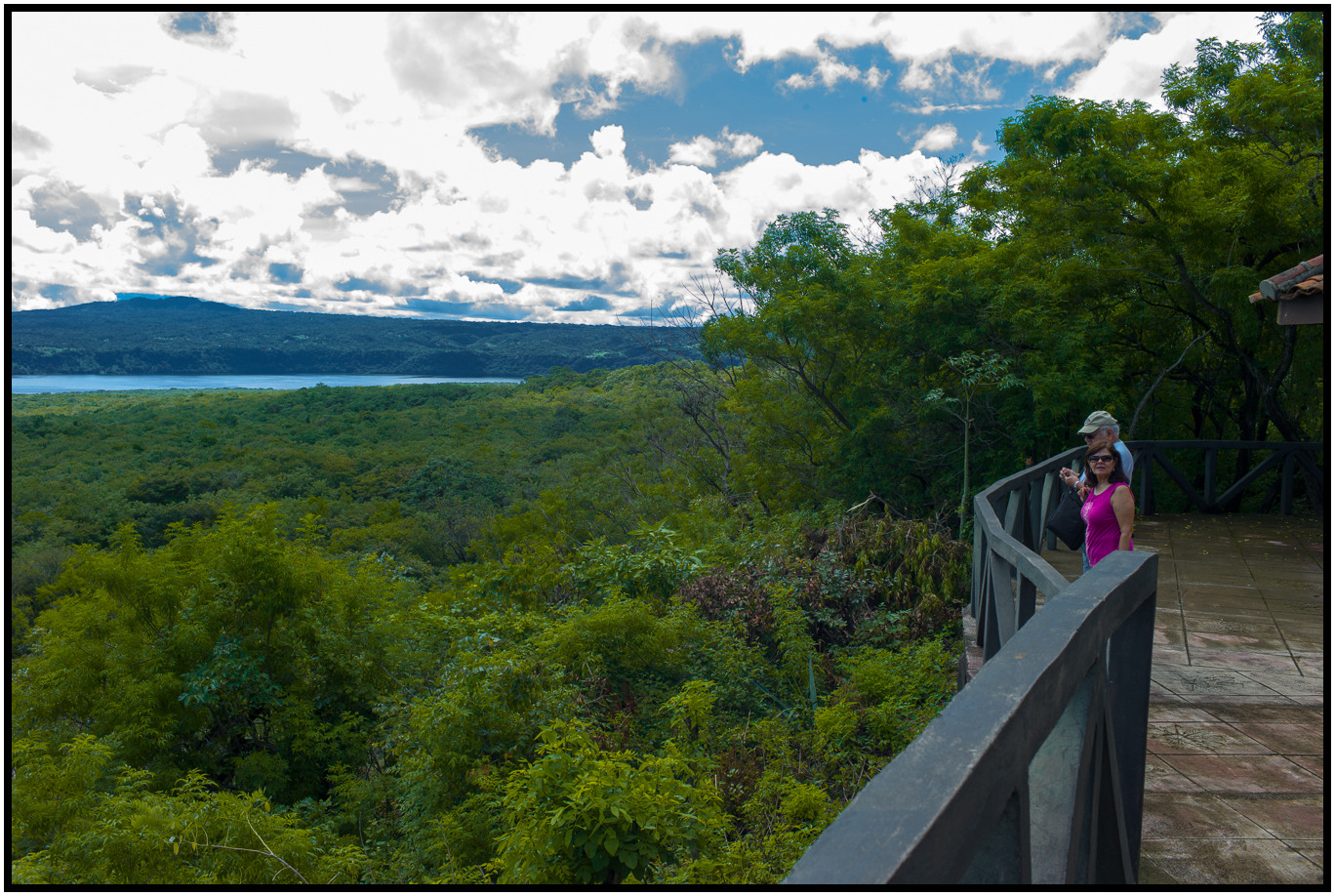
The first Spanish conquistadores arrived in this area sometime in the 1500s. They thought this volcano was the mouth to Hell, and named it La Boca del Infierno.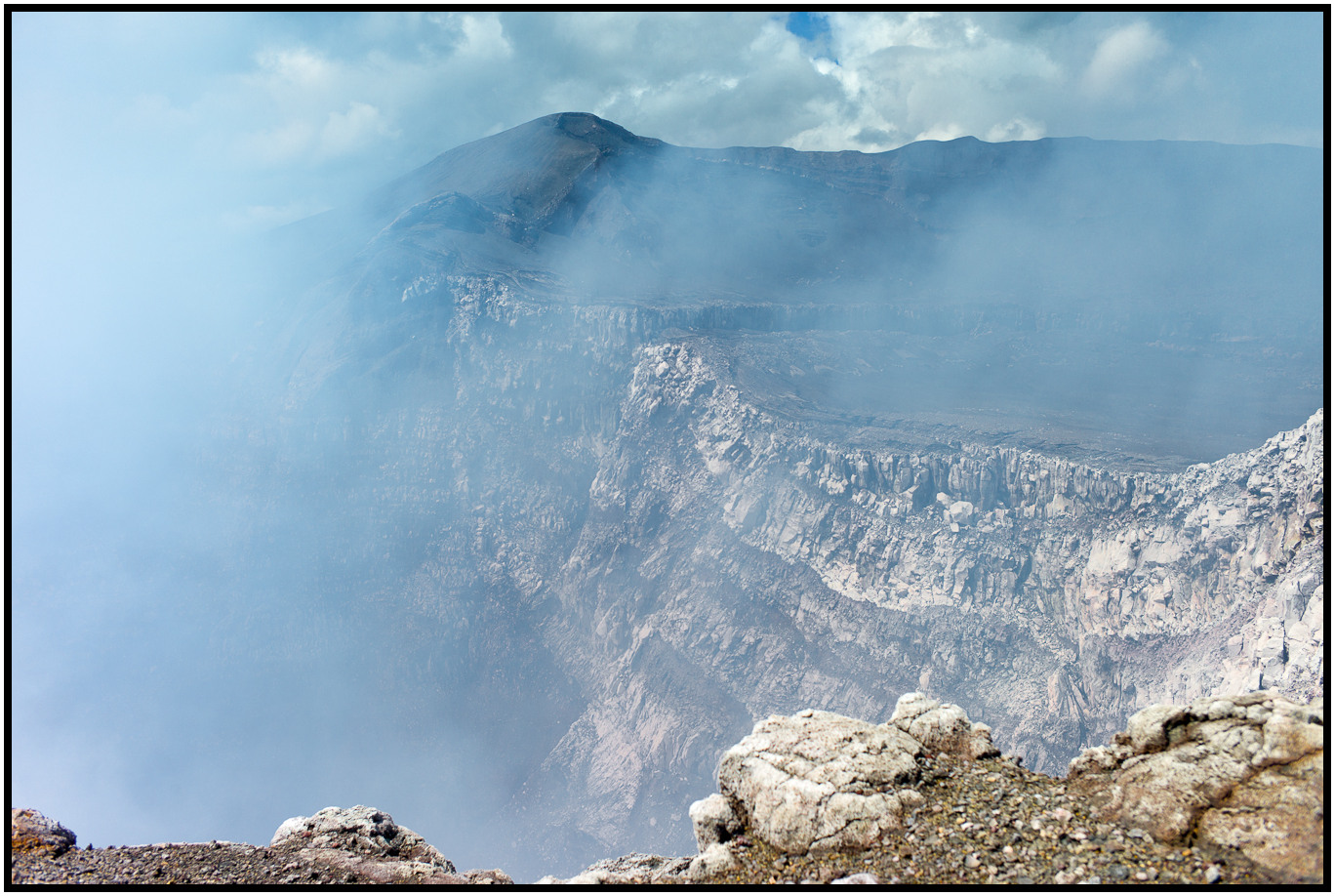
All that fog you can see in the photos is sulfur dioxide. It stinks and makes it really hard to breathe. It causes coughing fits and stings your eyes. They have warning signs all over the place telling people to head back to the parking lot if they start to feel poorly. 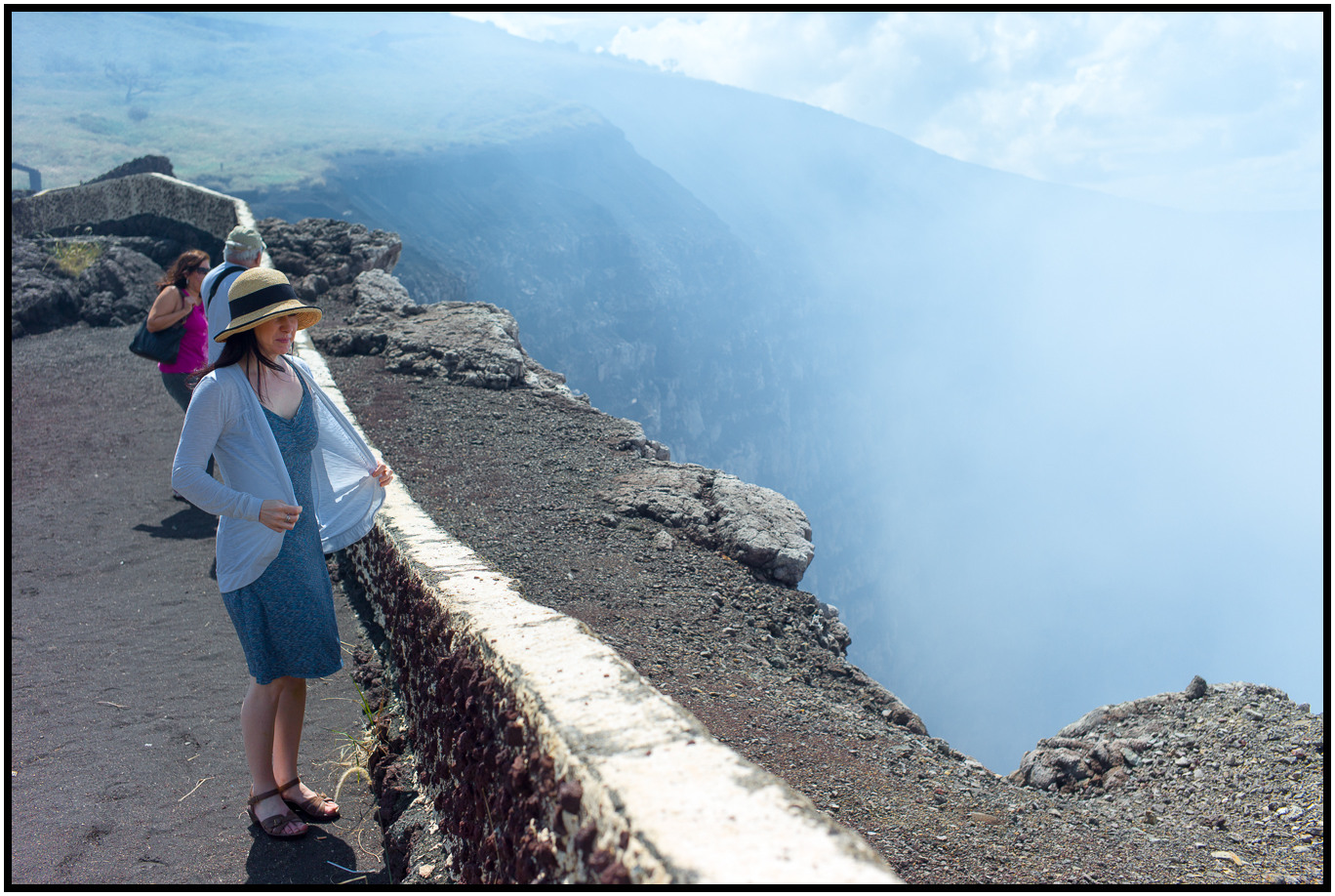
The huge wooden cross [photo below] was first erected by the Spaniards in the 1500s in an effort to keep demons from crawling out of Hell. (I’m having to rely on my memory for all these details because I can’t find much about it on the internet, so if I have gotten anything wrong, I apologize.)
I’m pretty sure this isn’t the same cross — wood tends not to last very long when exposed to the elements like this — but a cross has been on that location for a long time.
One of the saddest stories in the museum was about the villagers living near here when Masaya erupted in 1772. Lava was flowing into their village, burning everything in it’s path. The villagers tried to stop it by waving a giant wooden cross with a carving of Jesus on it at the lava flow, which of course didn’t do any good. They had a painting in the museum depicting this event … terrified people thinking that Hell had belched up through the earth to devour their village, and nothing they did deterred it in any way. I seem to recall that they ended up settling somewhere else after a long period of wandering homeless. Their original home ended up as a smoking, barren lava field. Vegetation is just now, in 2014, starting to grow back. It’s still mostly grass, which is rather amazing considering how jungly the rest of the area is. 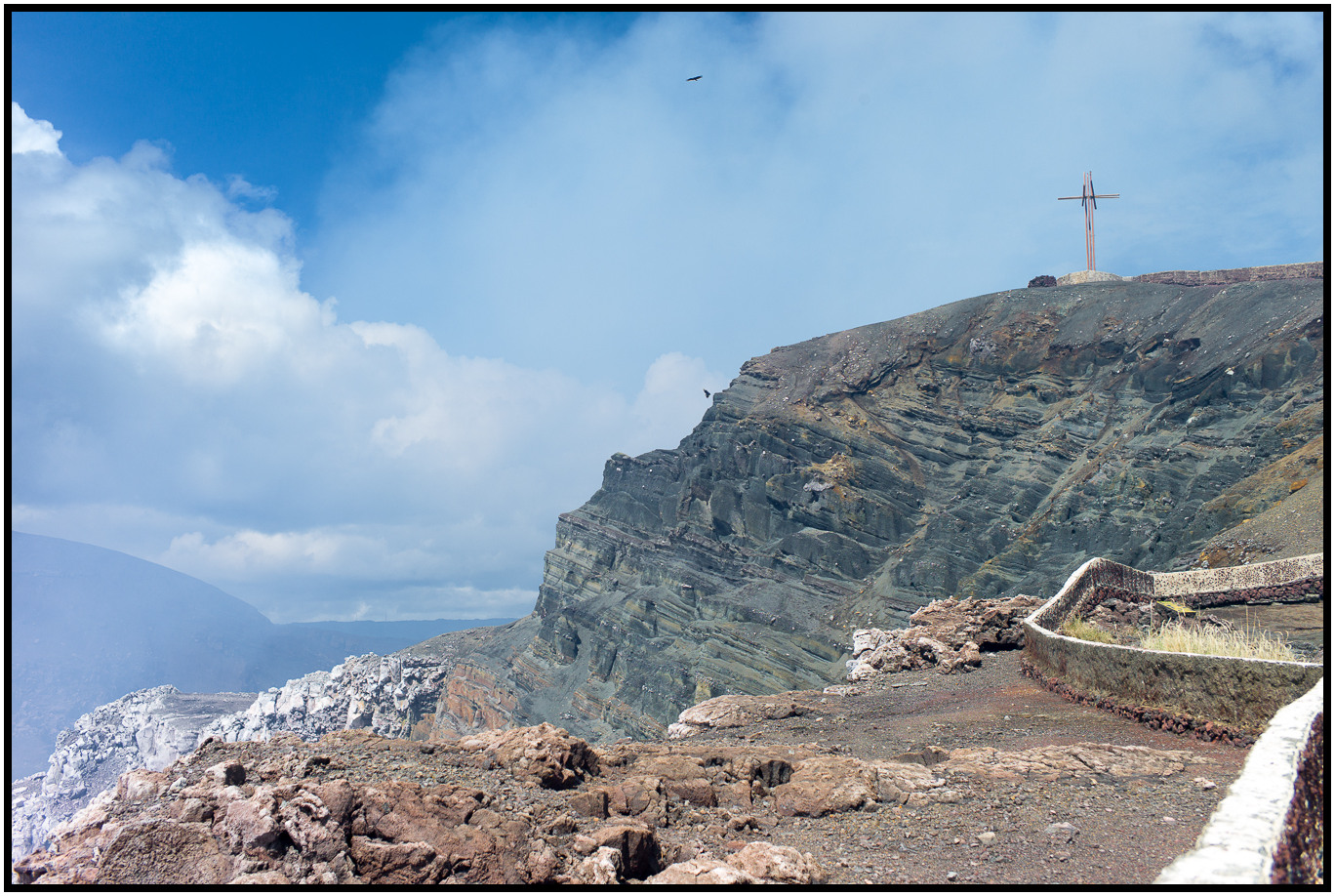
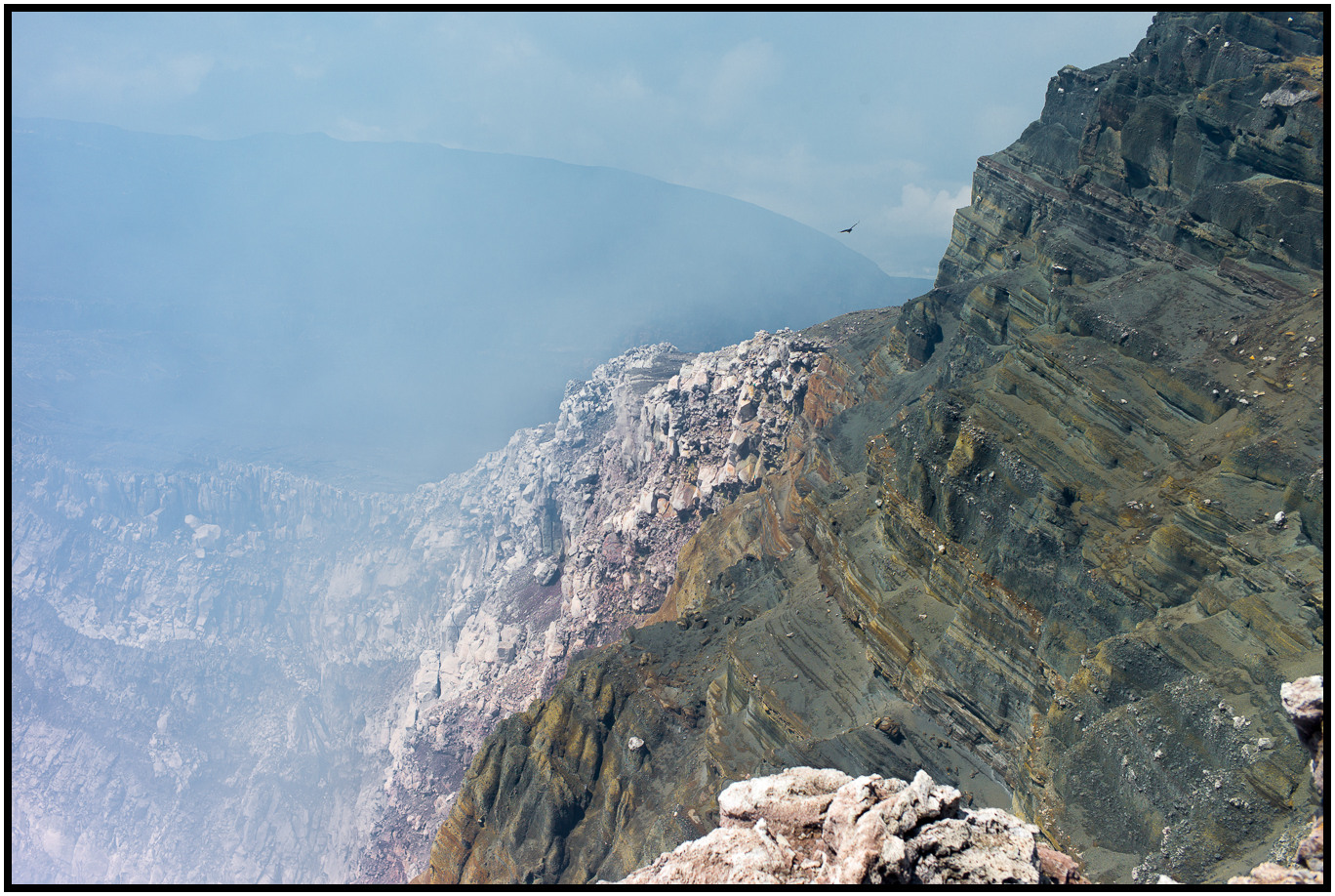
Some kind of hawk or vulture. They appeared to be nesting in the cliffsides.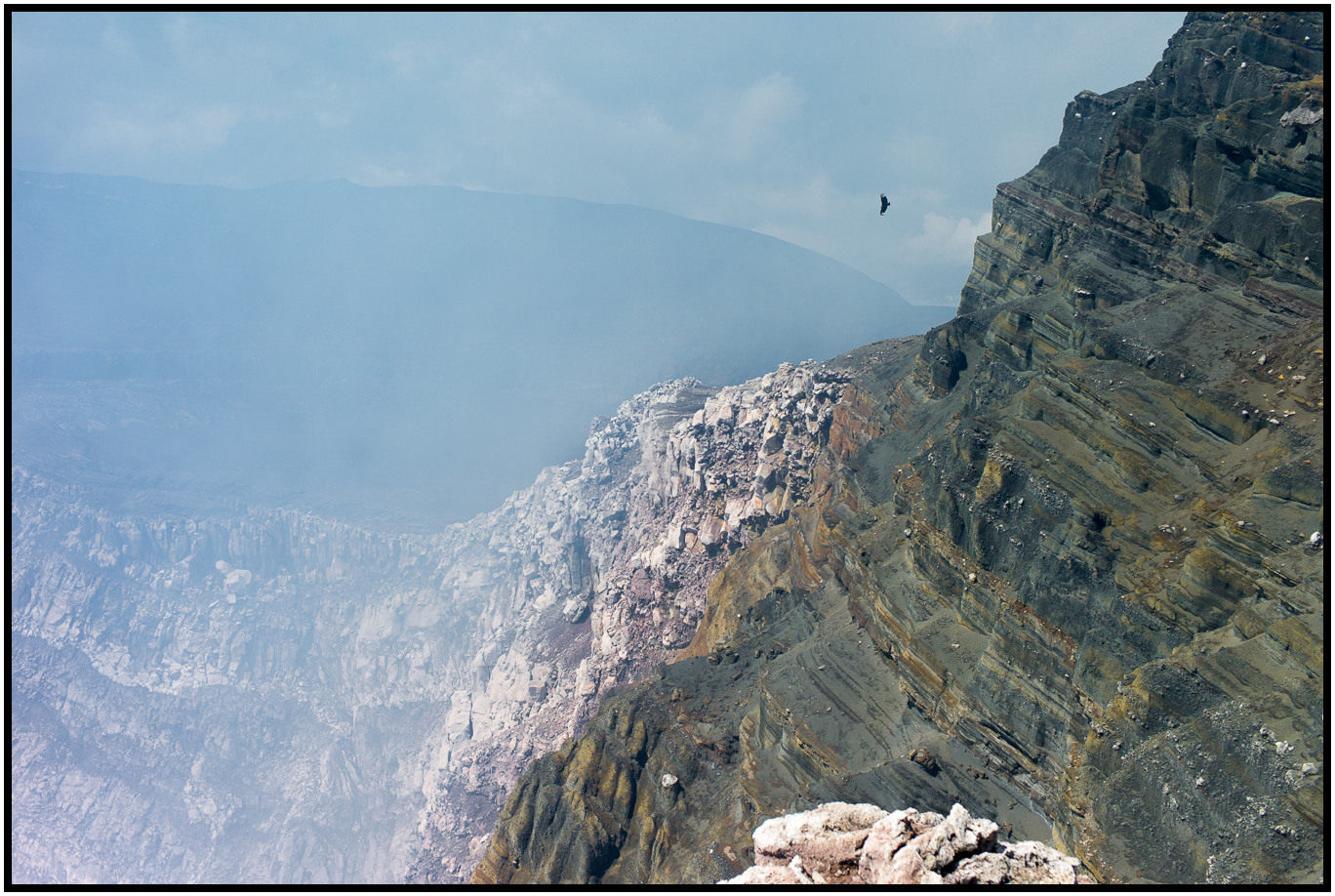
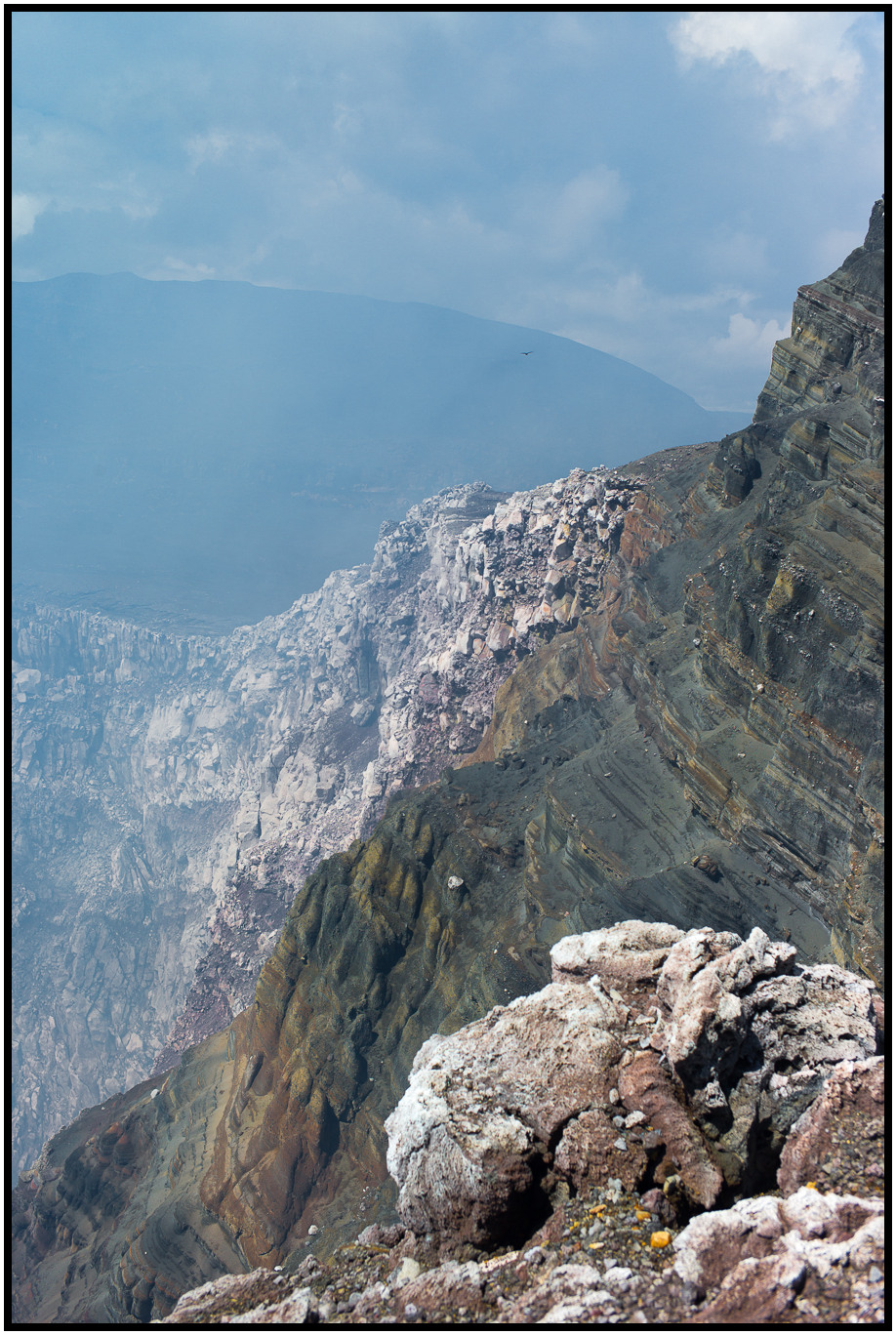
The sulfur was particularly bad today so the stone staircase to the top of the crater was closed. The park rangers said it was too dangerous to go up there.
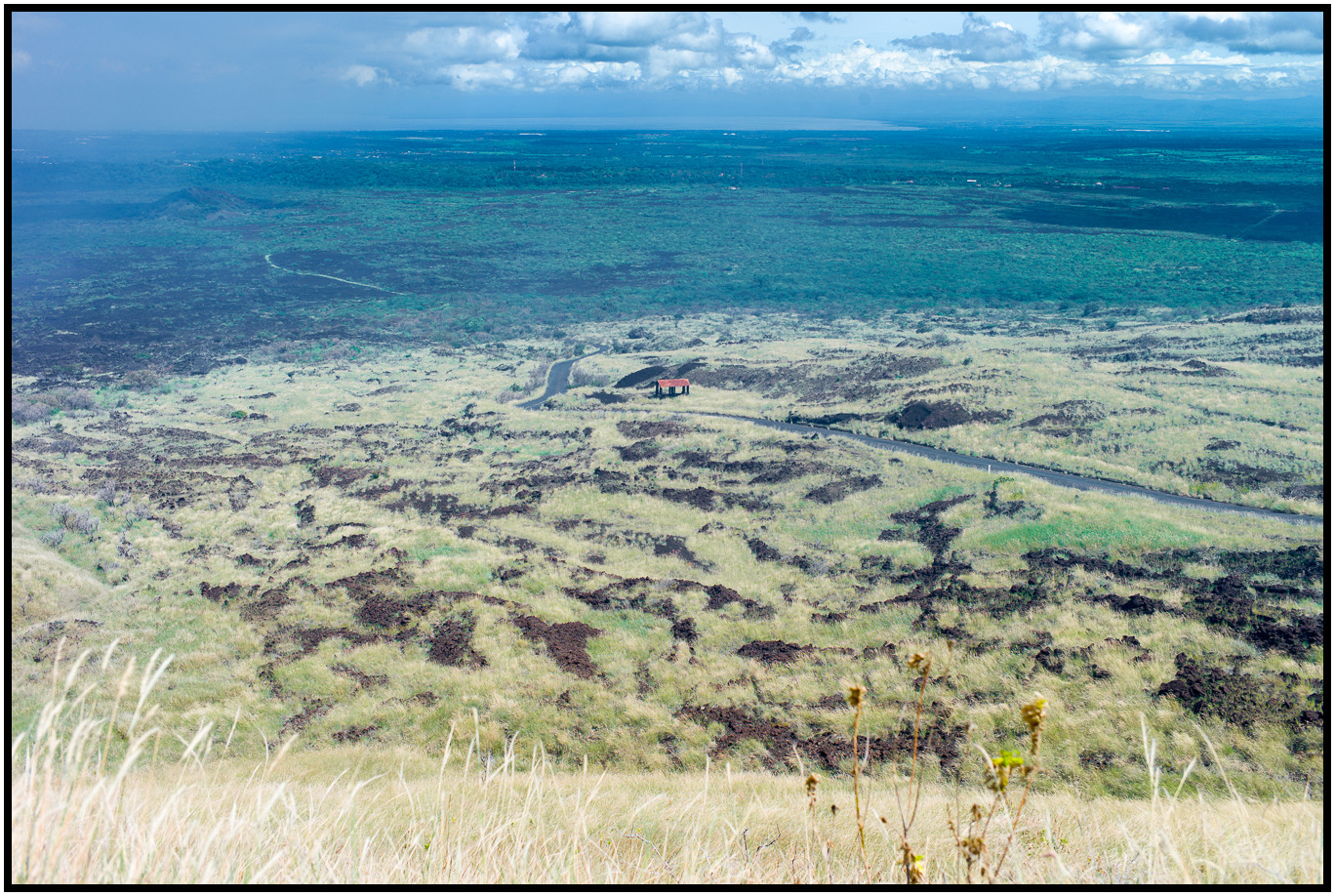
Below: a photo of the lava fields. There is a road going through them, and pretty much nothing else as far as the eye can see. (That little red structure is a rest stop for cars. I think.)
Our next stop was the Masaya mercado. We did a little tourist shopping and then I heard a parrot. If there is a bird in the vicinity, I will find it! This little guy was friendly and talkative. The owner told us his name was Paco. 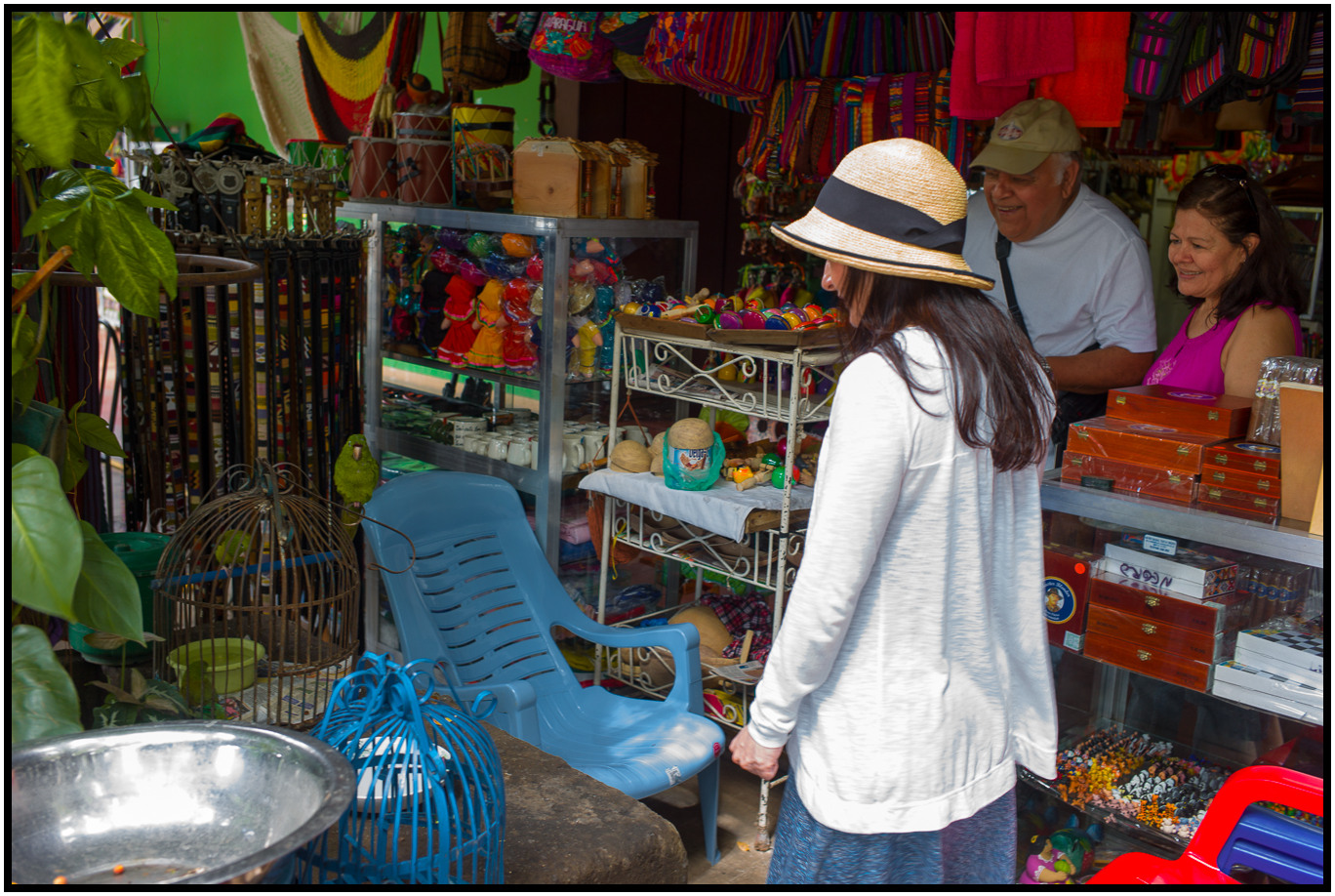
This market has a wide variety of colorful textiles to choose from. 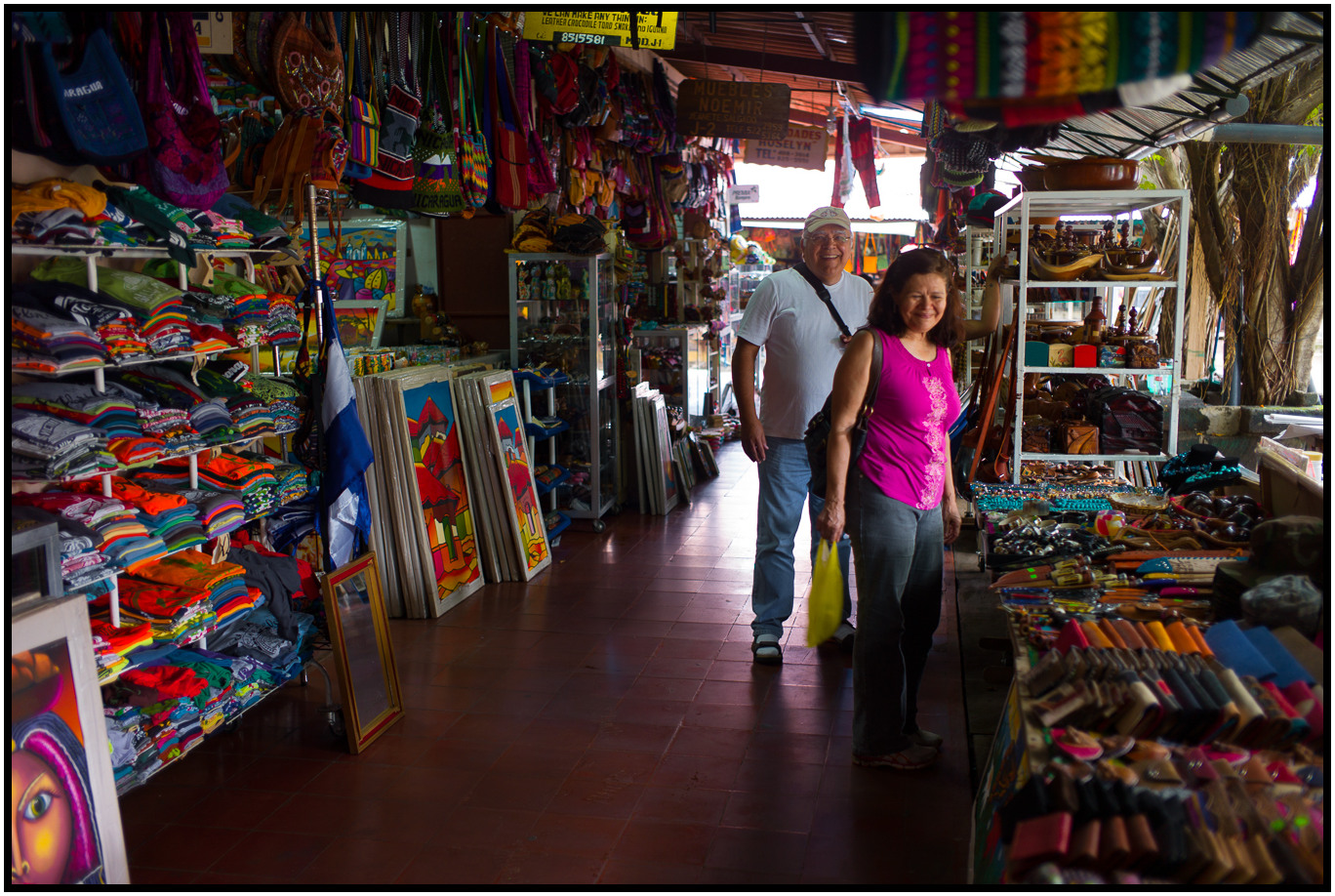
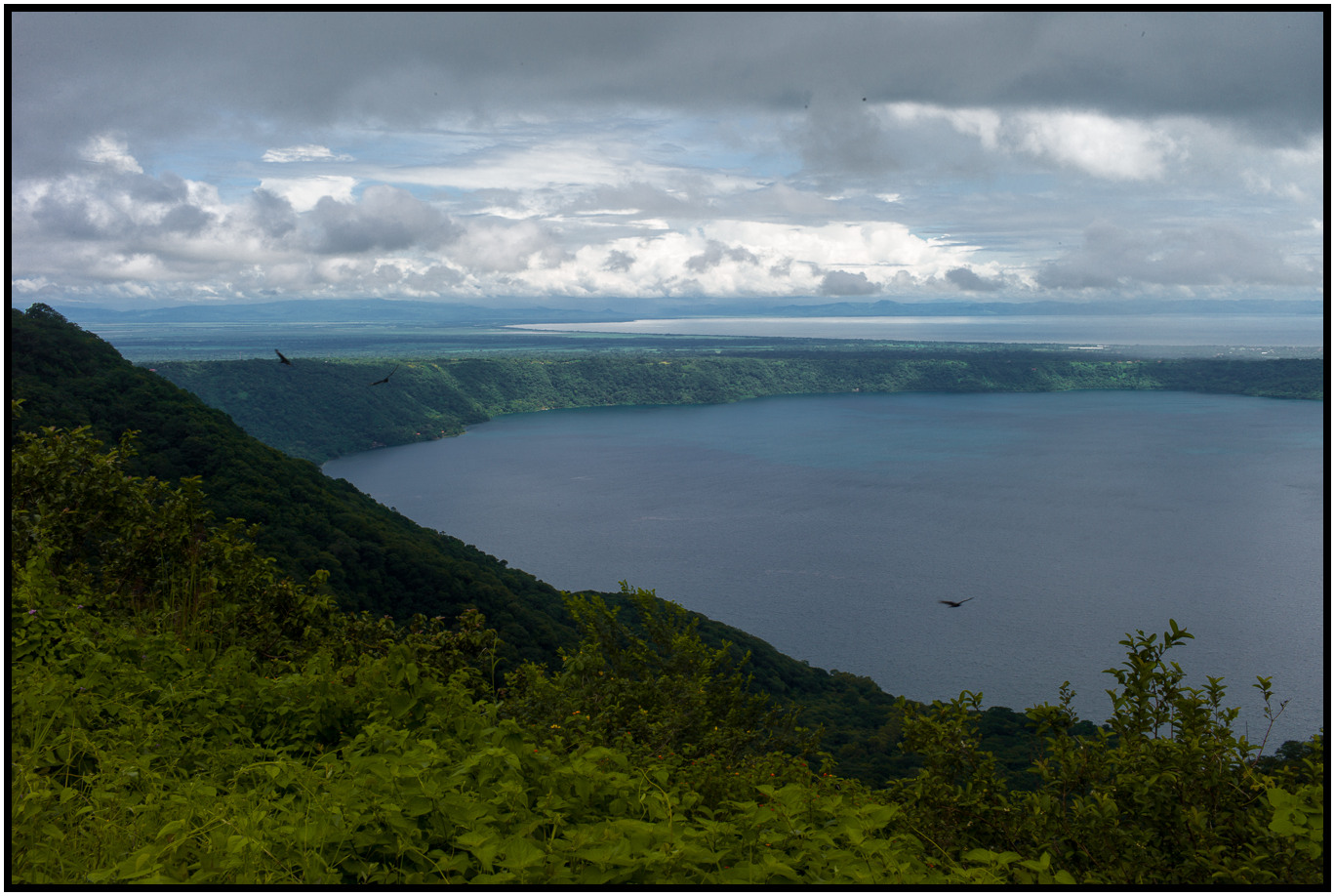
Our last stop before Granada was the town Catarina to see the Laguna de Apoyo. It formed about 23,000 years ago after a large volcanic explosion. The volcano caved in on itself and eventually filled with water. You can hire horses (shown below) and tour through the jungle, but we didn’t have time and it was starting to rain. I think this would be a really neat place to explore if we’d had more time.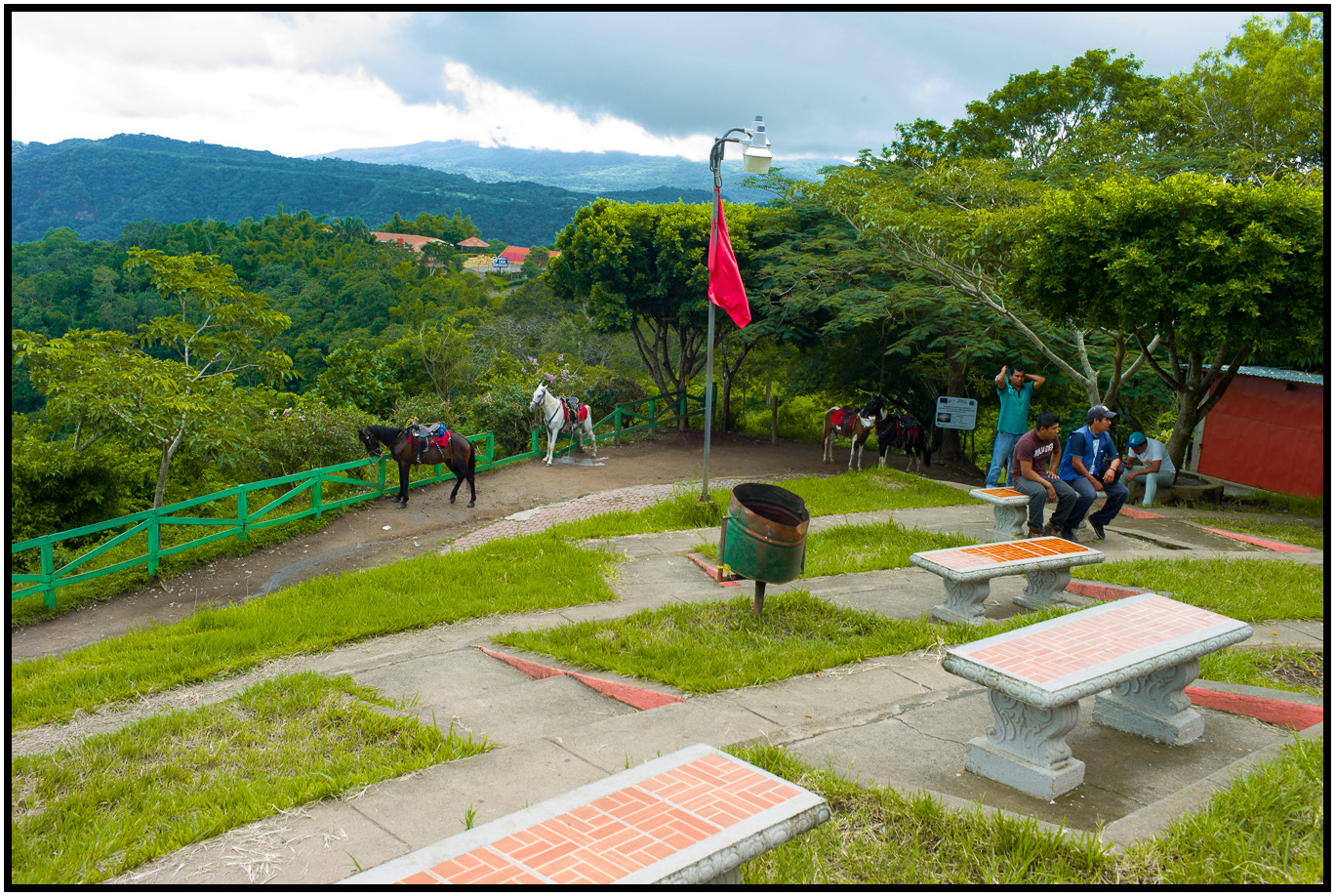
In Granada, we checked into our hotel, then went for lunch at a steak house recommended by Adam and Sal’s client. After eating, we still had several hours of daylight left to explore the city and get our bearings.
Cathedral across from our hotel.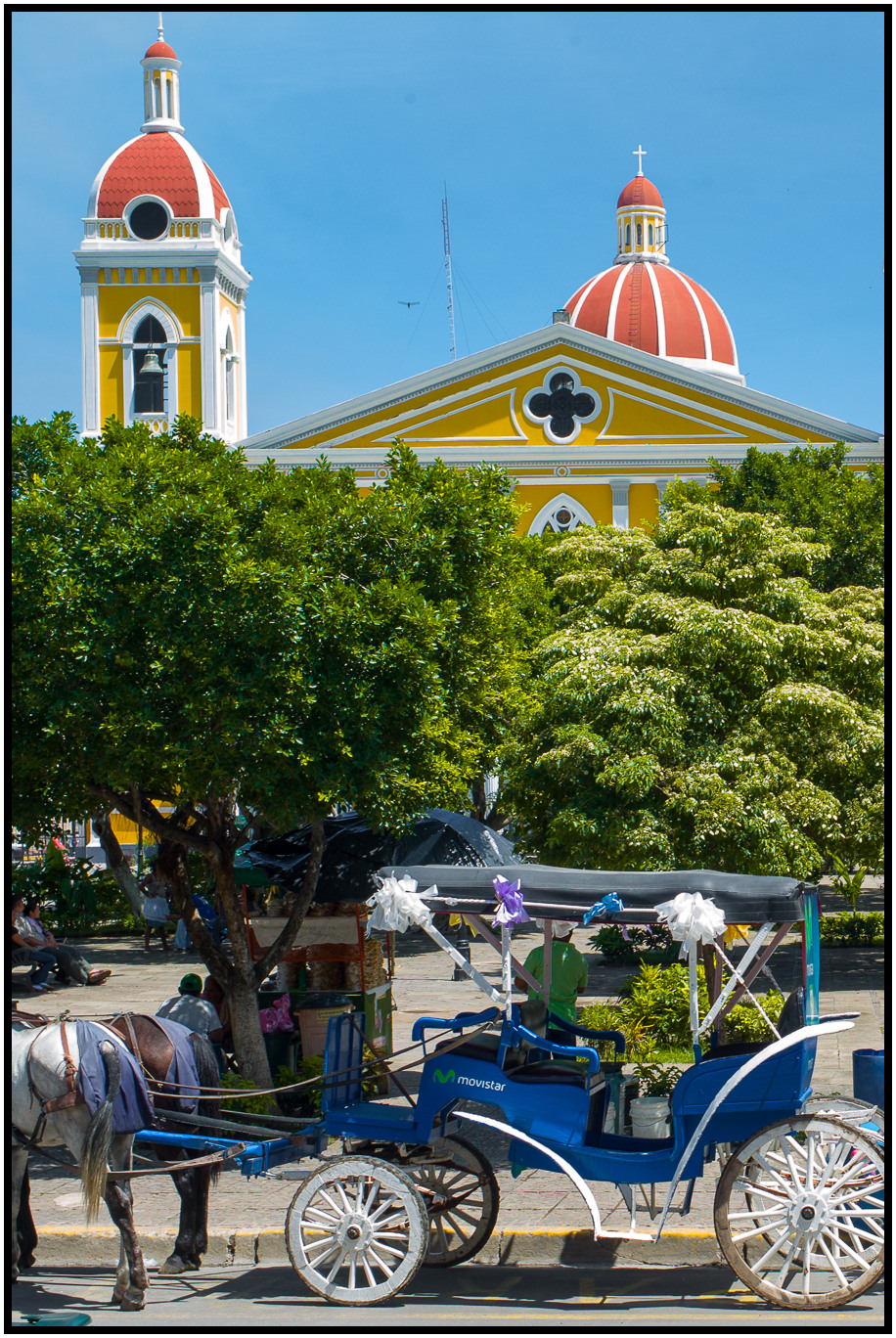
This restaurant name cracked us up. You’d have to be a Family Guy fan to get the joke. (Peter Griffin: “Roadhouse!”)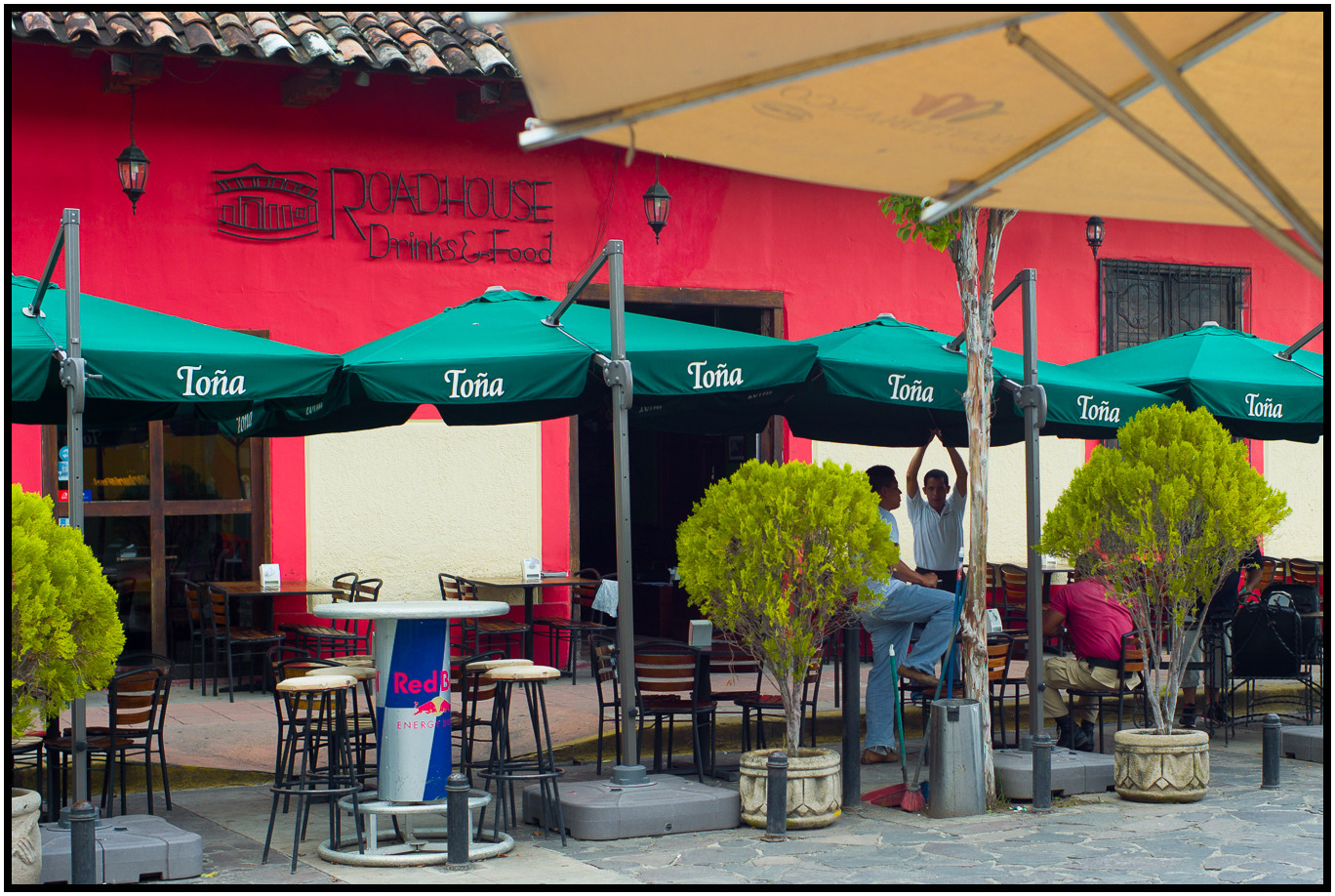
We don’t know the significance of this old church, but it looked in need of some serious restoration. 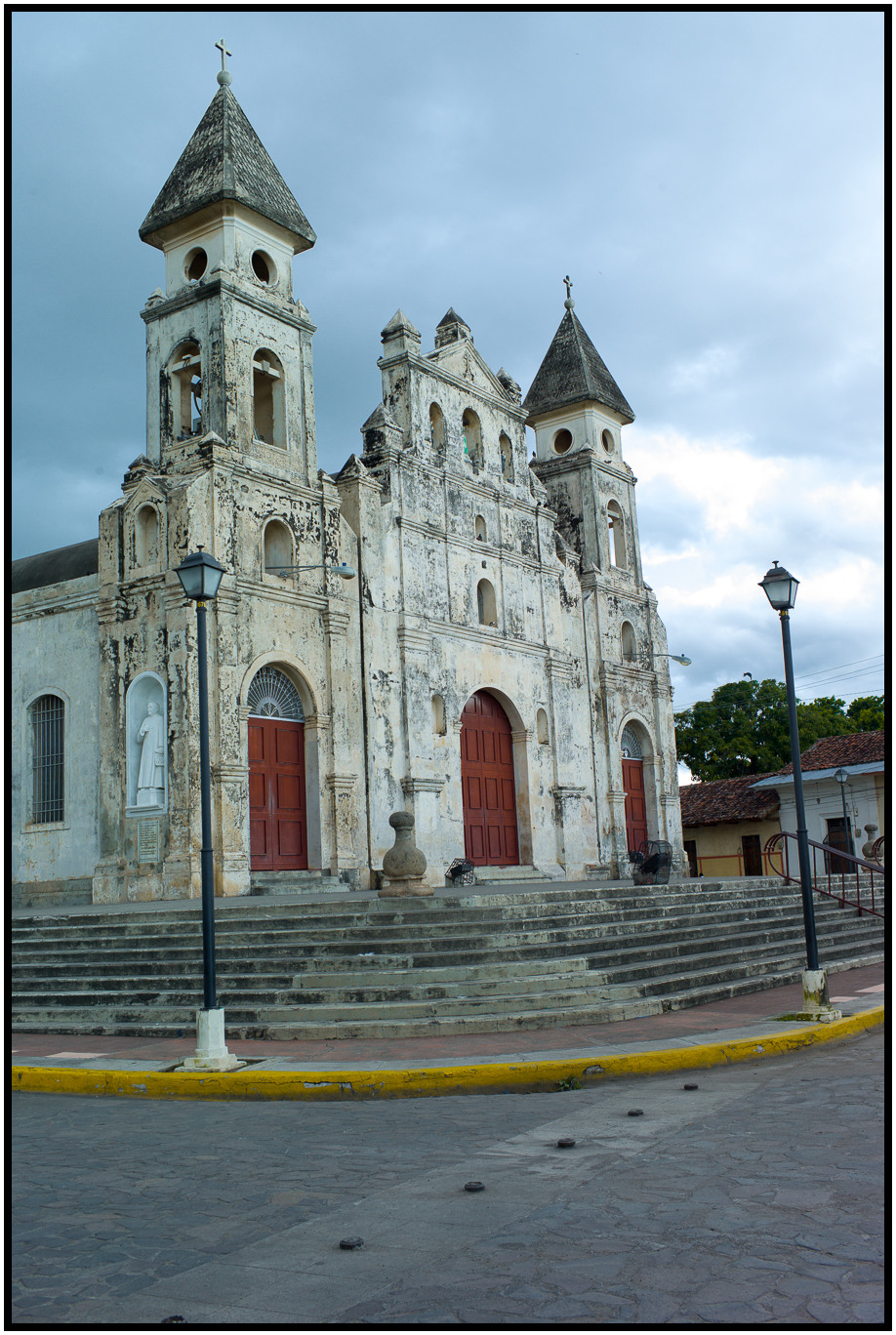
Street scenes around Granada.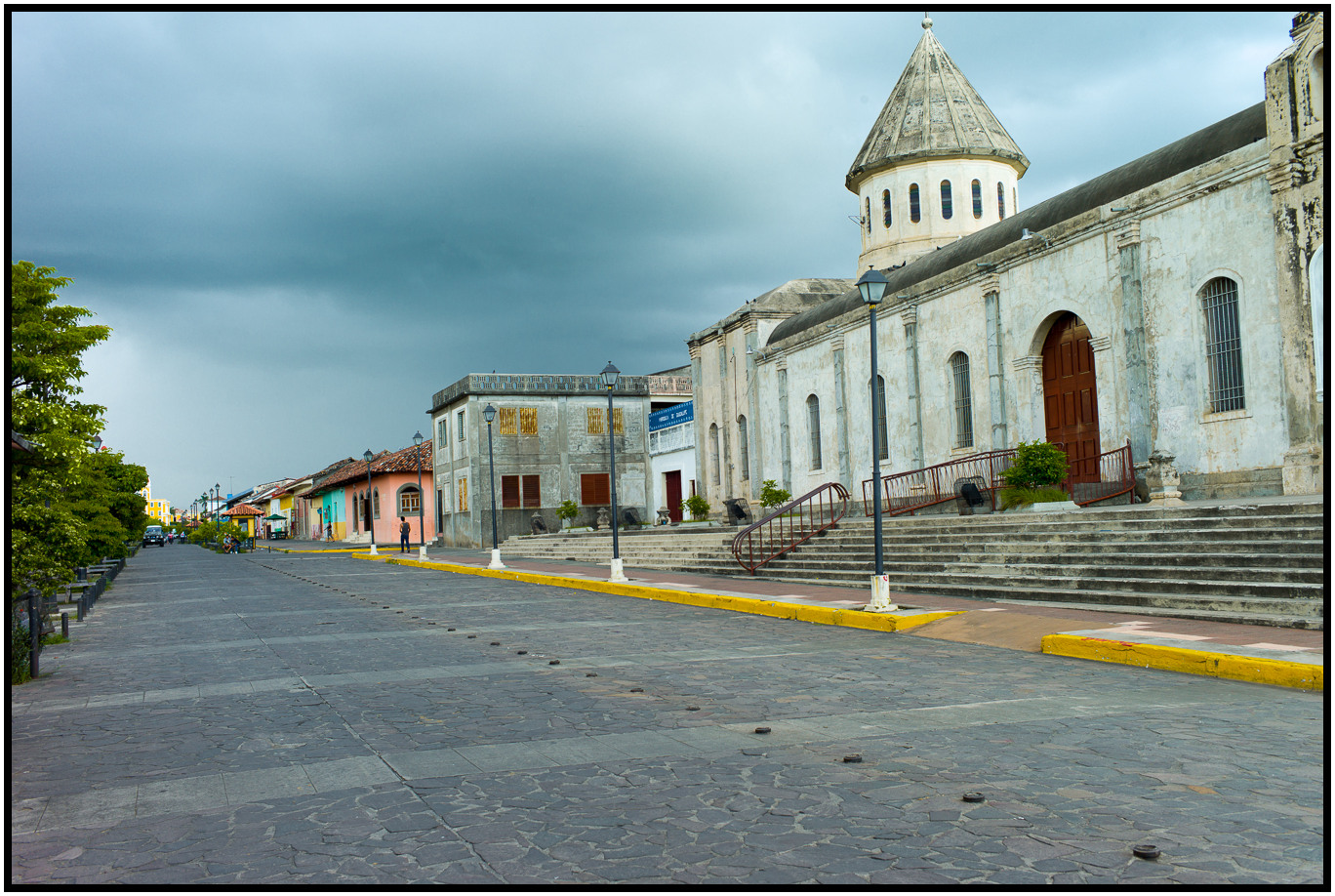
It was about to start raining, so people were all hurrying home. This guy got out his guitar to entertain his family (there is a little girl down there you can’t see in the photo) until the rain stopped. 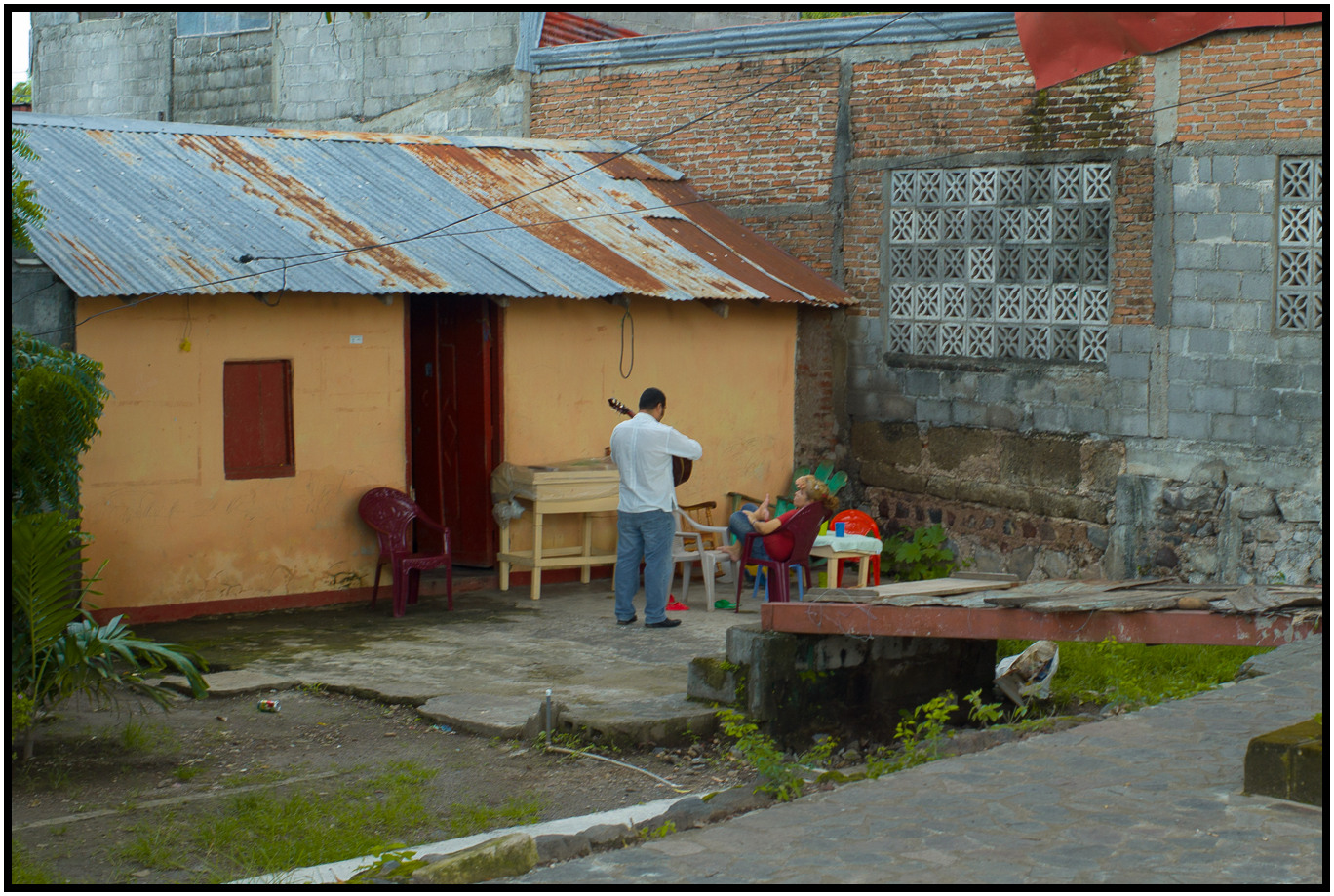
Finally, this is Lake Nicaragua. (We were mistaken about the lake we visited in Managua. That was Lake Managua. I corrected yesterday’s post.) These cows were grazing on the grassy area between the lake and the parking lot. 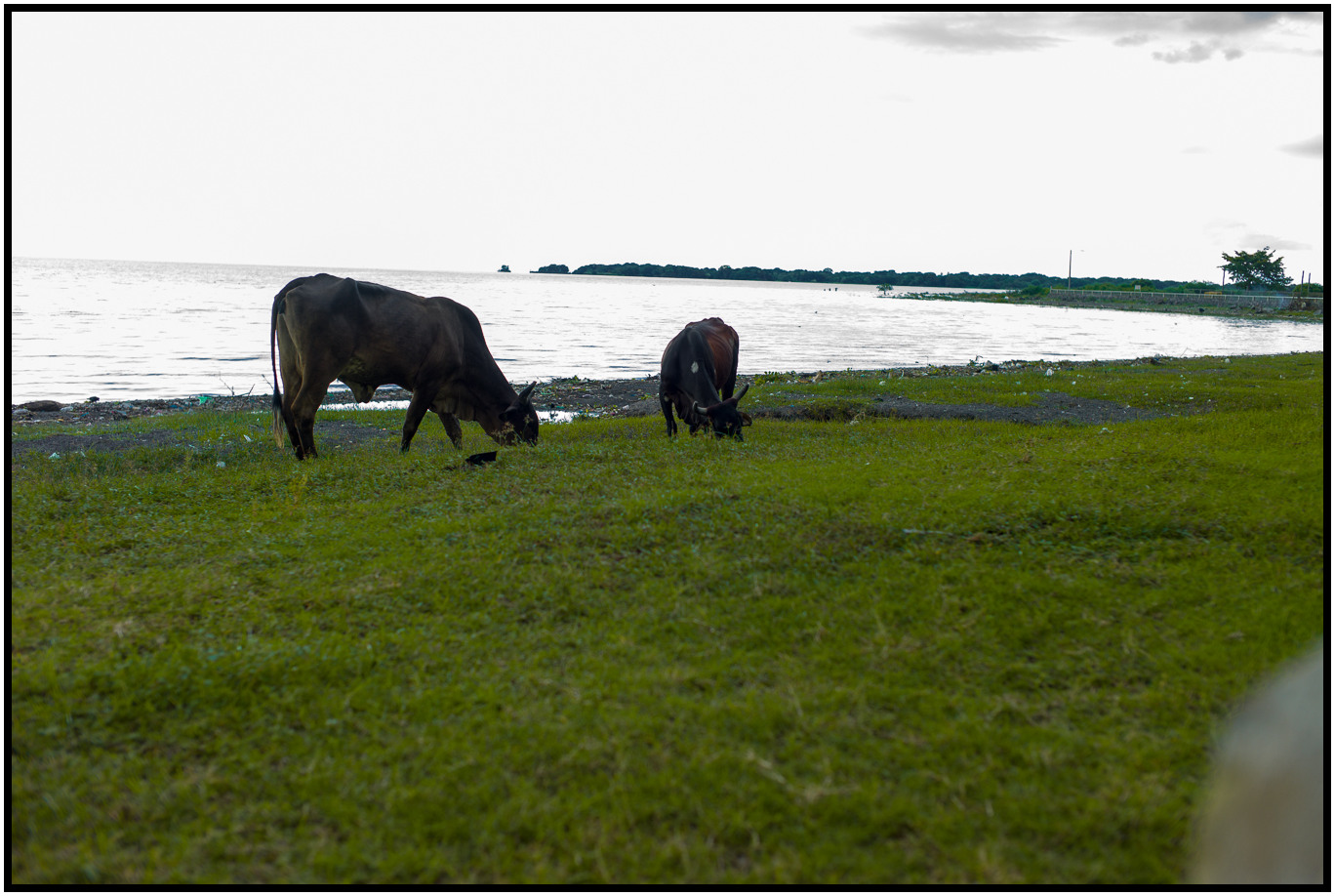
This cow decided to make a break for it, but people quickly chased her back to the other side of the short rock wall. 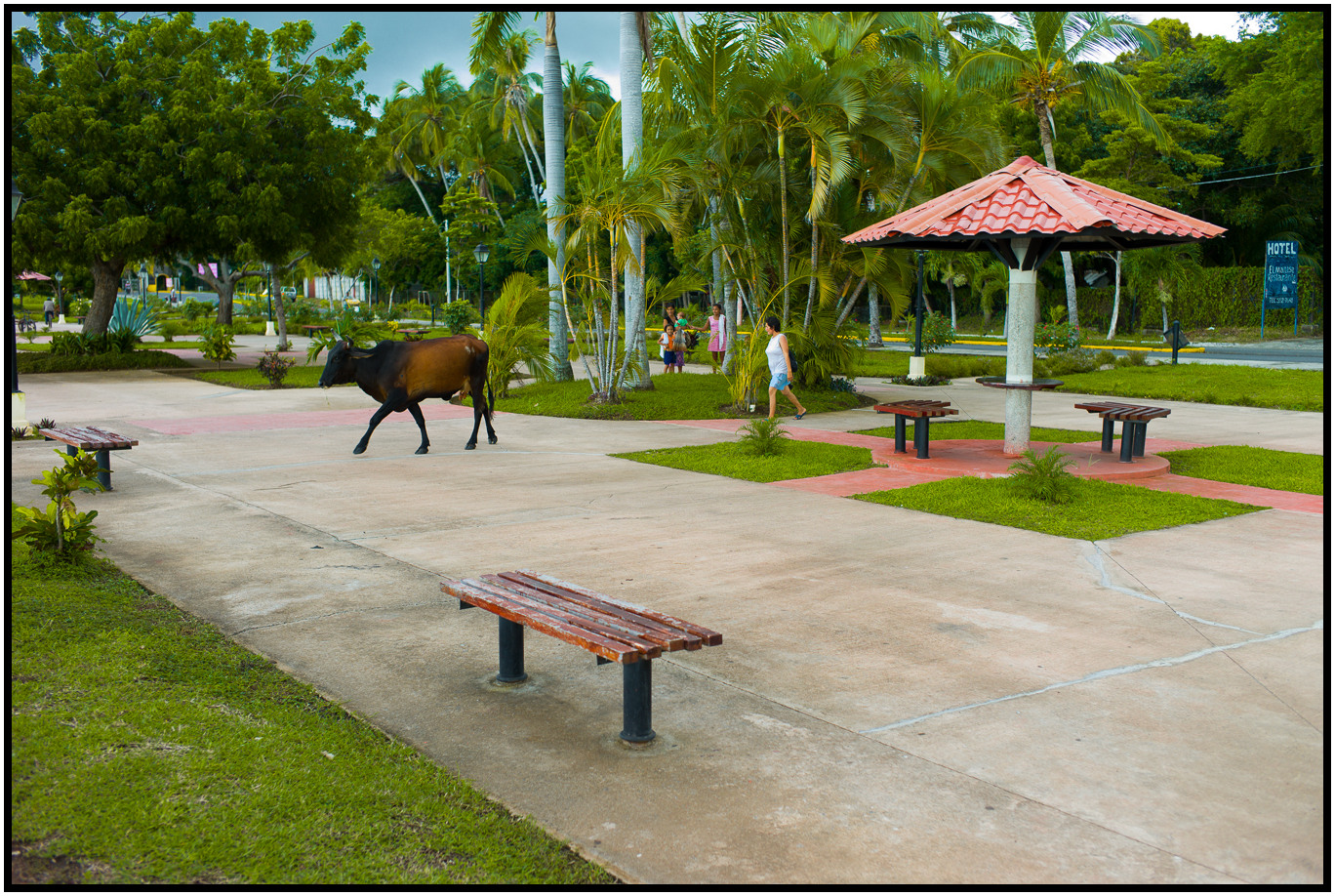
She jumped over this fence and joined the rest of the herd. All is well!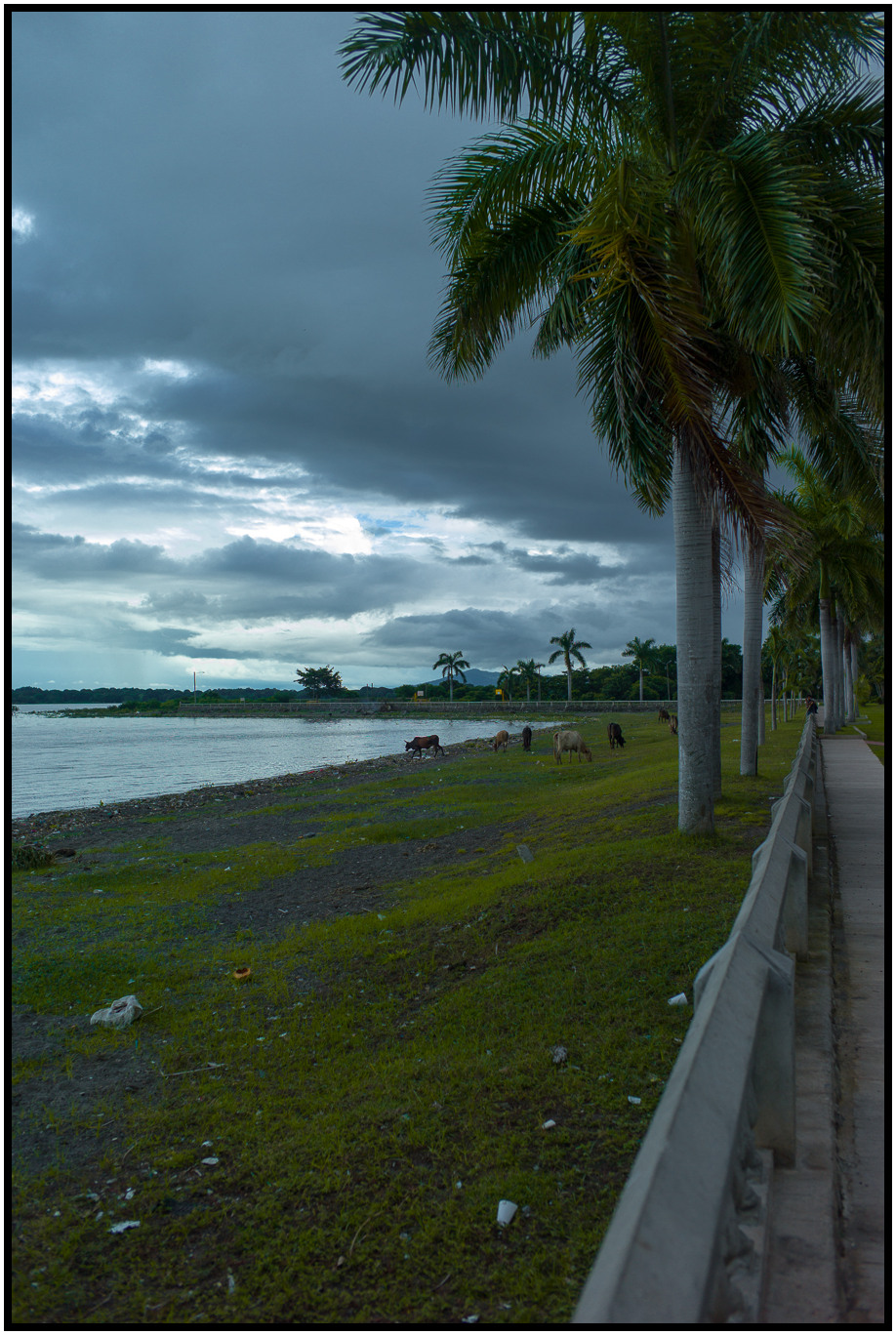
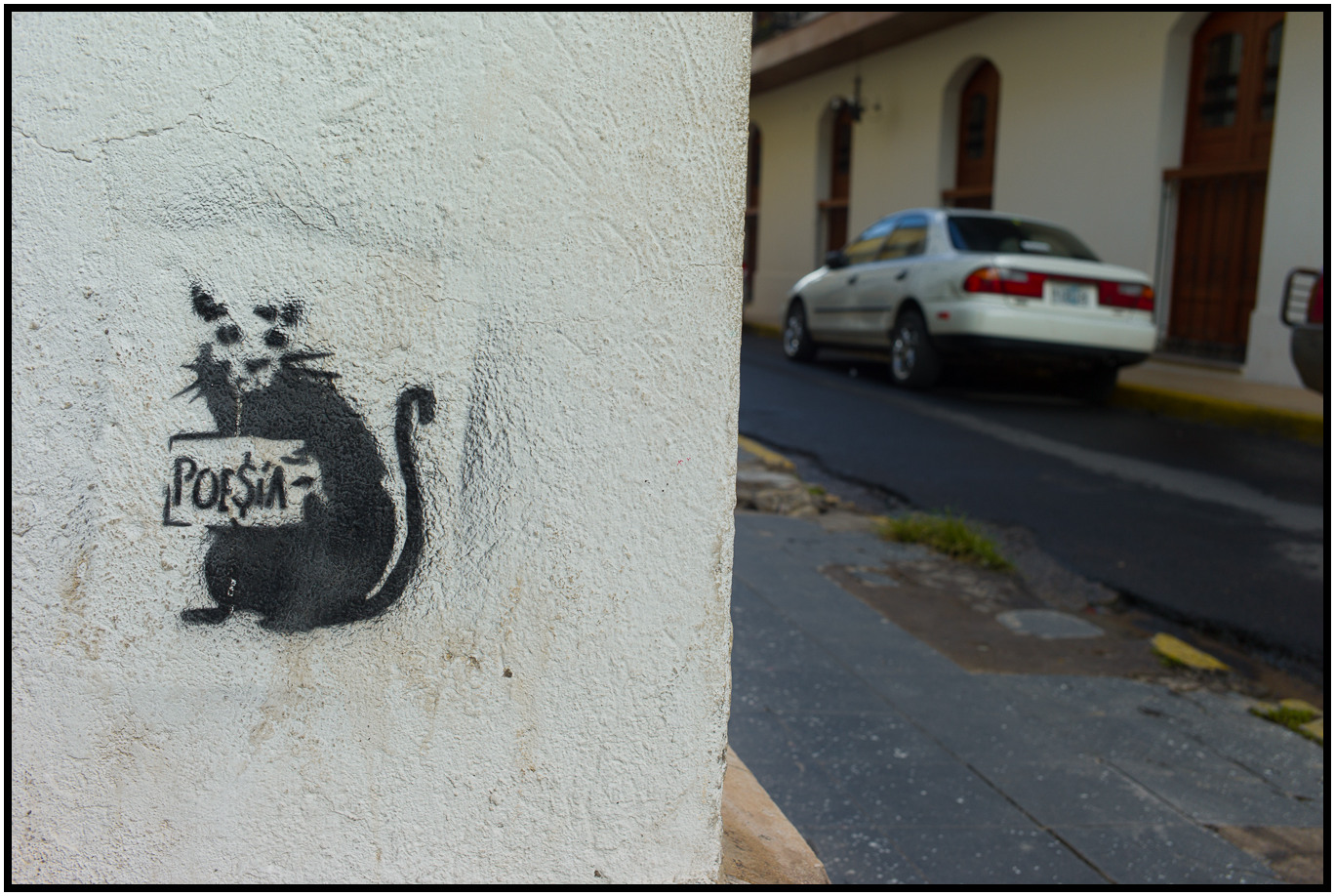
I spotted a small yellow bird in this tree. It looked like a canary or some type of finch, but I wasn’t able to get a really good look. 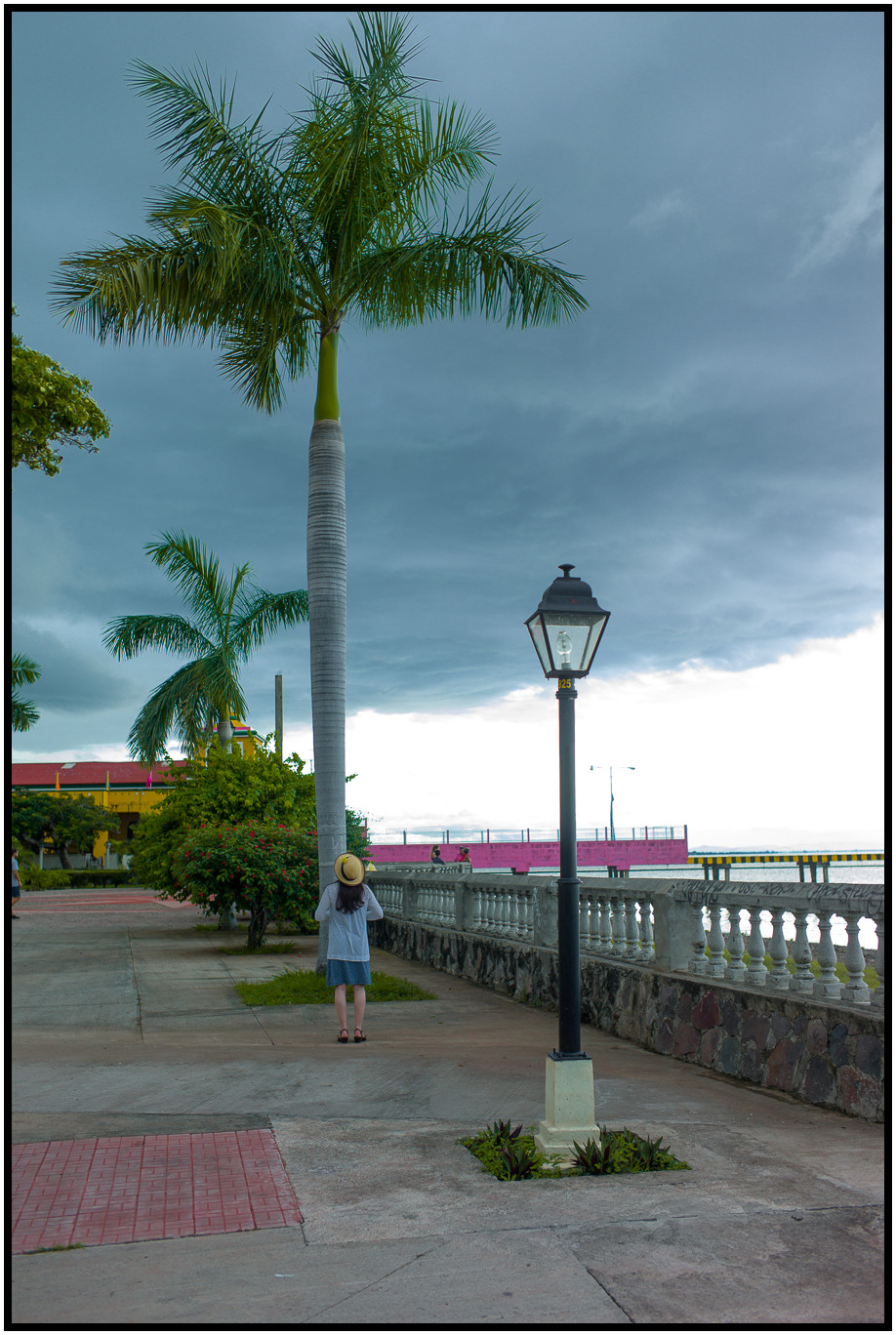 I asked Adam to take a picture of this graffiti (graffito?) I thought it was cool. Poesia means poetry in Spanish.
22 October, Wednesday
We didn’t have a plan for today, so at breakfast the four of us made an impromptu decision to take a boat out to the islands in Lake Nicaragua. It turned out to be the highlight of the trip.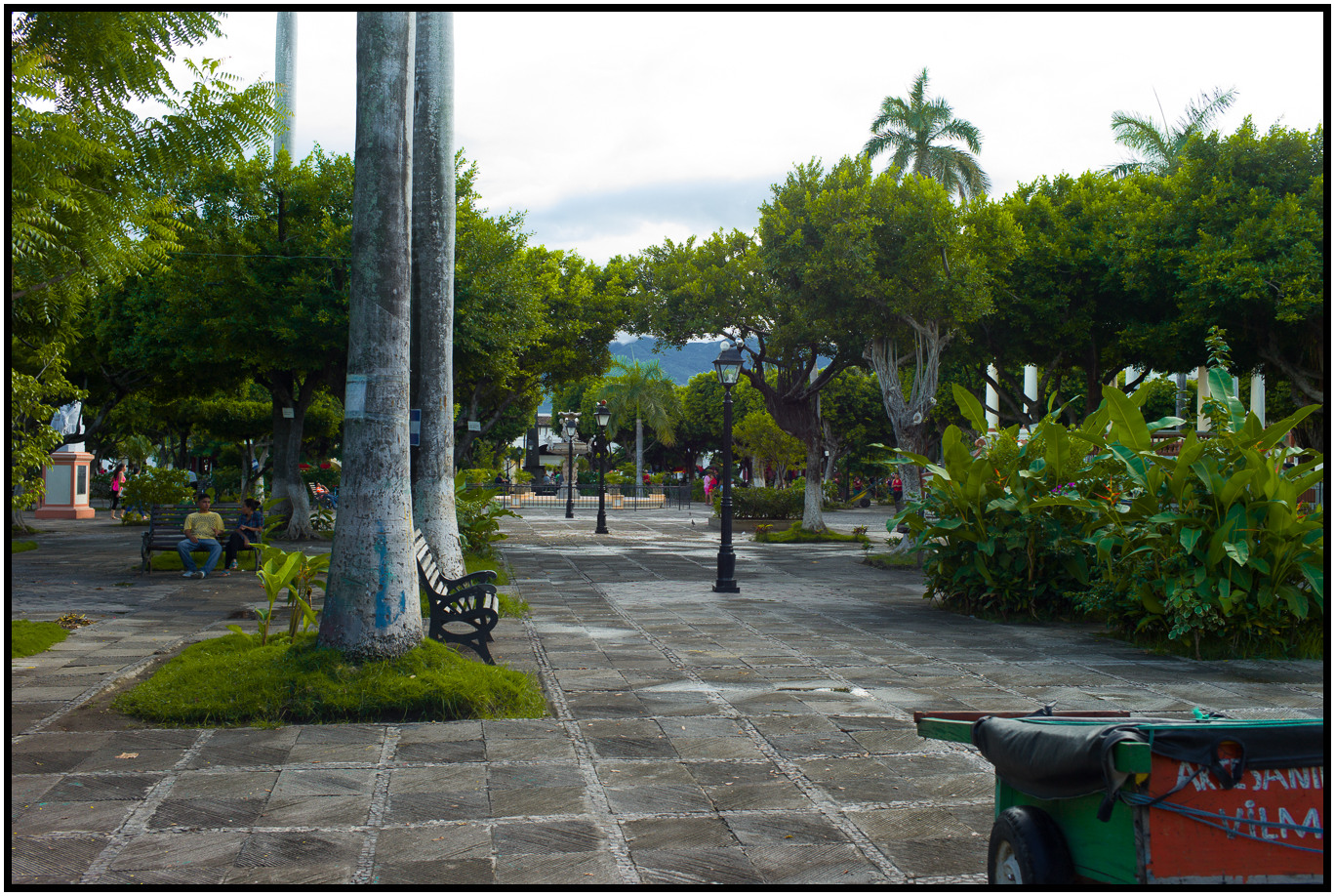
Heading onto the boat. Ours is the blue one.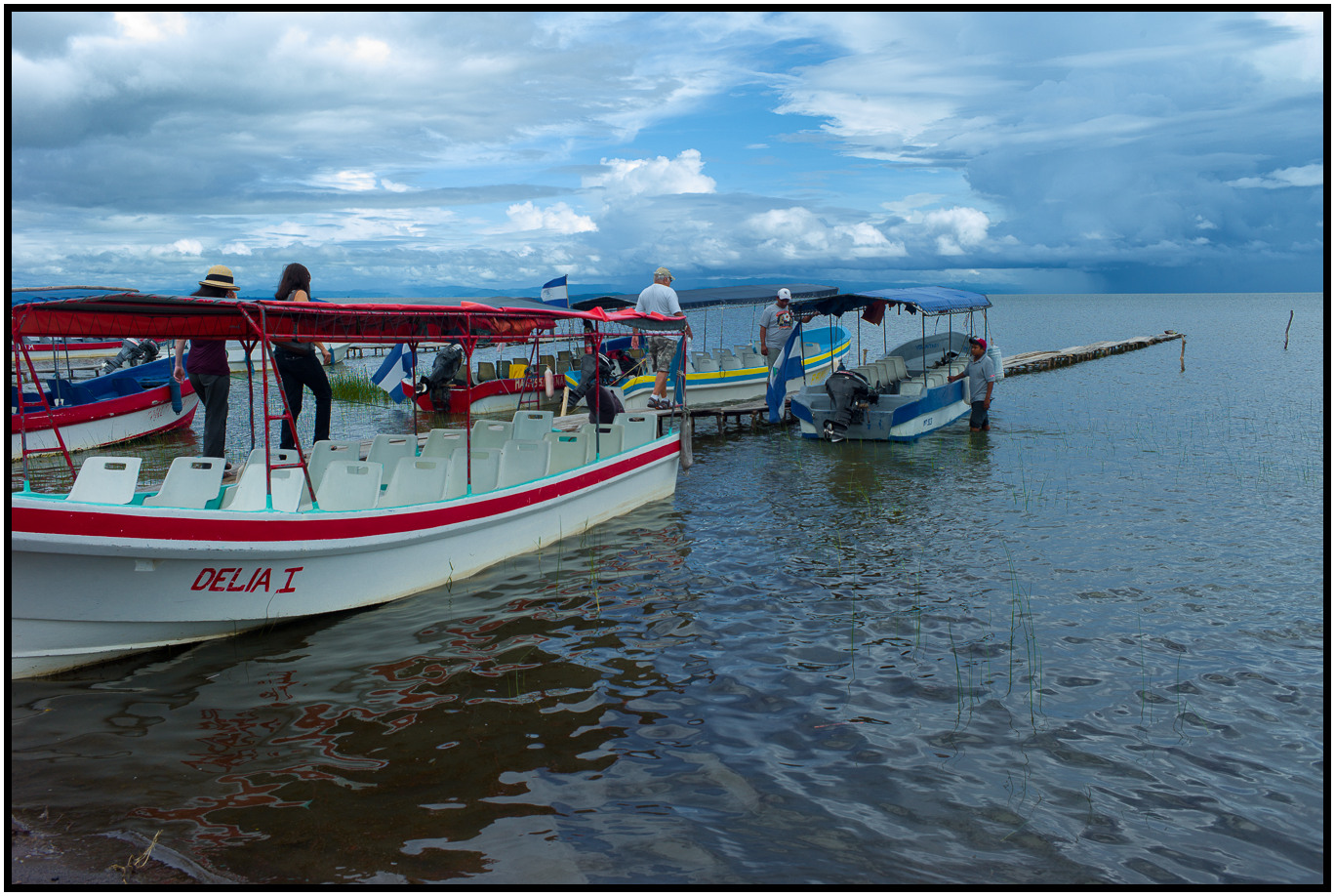
I was really grateful that Sal and Ana were on this trip with us. Adam speaks Spanish quite well, but he found the Nicaraguan accent really hard to understand. Sal and Ana (both from neighboring El Salvador) said even they have a hard time making it out — they compared it to an American English speaker trying to understand someone with a very heavy Scottish accent.
Anyway, they were able to understand the tour guide on our boat. Nearly half of these tiny islands were for sale, and he knew the prices of each one. He also knew the names of the owners of the other houses.
The area is absolutely gorgeous, but has a sad history. I didn’t catch all of it, but essentially these islands were originally owned by wealthy people from all over the world. They are all tiny little slices of jungly heaven, most less than an acre in size.
At some point, the Nicaraguan government nationalized (i.e., stole) the property and gave it to poor folks in a socialist “We’re For The People” move. (If you want to see socialism done epically wrong, come to Nicaragua. If you want to see socialism done right, go visit the Scandinavian countries. They are spectacular.)
The poor families couldn’t afford the taxes and upkeep, so tried to sell the islands back to the rich people from whom they had been taken …. but not very many of the rich folks wanted to invest in real estate in Nicaragua anymore. Even the wealthy Nicaraguans decided to park their money in other countries, and investments in Nicaragua plummeted. Nobody wanted to take the risk.
Nicaragua is now the poorest country in Central America, and it shows. I’ve been to El Salvador and Costa Rica (neighboring countries) and thought I knew what to expect from Nicaragua. I didn’t.
The poverty is staggering. In addition to poor government practices ruining the country as a place to make any financial investments, the poverty has made it a lousy place to visit as a tourist, too. It’s depressing and the locals are so aggressive with their selling/begging that it doesn’t feel safe to walk around.
Many of the beggars are little kids and they form mobs around you as you try to walk down the street. They don’t take no for an answer, and we were really worried about pickpocketing. I didn’t carry my purse with me, and Adam kept his wallet on an inside zippered pocket. One of the things I liked best about the boat tour was getting to see some of the countryside without being hounded by hordes of locals with their hands in my face.
Here is a typical little island with a nice house on it.
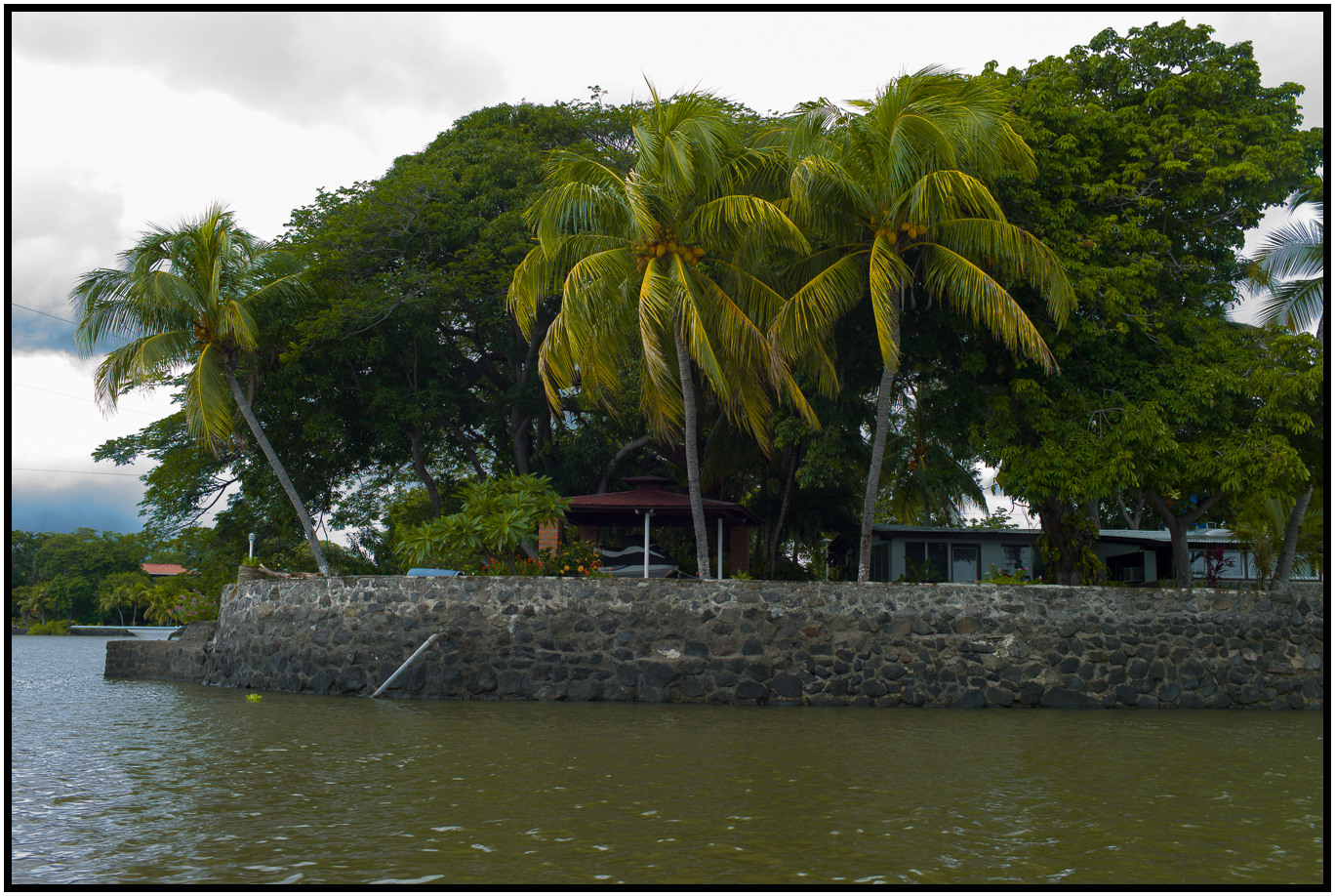
They are so tiny and peaceful out here.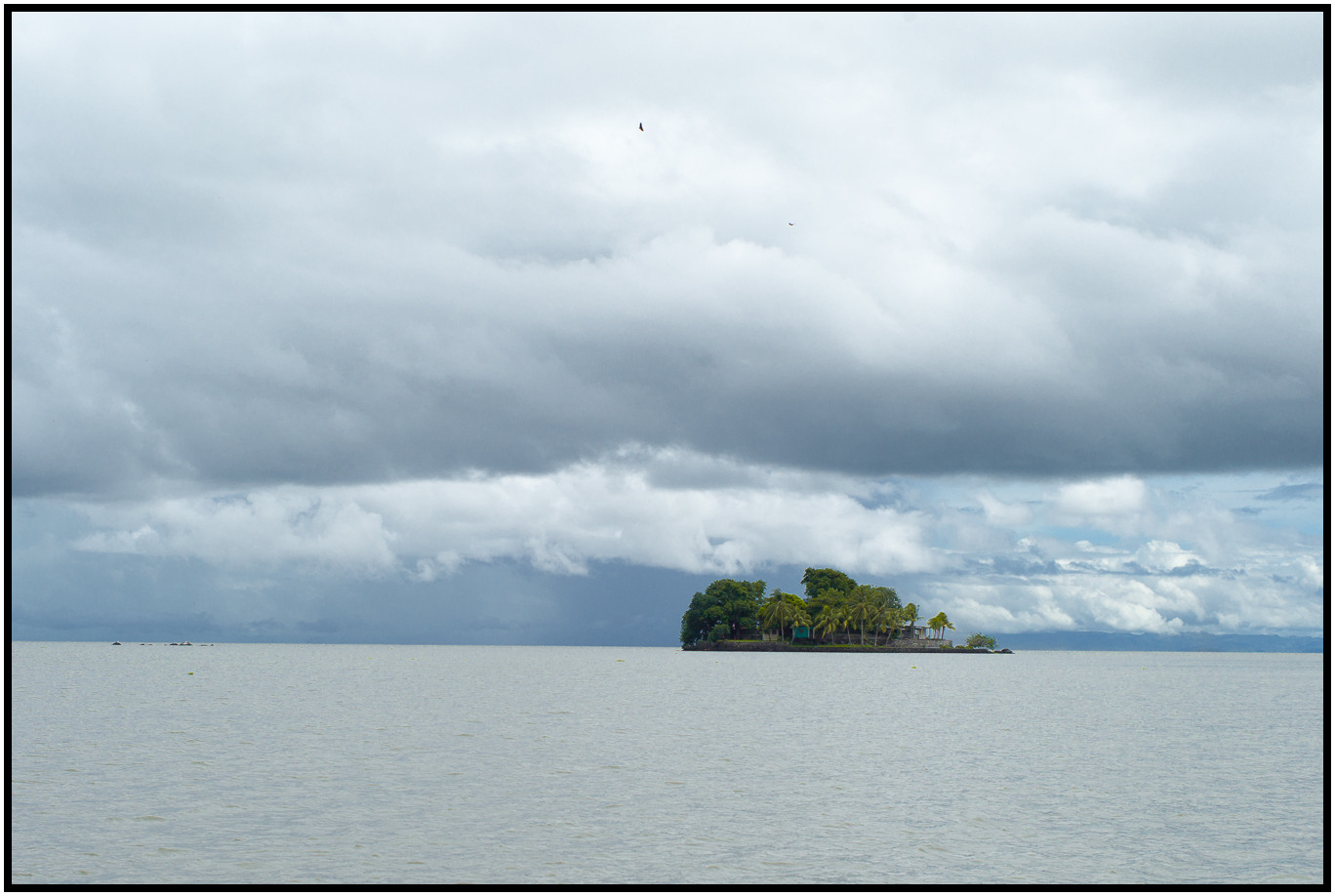
This was called Monkey Island. It is too small for a house, so a veterinarian who owns another island bought it and put monkeys on it. It’s now the most popular island on the boat tour.
A caretaker comes by each morning to feed the monkeys, but the rest of the day they rely on tourists for food. We didn’t know you could take food out to the monkeys because we made our plans so spontaneously (no advanced research like we usually do) but at least we got to watch another tourist boat feed them. People bring fruit and other vegetables all day long and the monkeys are really quite tame. 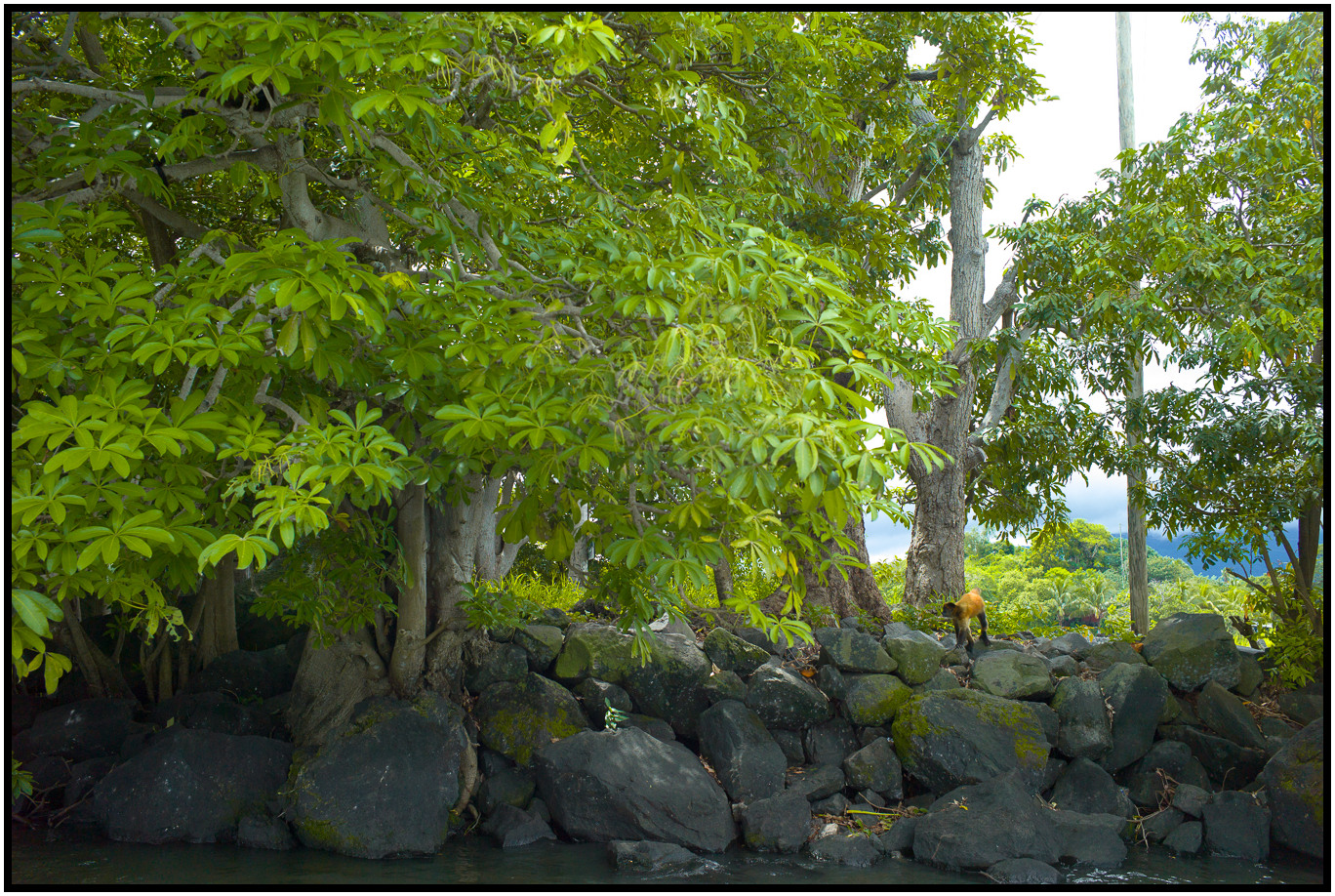
This one (in the tree) was named Michael Jackson because of his white face. Another monkey named Lucy had just had a baby … the cutest thing in the world. Sadly, we didn’t get any decent photos of Lucy or the baby Lola because Adam didn’t have a zoom lens. 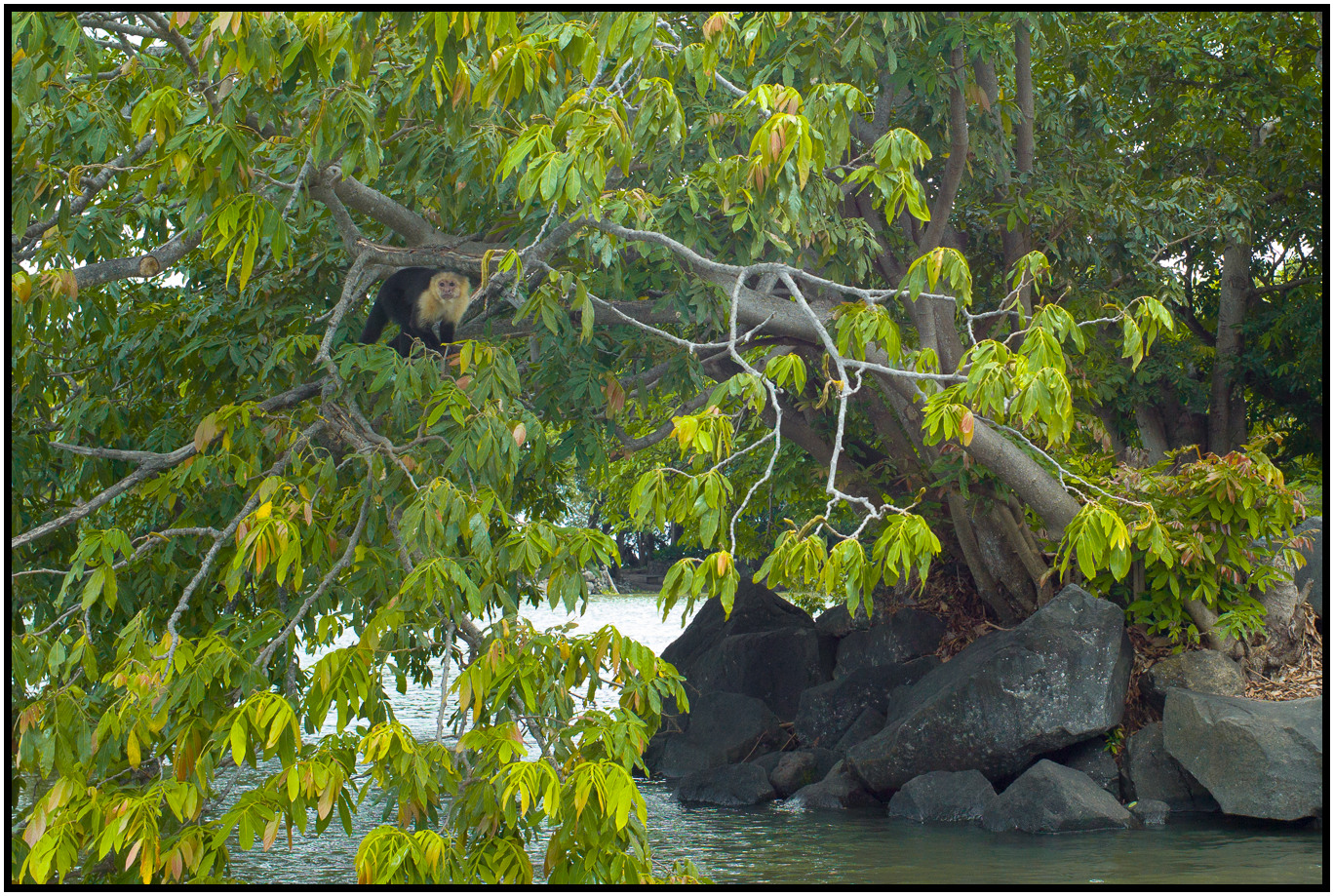
The smart people who knew in advance to bring monkey food. Lucky ducks!!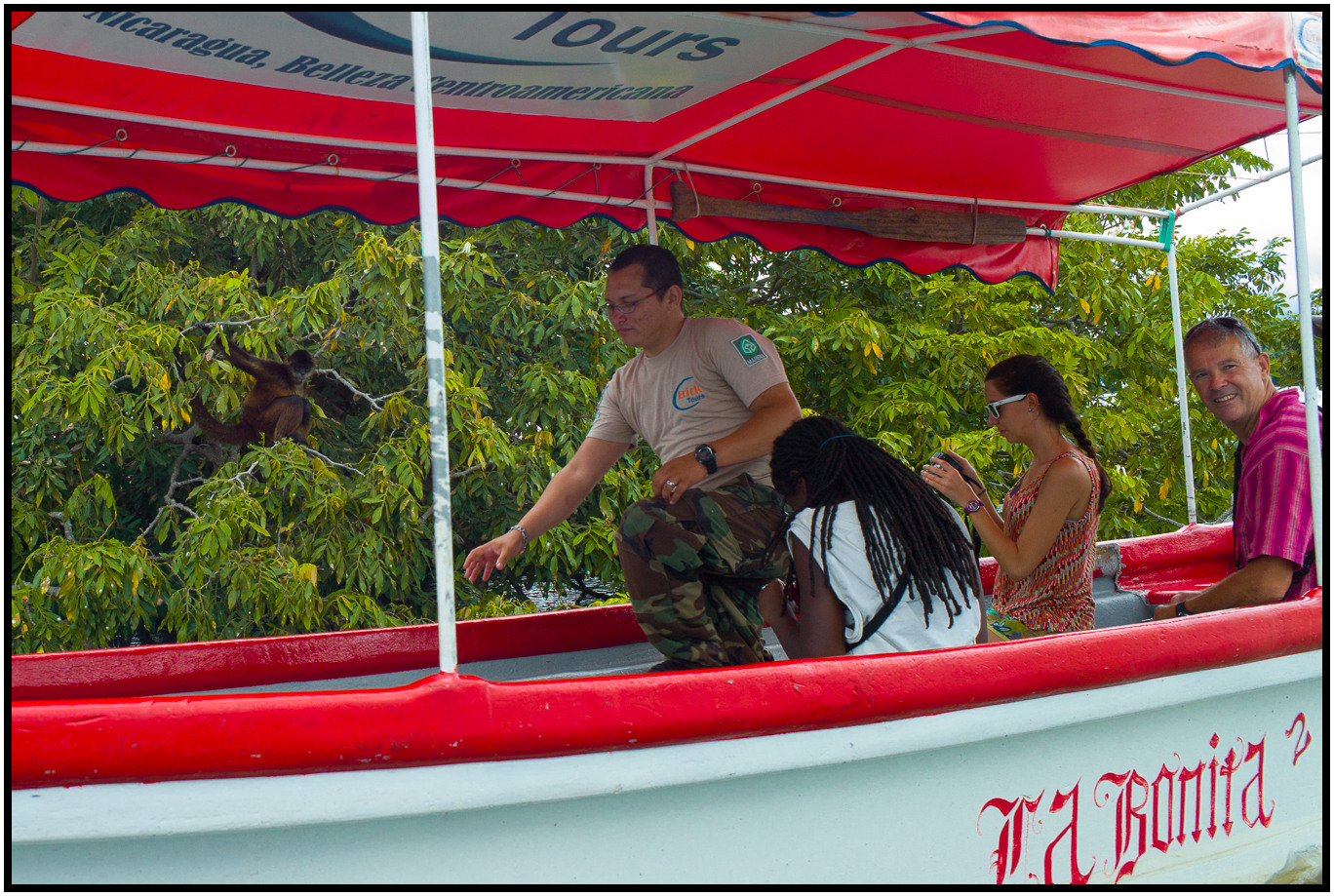
This is one of the hold-out poor families who managed to hang onto their “gifted” island. The boat guide said they live a completely sustenance lifestyle, eating only what they can grow on their island and fish they catch in the lake. He didn’t mention how they manage to pay the property taxes each year. I’m under the impression they don’t have running water or electricity, but I can’t remember why I think that … maybe the guide said something. Today they were bathing and doing laundry in the lake.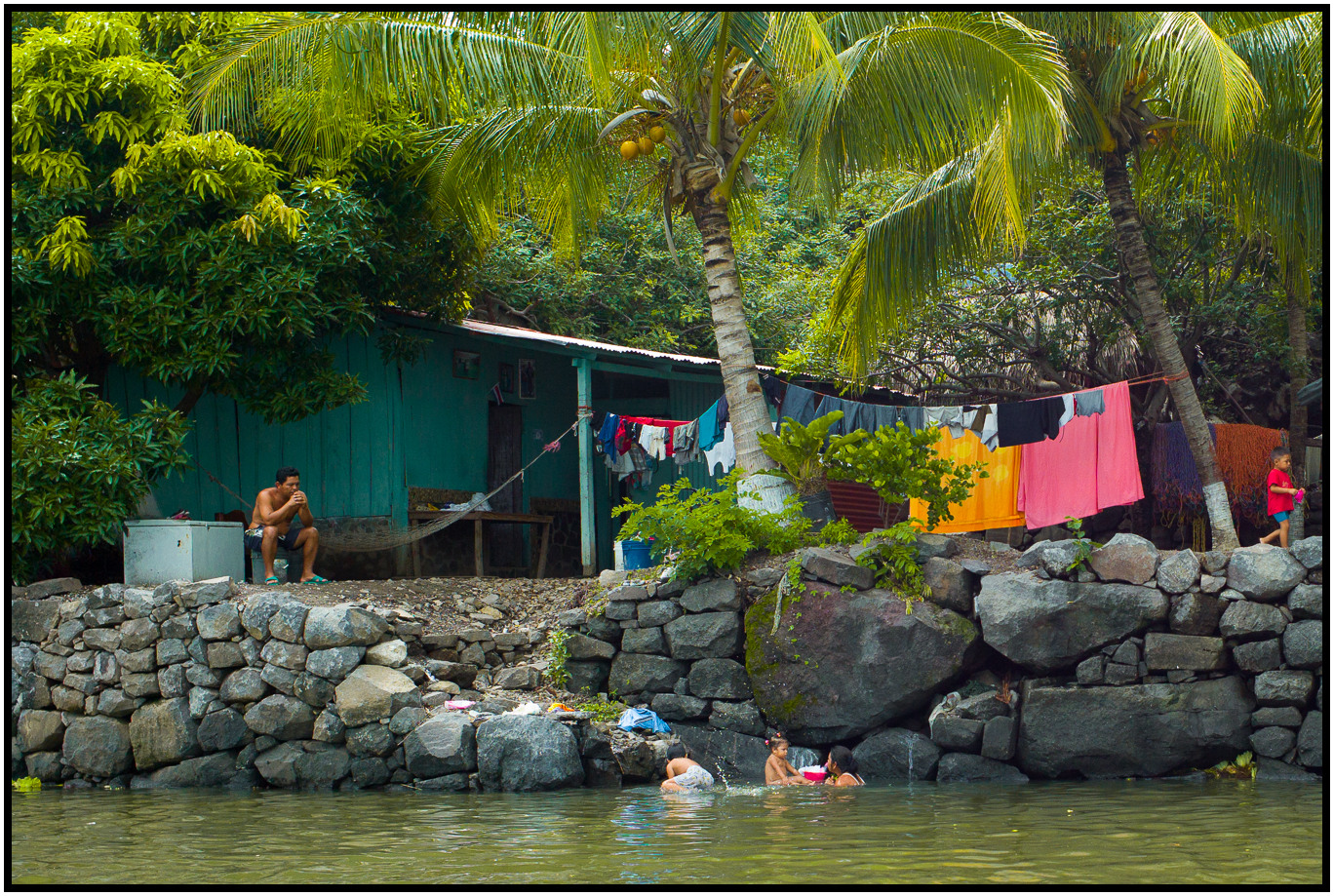
One of the big holiday houses owned by a wealthy family. Many of these are rented out to tourists at extraordinarily cheap prices. If you want to go hang out in the jungle with near-complete privacy and be off the grid for a couple of weeks, this would be the perfect place to go. It’s cheap, beautiful, and private.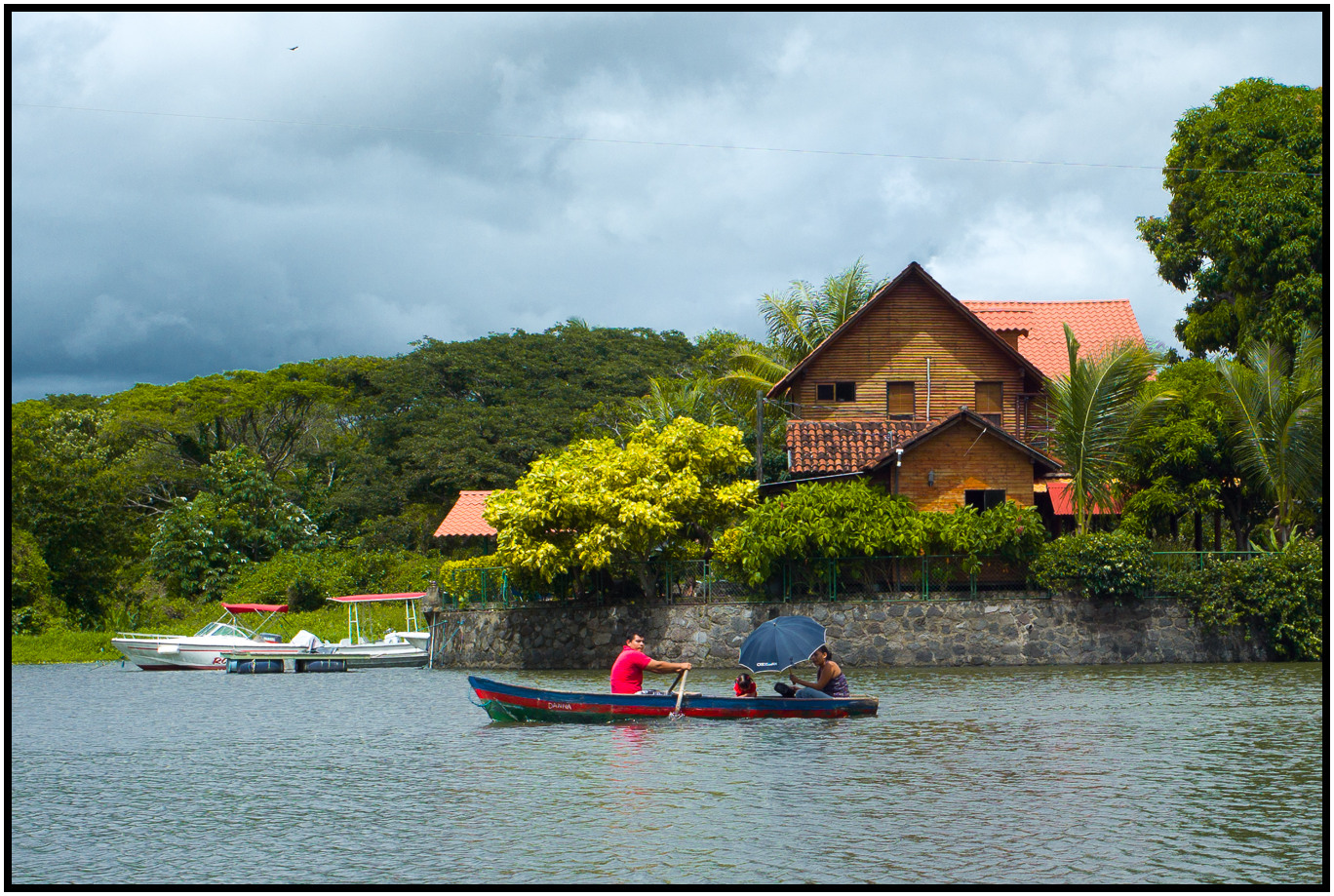
The sky was starting to get a bit dark. 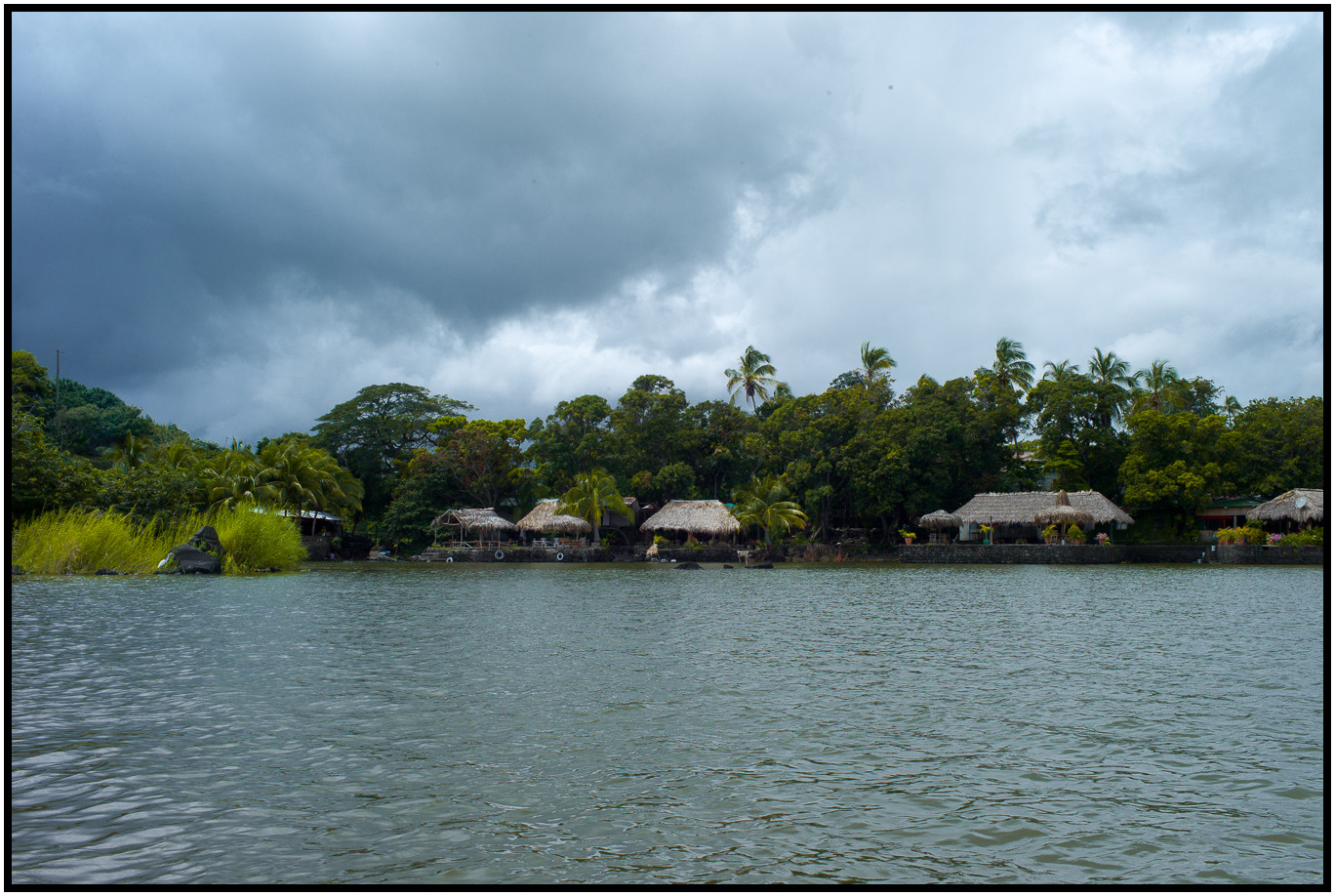
Sal and Ana, having a good time. That weird red flower Ana is holding came off a tree hanging out over the water. The boat guide picked one for each of us. 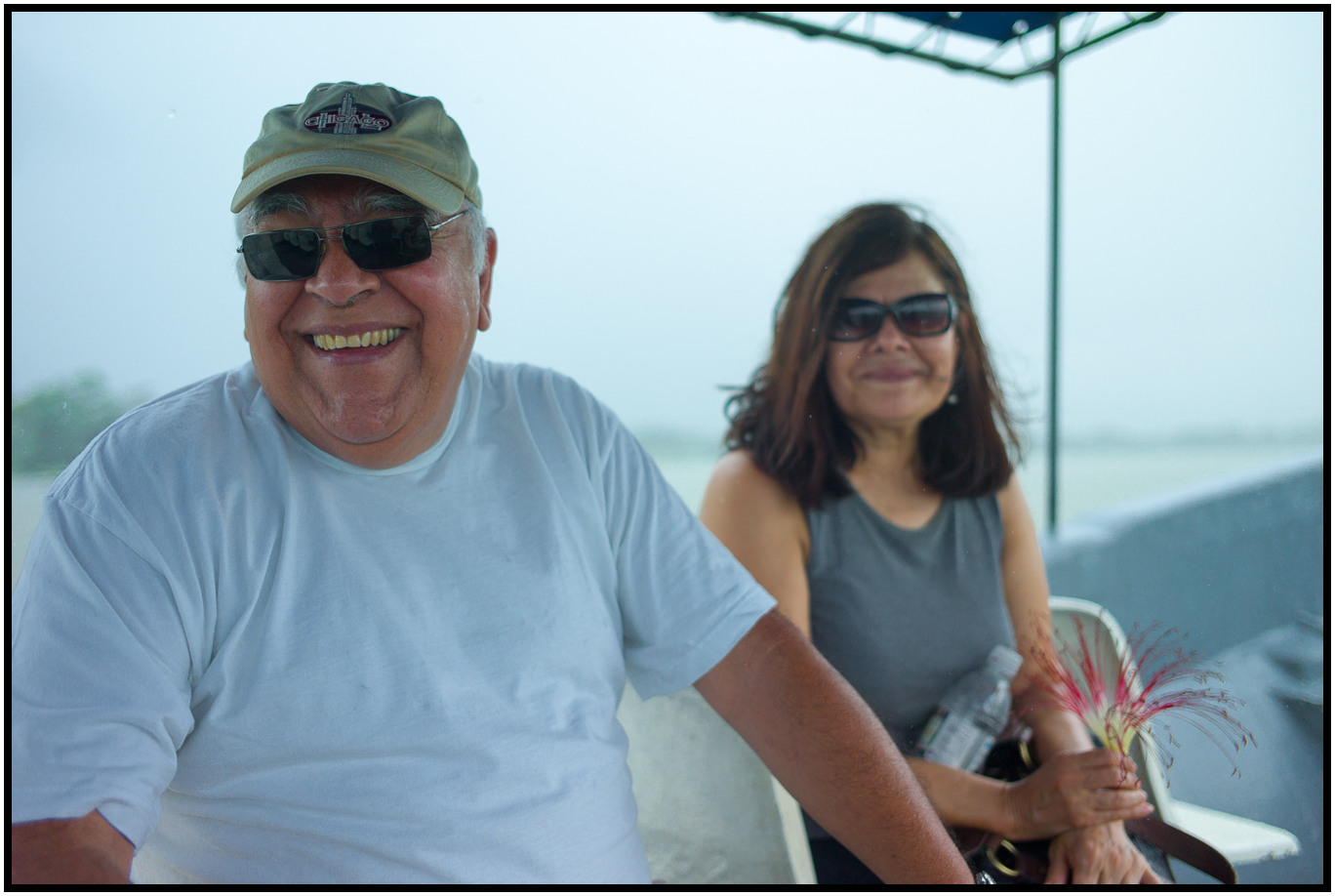
It started raining right before we got back to the dock. The horse carriage was still waiting for us, so we had to make a run for it. We got soaked.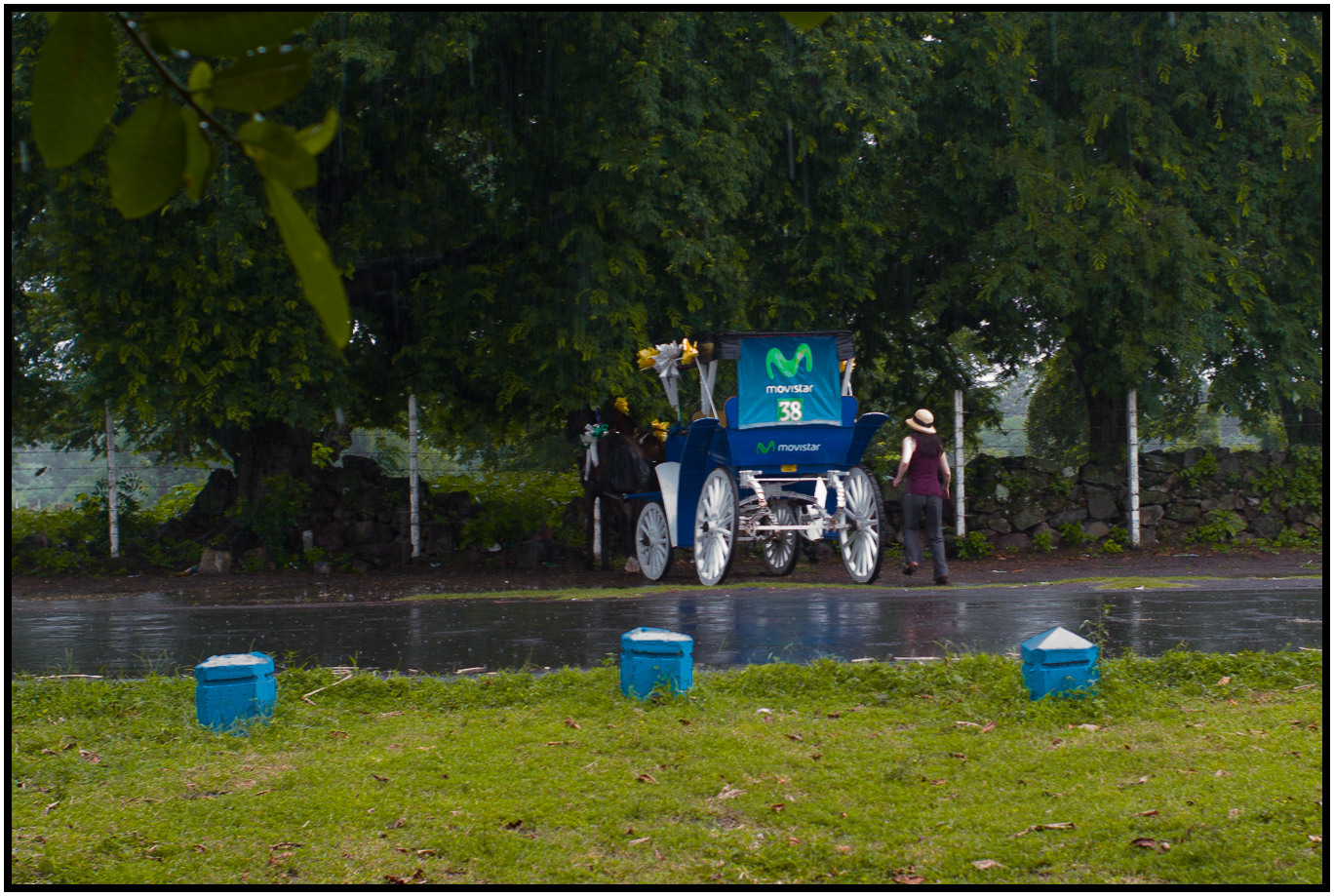
Getting out at a restaurant for lunch [below]. The horses seemed really happy with the rain. It finally cooled off a little.
We raced into the restaurant to get out of the downpour and were turned away at the door by a big, thugy-looking maître d’. Sal inquired and got the gist of what was going on. The entire restaurant had been rented out by a local drug lord (or other highly corrupt person) who wanted complete privacy to conduct their dastardly business. This information was all conveyed in a conversation (in Spanish) that included a lot of phrases like, “I can’t tell you who is in there (wink wink) but if you guess it then I won’t say no” and “Welllllll, they need their privacy (wink wink).” Sal caught the drift and we quickly hot-footed it out of there. 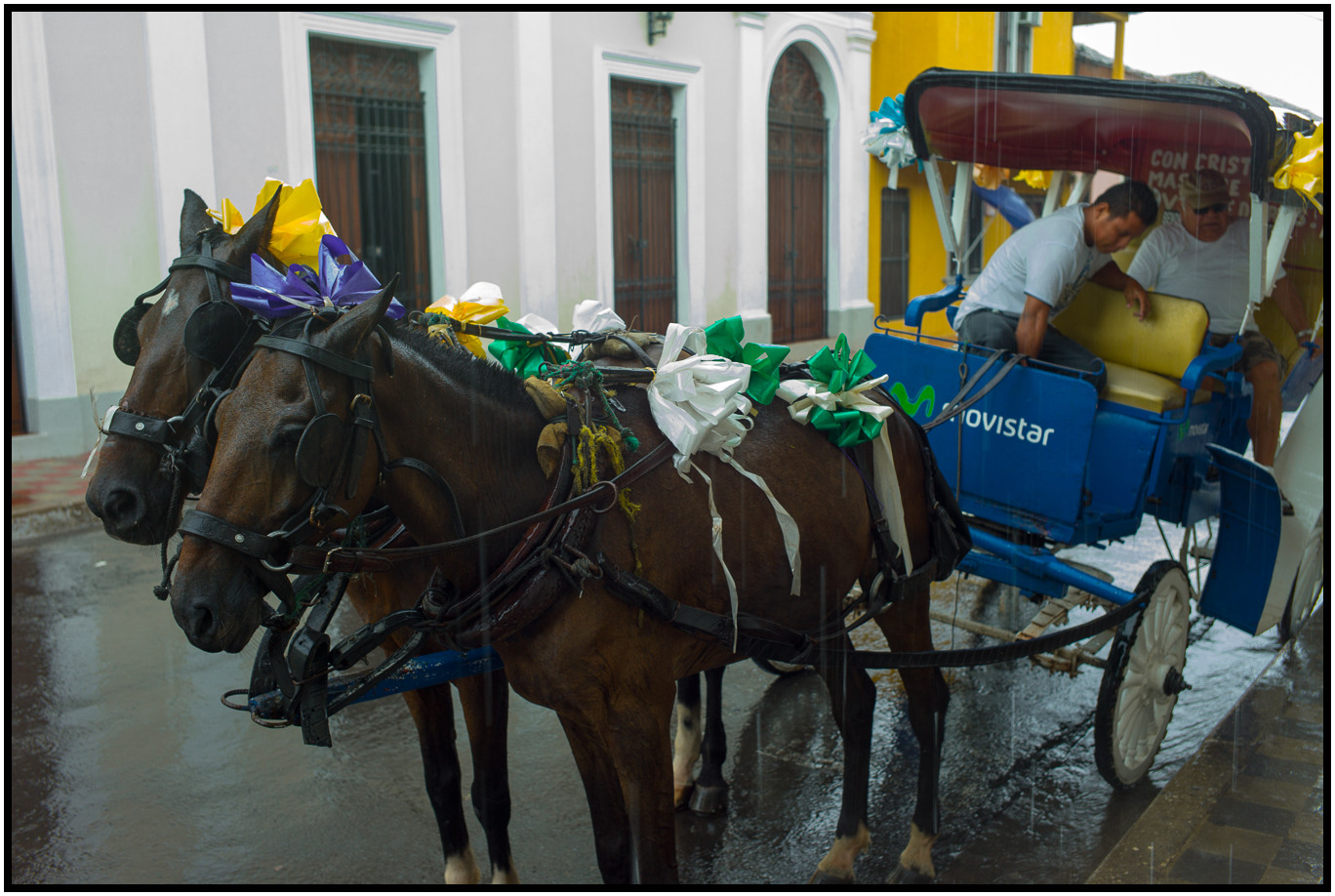
The inner courtyard of what I believe used to be a privately owned house. It’s now a series of shops and an ice cream parlor. 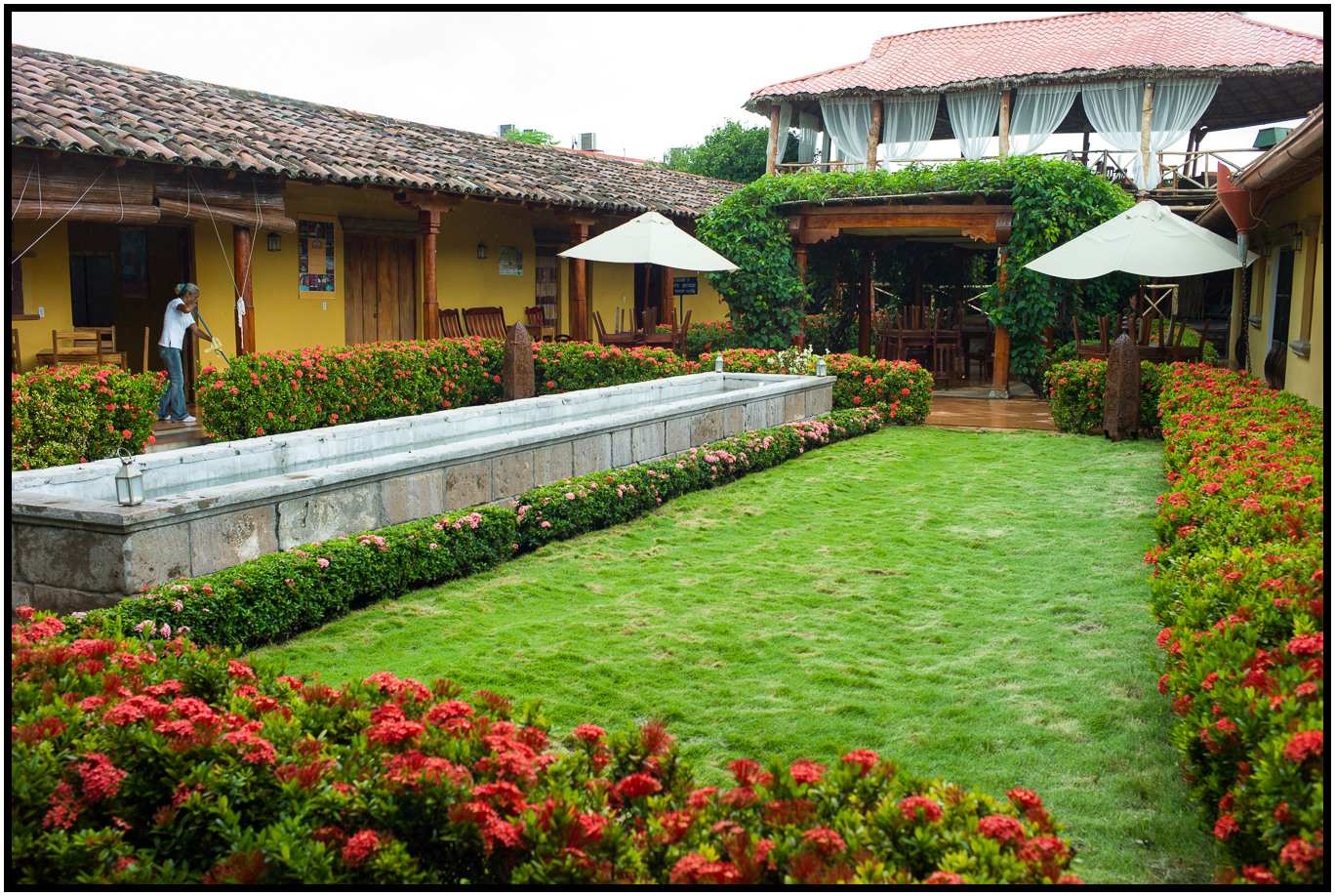
The main tourist drag in Granada.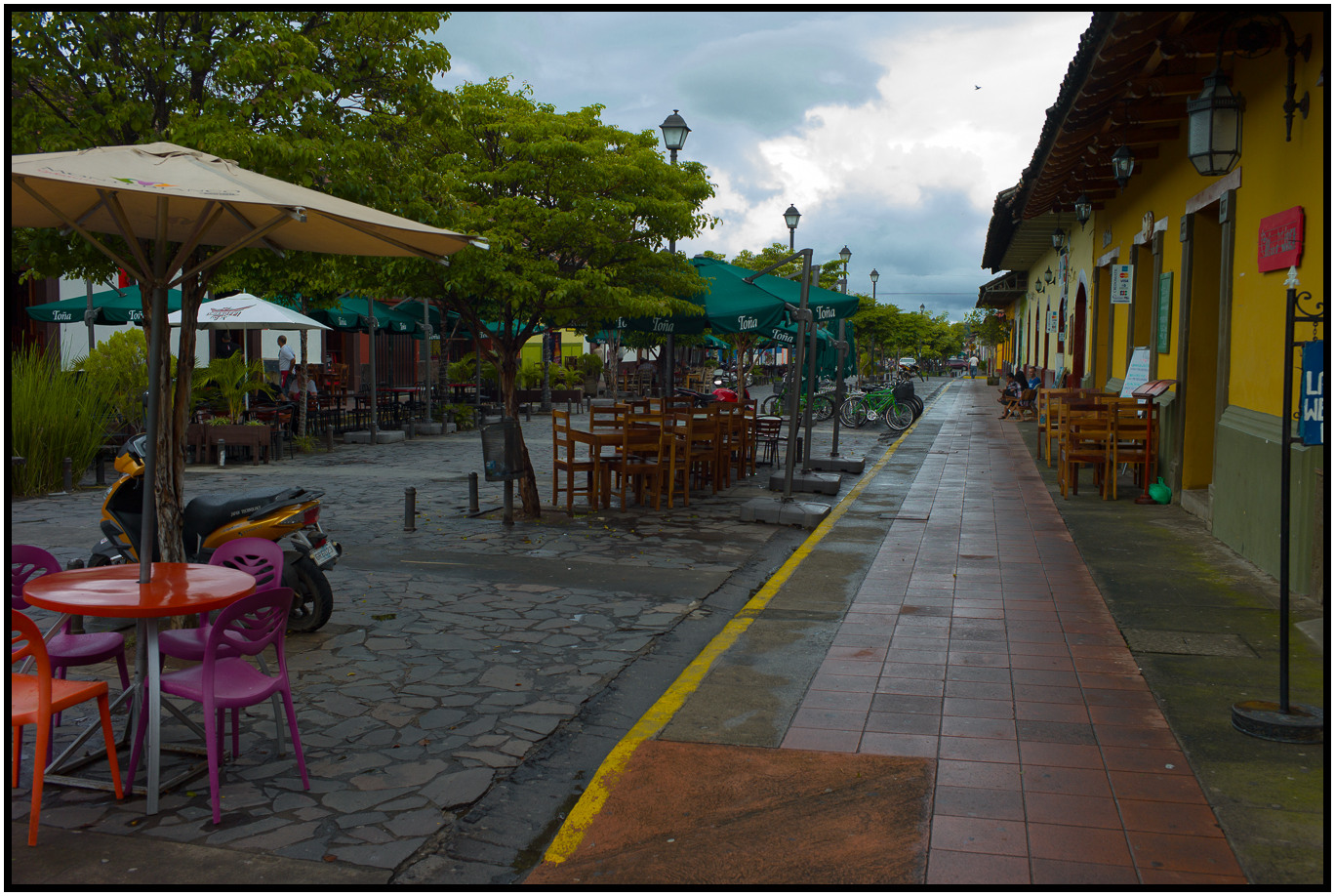
View from the front porch of our hotel. Ana and I are standing down in the left corner of the photo. 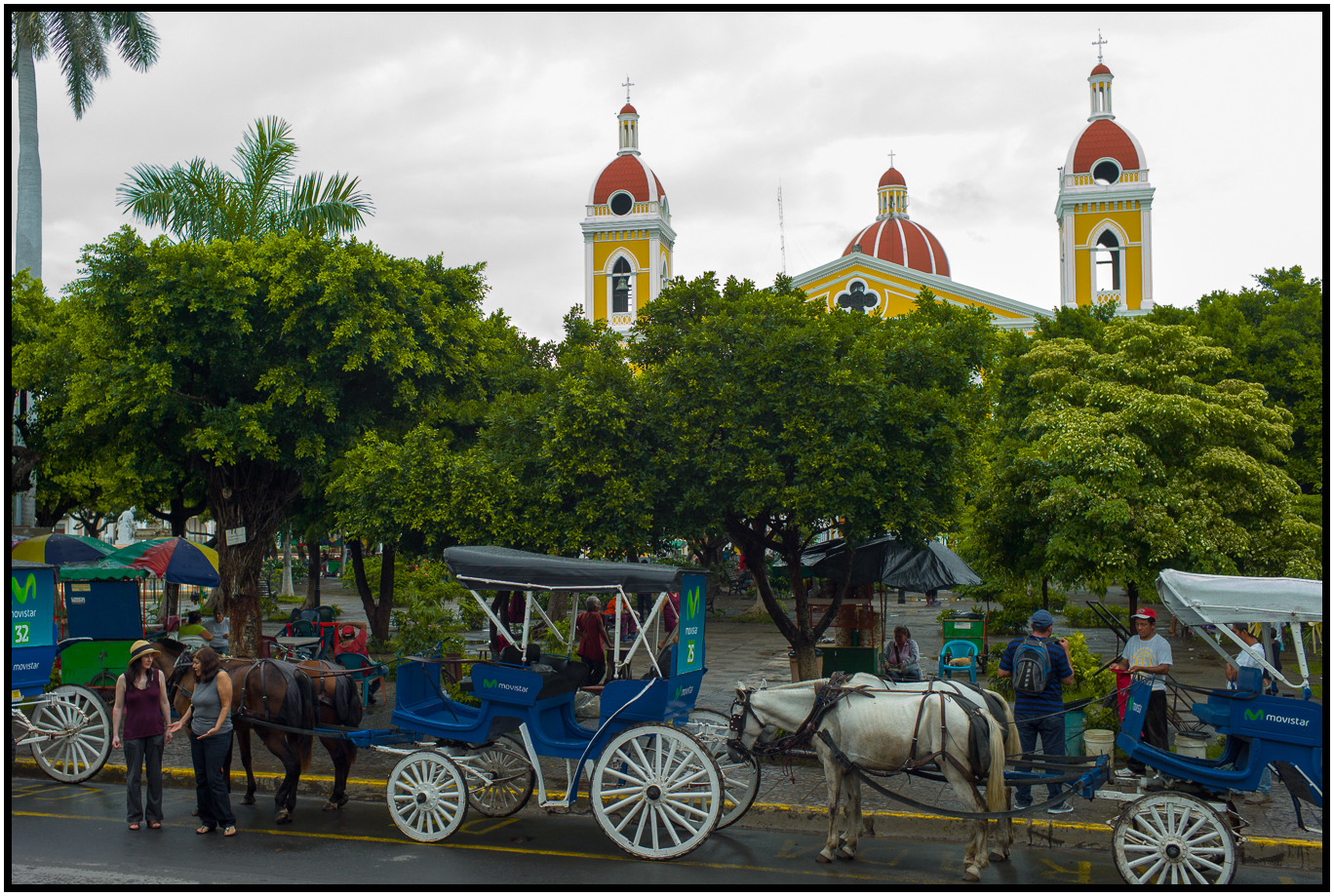
Front porch of our hotel. It was another fancy private house that had been converted into something else. 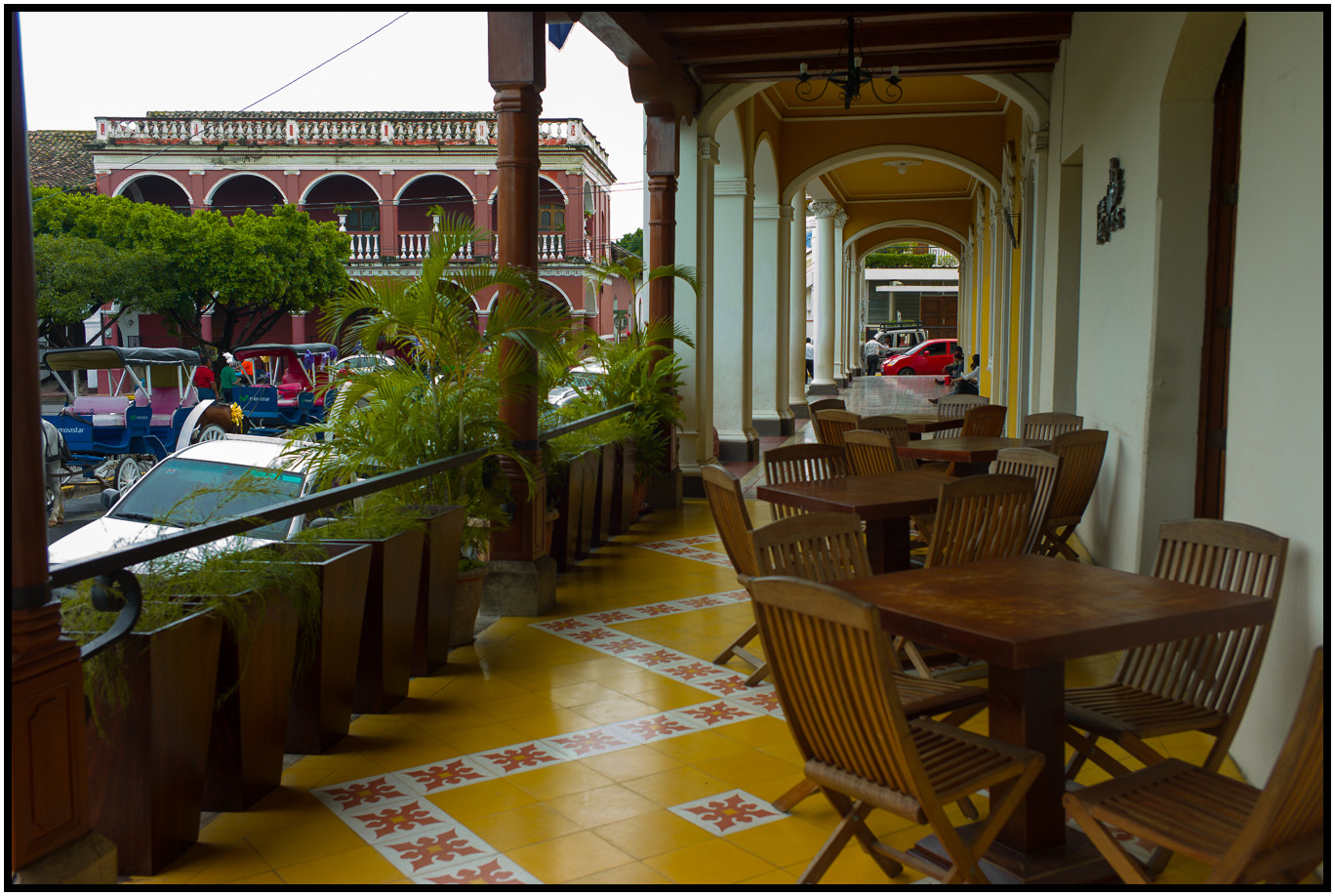
I’m glad we came to Nicaragua, but I hesitate to recommend it as a destination to anyone but the most seasoned of travelers. I would have been very uncomfortable to be there without someone who spoke Spanish really well and I was grateful that Sal and Ana were members of our party. Aside from being wonderful travel companions and all-around good company, they knew the culture and language in a way that Adam and I never will.
Until next time!
Brenda and Adam

