
7 January 2014 (Tuesday)
“Why, Sir, you find no man, at all intellectual, who is willing to leave London. No, Sir, when a man is tired of London, he is tired of life; for there is in London all that life can afford.”
— Samuel Johnson
Today we visited the house of Samuel Johnson. He was the first person to compile an English language dictionary. That is the very least interesting fact about him. The guy was a real character.
The house had been built in 1700, and Johnson lived in it during the 1750s. The first floor rooms of the house were painted an unappealing brownish color (as seen in the photo below with the clock). This was because the street-level floor of every house was so grimy from soot, dirt, pollution, smoke, etc. it was impossible to keep the walls clean. The brown paint helped hide the dirt.
Here is an excellent description of what London was like in the 1700s, for anyone with a strong stomach who enjoys reading about really disgusting things and tragic child mortality. I’ve excerpted a few passages:
London was filled with the smell of wet horses and the waste materials associated with them. Sanitation was unheard of. Water was unpurified, and raw sewage ran down city streets in open drains. It was common practice for people to empty their chamber pots out of their windows, and to leave garbage out in the street to rot. C.P. Moritz wrote in 1782, “Nothing in London makes a more detestable sight than the butchers’ stalls, especially in the neighborhood of the Tower. The guts and other refuse are all thrown on the street and set up an unbearable stink.”
An amazing variety of filth slopped down London’s cobblestone streets. Along with dirt, dust and animal manure, there was the ever-falling London rain to add to the mess. Cesspools of human waste collected in puddles everywhere. Dead animals (dogs, cats, rodents, even horses) were left to decay in the streets. In darker corners of the city, an occasional human corpse might even be found. To add to all this, horse-drawn carriages with heavy metal wheels often splashed through puddles, slopping the street’s putrid muck all over strolling pedestrians.
In 1771, Tobias Smollet wrote, “If I would drink water, I must quaff the mawkish contents of an open aqueduct, exposed to all manner of defilement, or swallow that which comes from the River Thames, impregnated with all the filth of London and Westminster. Human excrement is the least offensive part of the concrete, which is composed of all the drugs, minerals, and poisons used in mechanics and manufacture, enriched with the putrefying carcases of beasts and men, and mixed with the scourings of all the wash-tubs, kennels and common sewers within the bills of mortality.”
Sanitation in the 1700s was simply unheard of. Private bathrooms, later known as “water closets,” did not exist until late in the century, and even then, they only appeared in the wealthiest of homes. Most London residents used chamberpots, dumping them right outside their windows. The raw sewage would accumulate and stagnate in cesspools until the night soil men came along to clear it all out.
Coal was the main source of heat and energy in 18th-century England. In 1727, more than 700,000 pounds of coal were delivered to London alone. Residences and factories, tenements and shops, all regularly belched thick clouds of black soot into the city’s air. The cinder smoke, mingled with the rank odor of the city’s decaying garbage, open sewage, and decomposing corpses, and the stench emanating from the Thames created such a powerful stink that with a proper wind, London could be smelled from several miles away.
Anyway, you get the idea. London was really gross. And it was against this fetid backdrop that Samuel Johnson was legendary for being an unusually unhygienic and stinky man. Just think how bad he had to have been in order to stand out under these circumstances. He would go for weeks without changing his clothes (meaning not only didn’t he change into a clean outfit, he didn’t take them off for sleeping or bathing. He didn’t take them off, period.) The museum had several painted portraits of him and asked visitors to note that Johnson was wearing the same outfit in every painting, despite the fact they were created years apart. He must have smelled like a corpse.
Samuel Johnson also had a number of psychological problems. Likely today he would be diagnosed with either Tourette’s Syndrome or some form of obsessive-compulsive disorder, in addition to clinical depression. He lived in fear of going mad. After his wife died, he was so terrified of being alone that he filled his house with all manner of hangers-on and other social misfits. These people frequently didn’t get along with each other and loud quarreling could routinely be heard coming from his house.
Poor Samuel also suffered ill health. As a baby he had scrofula (lymph node infection, often caused by tuberculosis bacteria) and the treatment at the time was to make long cuts on his face and neck to drain out the infection. This left him with terrible disfiguring scars all over his face and neck. He had bad eyesight, asthma, insomnia, numerous “nervous tics,” and — later on — gout, a stroke, a testicular tumor, and “dropsy” (edema due to congestive heart failure) which he tried to treat himself by cutting his flesh to encourage drainage.
And he was poor. He lived in constant fear of being hauled off to debtors prison, and at one point owed so much money to the milk man that he barricaded his front door with his mattress to avoid being arrested.
In spite of his ill health, psychological problems, crippling poverty, and overwhelming stinkiness, he was wildly popular. He knew everybody and everybody knew him. He was beloved for his wit, brilliance, and humorous conversation; which is probably the primary reason he never ended up in jail. It pays to have everyone you meet think you’re an awesome human being.
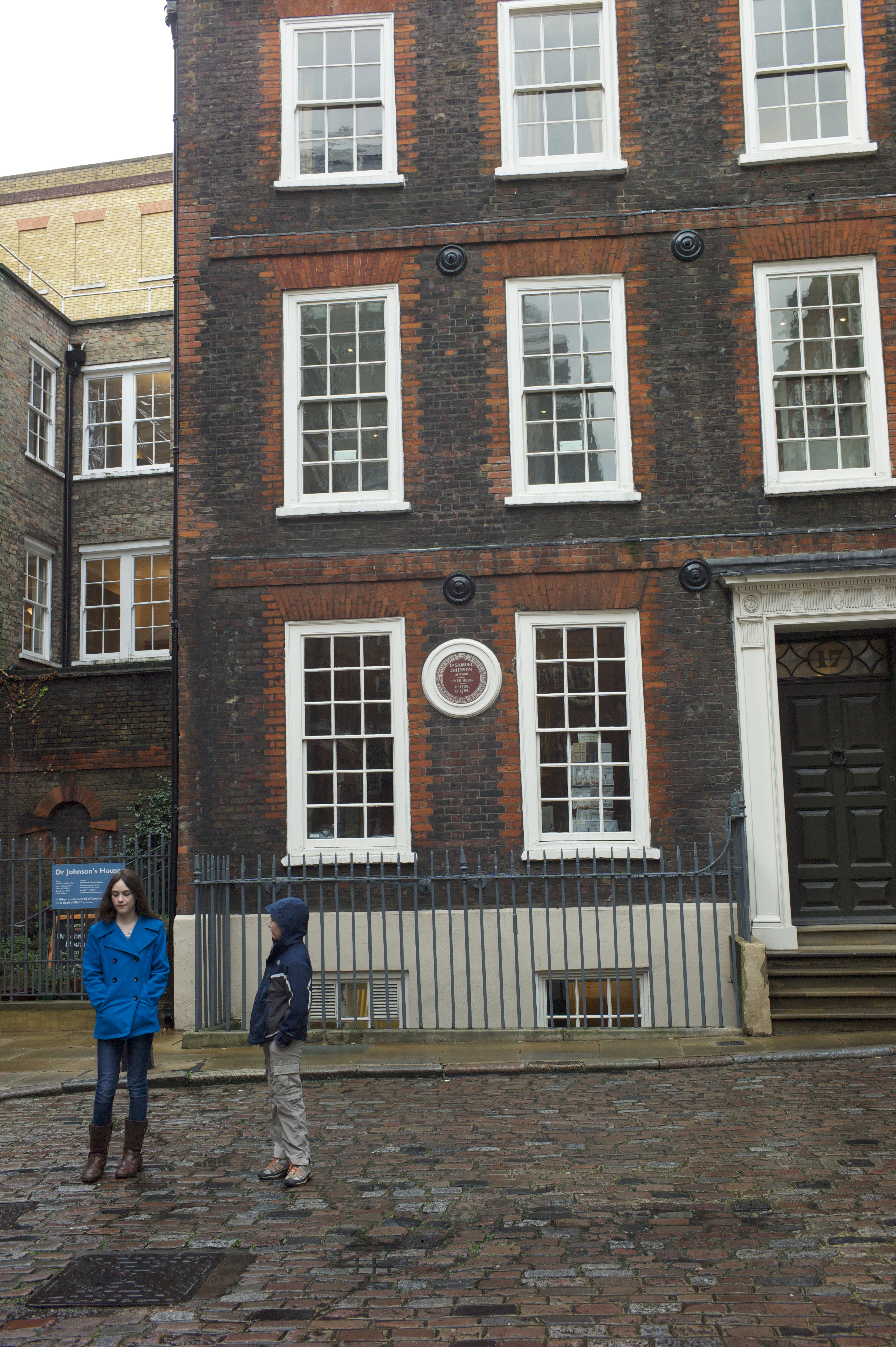
Front of house. The kitchens were in the basement level during Johnson’s time, along with the coal bins and cesspit where bedpans were emptied through a hole in the floor. The basement level has since been converted into storage and public restrooms.
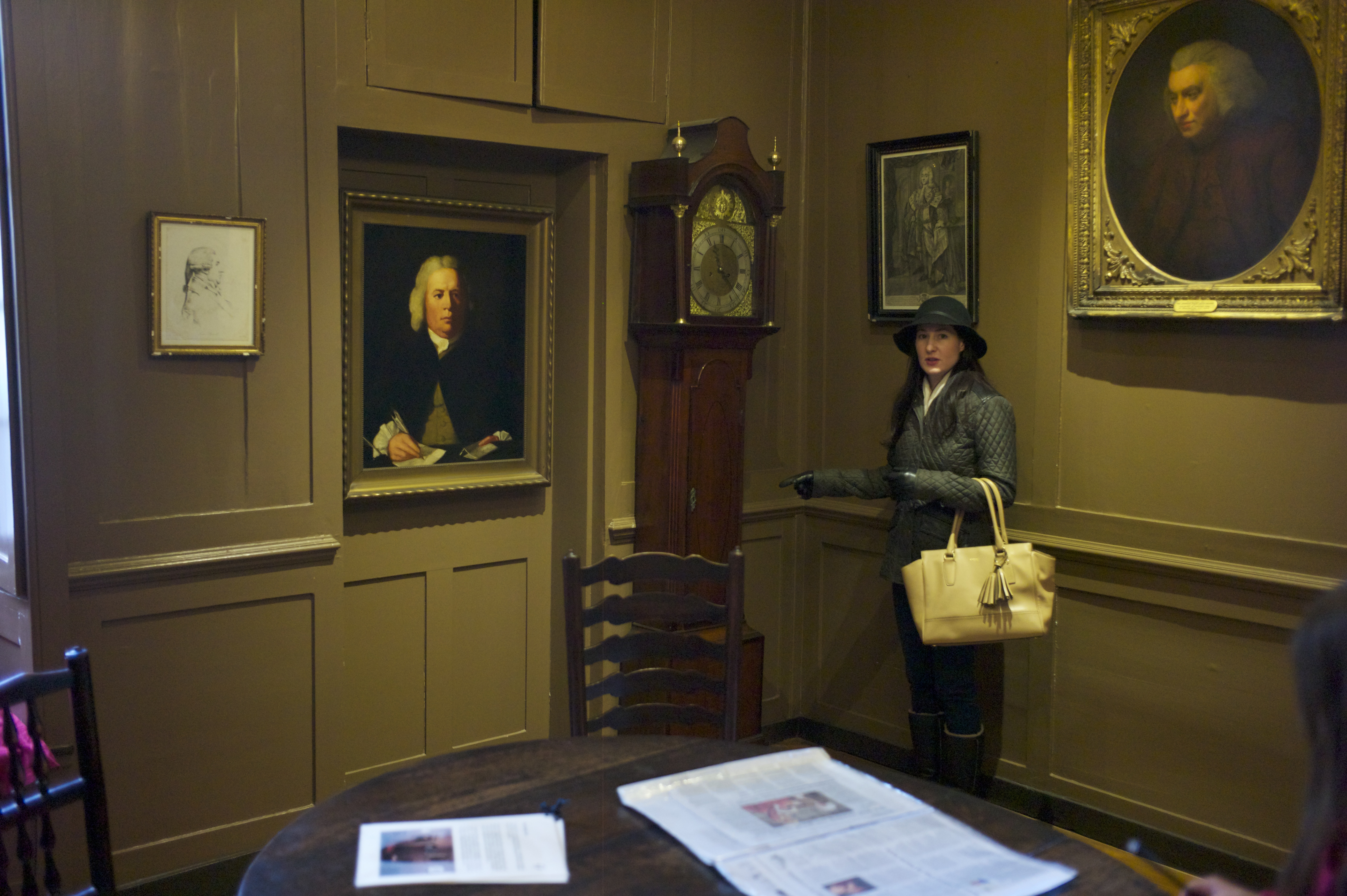
The brown paint was the perfect shade for hiding grime in the street-level sitting rooms. I am pointing at the clock because Adam’s dad loves clocks and I was wishing he was there to see it.
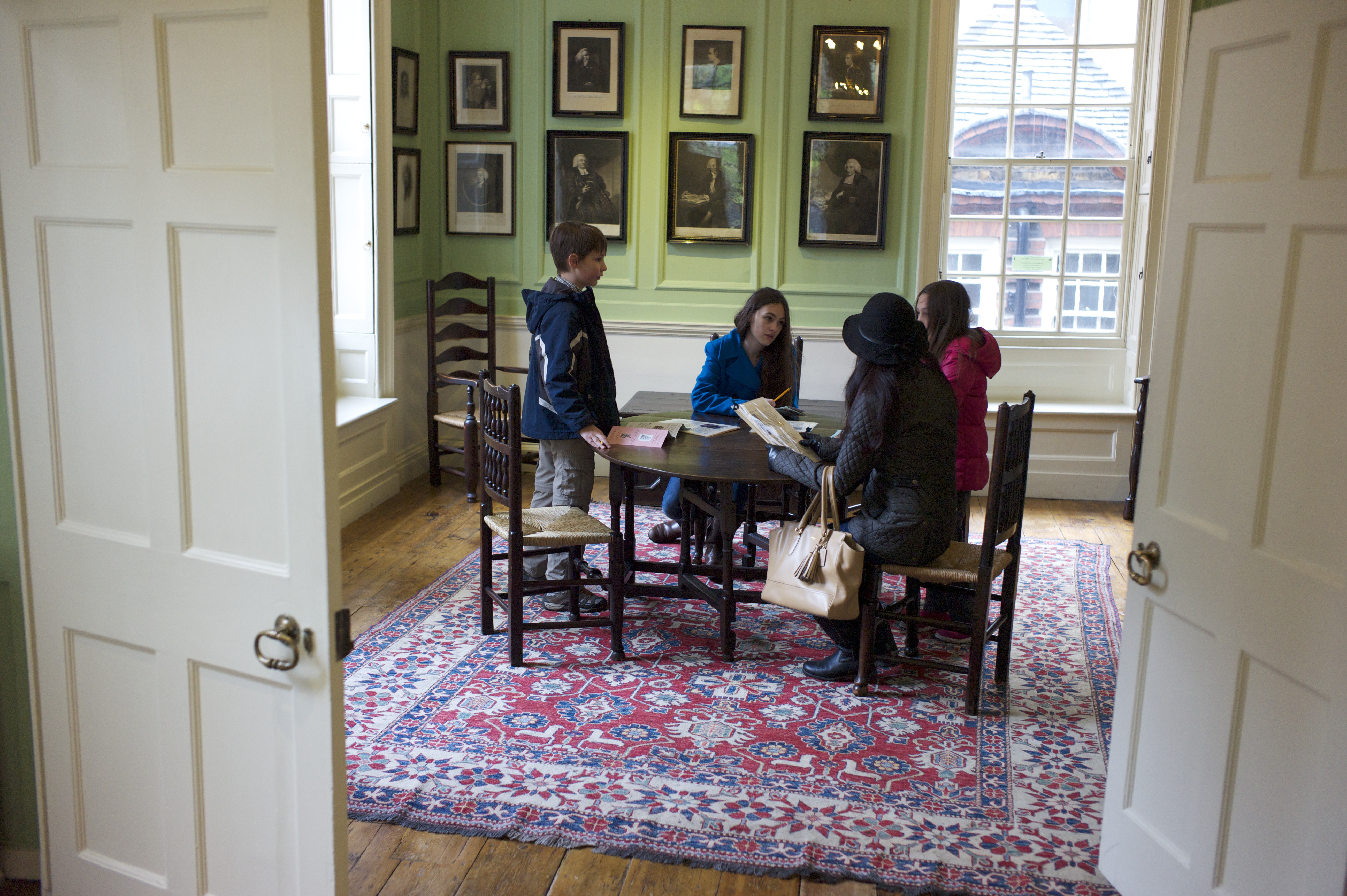
One of the second floor rooms. You can see they have a prettier color of paint. The kids are doing a treasure hunt; they were given a list by the lady at the front desk and if they found all the items around the house, they’d get a prize.
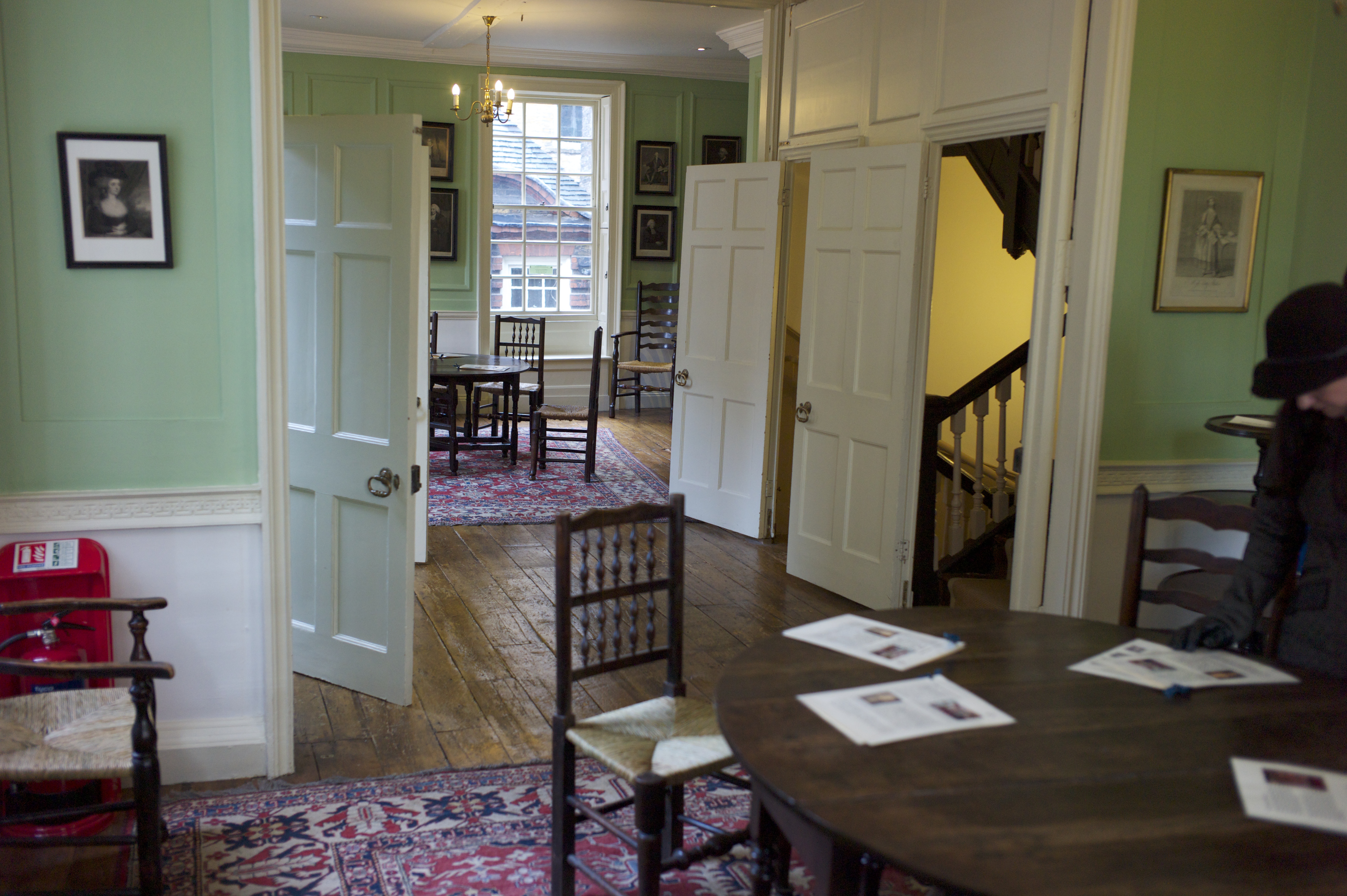
The wood panels on this floor were a genius design. The panels could be pulled out from the walls on either side to create different room configurations: one big open space, two larger rooms with a connecting passage, or three private rooms. It made the space very versatile.
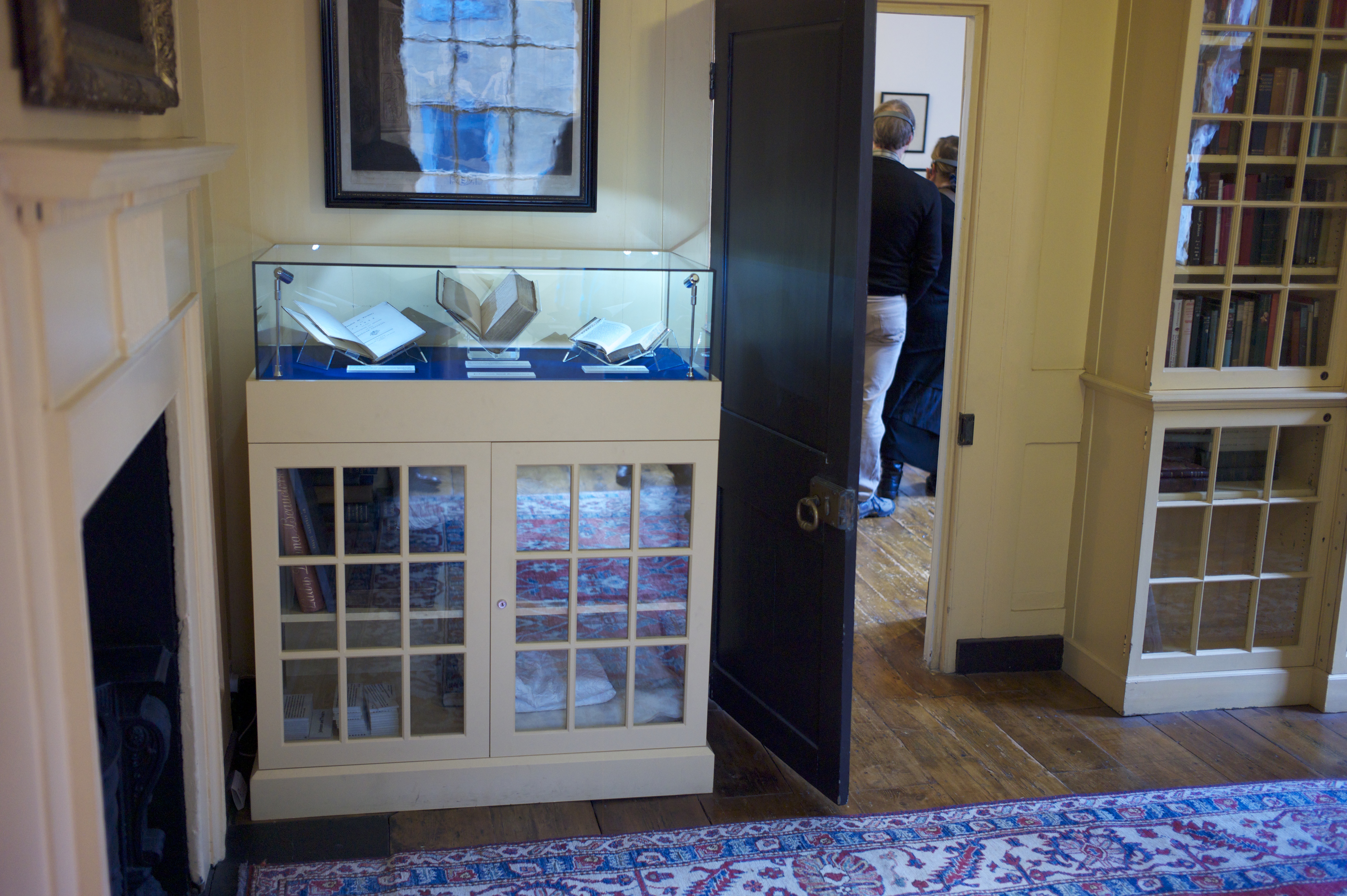
Third floor; bedrooms which are now being used to display some of Samuel Johnson’s works. The case contains a copy of the very first dictionary printed for the American market.
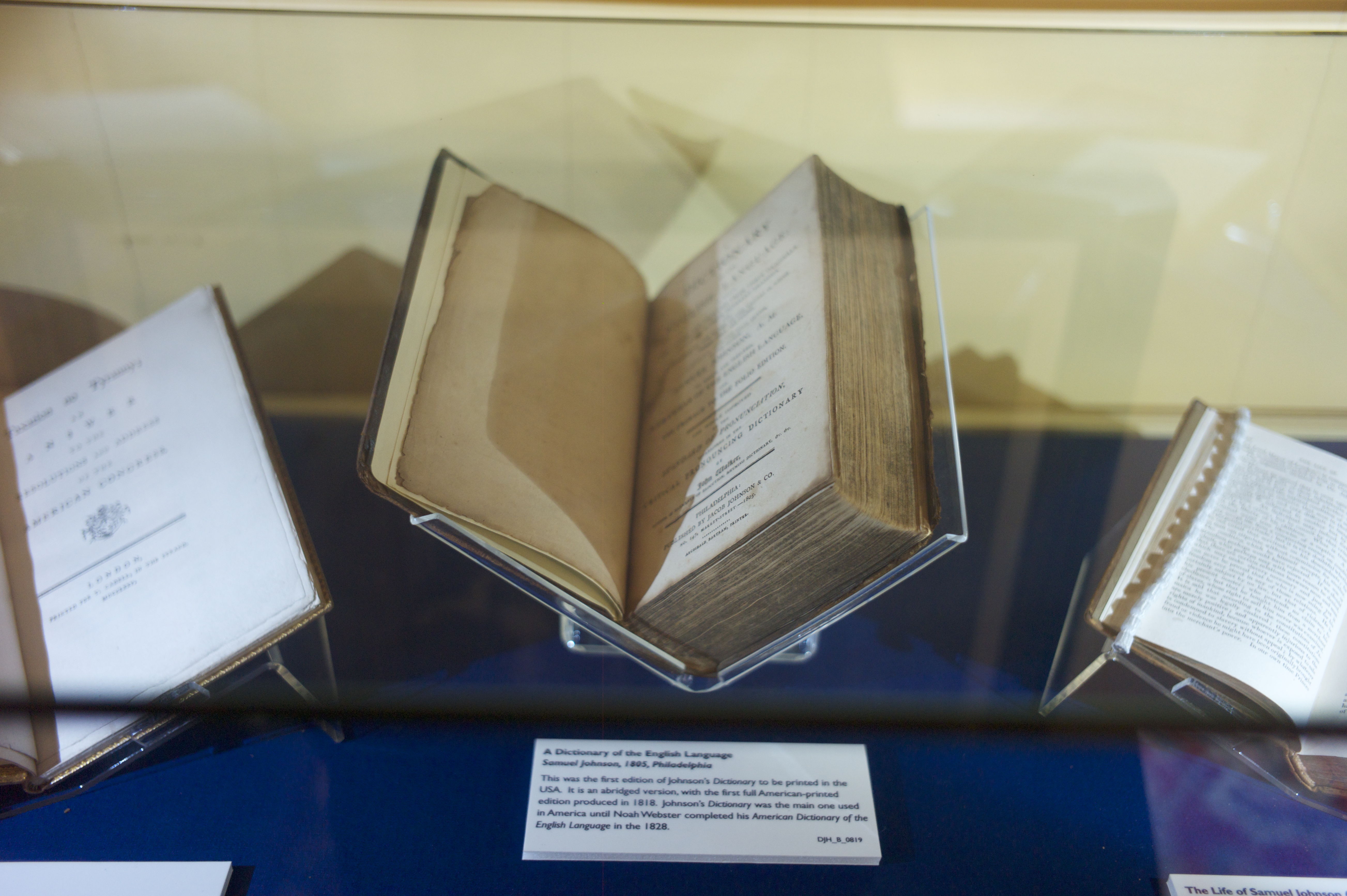
First edition of the dictionary printed for use in America.
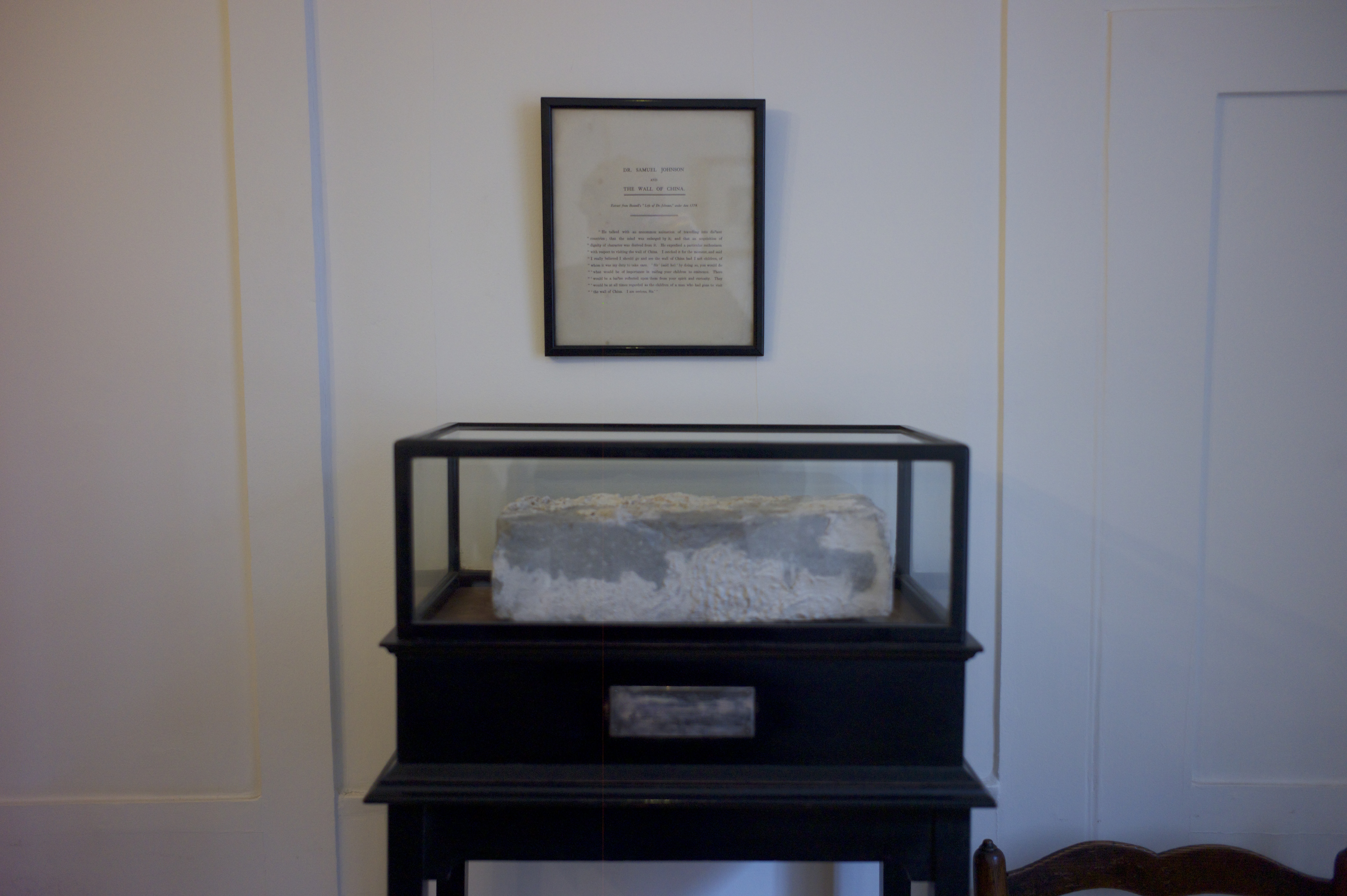
This last photo is of a case containing a stone from the Great Wall of China. The plaque above it reads:
This is one of our favorite discoveries on this trip because it so closely matches Adam’s and my philosophy about travel, childrearing, and life in general. It’s always nice to find that a genius agrees with you.
And just when I think I couldn’t like the guy any more, we came across a bronze statue of his cat, Hodge, in the courtyard with the inscription “A very fine cat indeed.” Hodge looks a little grumpy, but has an empty oyster shell at his feet. Wikipedia has this amusing entry about Hodge (cat):
“Although there is little known about Hodge, such as his life, his death, or any other information, what is known is Johnson’s fondness for his cat, which separated Johnson from the views held by others of the eighteenth century. Most of the information on Hodge comes from Boswell’s account. It is in this passage that Johnson is claimed to have an affection for animals in general, or at least the ones that he kept:”
Nor would it be just, under this head, to omit the fondness which he showed for animals which he had taken under his protection. I never shall forget the indulgence with which he treated Hodge, his cat: for whom he himself used to go out and buy oysters, lest the servants having that trouble should take a dislike to the poor creature. I am, unluckily, one of those who have an antipathy to a cat, so that I am uneasy when in the room with one; and I own, I frequently suffered a good deal from the presence of this same Hodge. I recollect him one day scrambling up Dr. Johnson’s breast, apparently with much satisfaction, while my friend smiling and half-whistling, rubbed down his back, and pulled him by the tail; and when I observed he was a fine cat, saying, ‘Why yes, Sir, but I have had cats whom I liked better than this;’ and then as if perceiving Hodge to be out of countenance, adding, ‘but he is a very fine cat, a very fine cat indeed.’
Who could dislike a person who has a love for animals? Everyone who knew Samuel Johnson liked him, and now I like him, too, despite the fact he’s been dead for more than 220 years. In my book, that is the very epitome of a successful human being. I feel honored to have toured through his house.
Down the road just a little ways from Johnson’s house is the original location of the R. Twinings & Co Limited (otherwise known as Twining’s Tea House) which has been there since 1706.
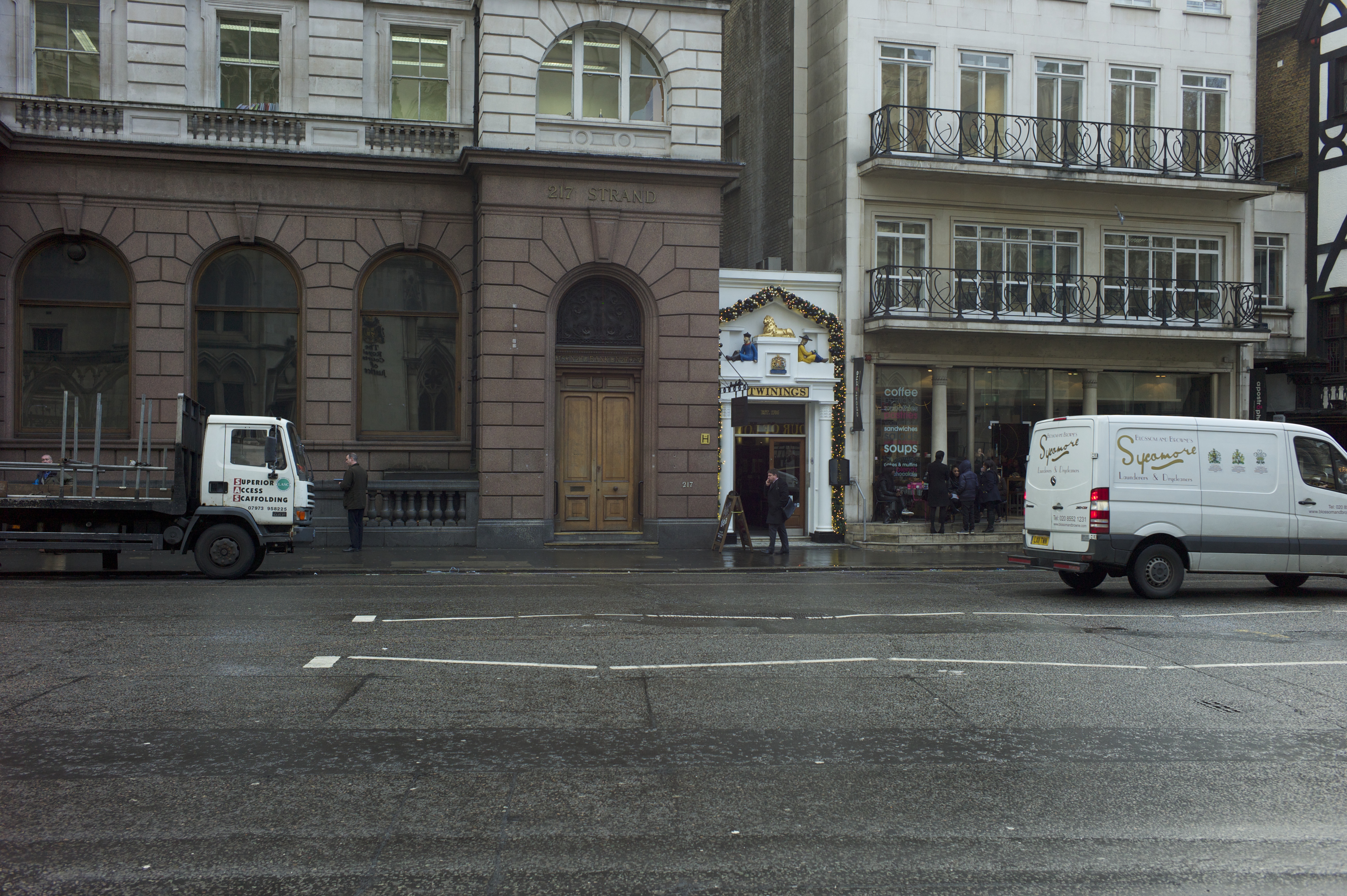
That tiny building squashed in-between the big buildings is the original Twining’s Tea House.
Inside, they have a station set up where customers can sample various teas prior to buying them. I found some “yellow tea” which I had never heard of … I have been drinking white tea for years and feel myself fairly knowledgable about tea in general, but this one took me by surprise. Evidently, yellow tea is ever-so-lightly fermented — somewhere between white (simply steamed and dried) and green (very lightly fermented) — they must stop the fermentation process before it gets to the “green” stage.
Anyway, the girl brewed up a cup of the yellow tea for Isabella and I to try. It was awful. I felt bad for not liking it, though, so ended up purchasing a bag of white tea to make up for having her go to all the trouble of brewing up the icky yellow stuff.
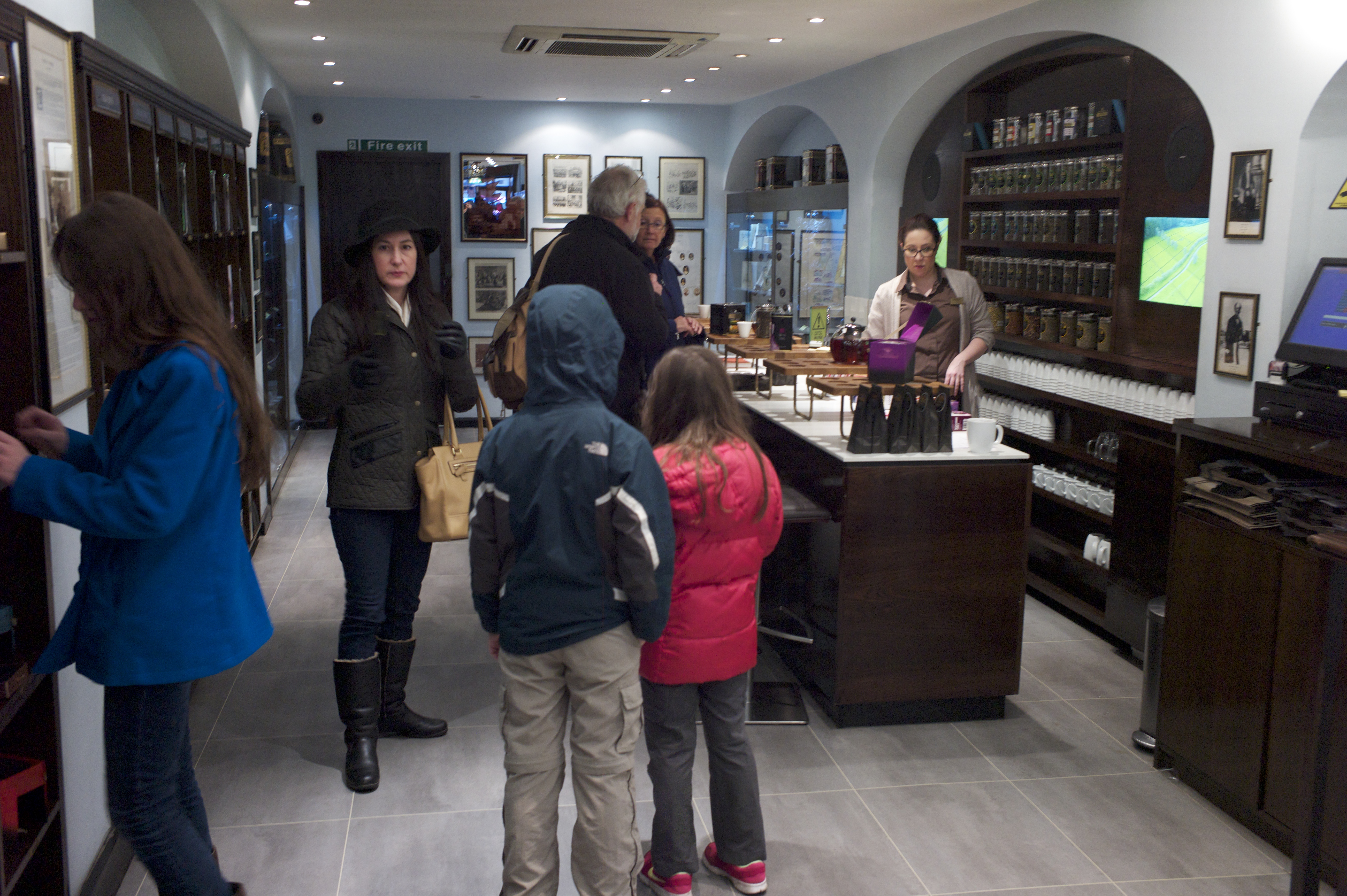
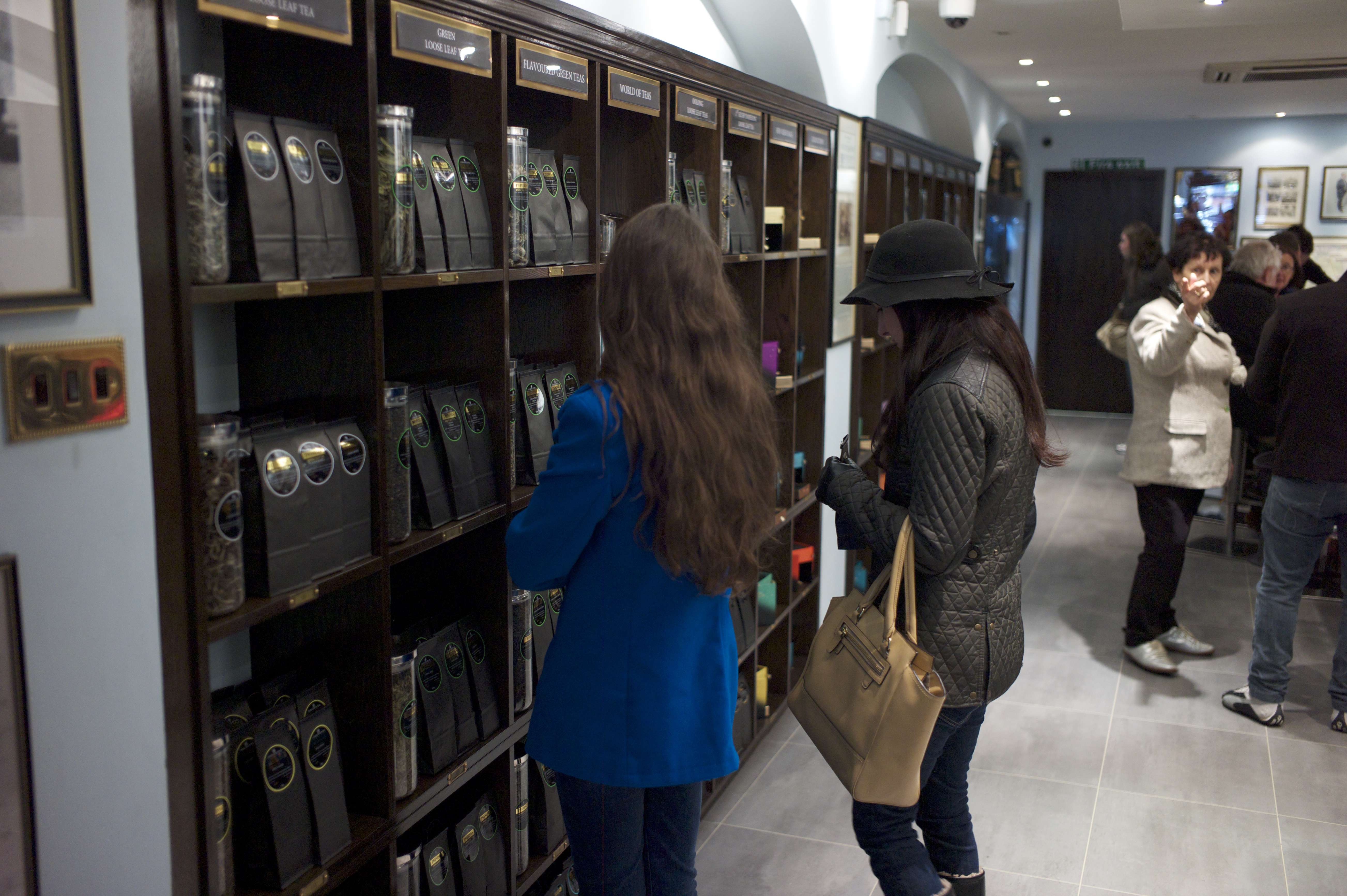
Next door to Twining’s was “The George.” It’s now a pub, but back in Samuel Johnson’s day it was a coffee house that he frequented and used as his mailing address. (We do not know why he used The George as his mailing address; the plaque on the front of the building just told us that he did.) We decided to eat lunch there.
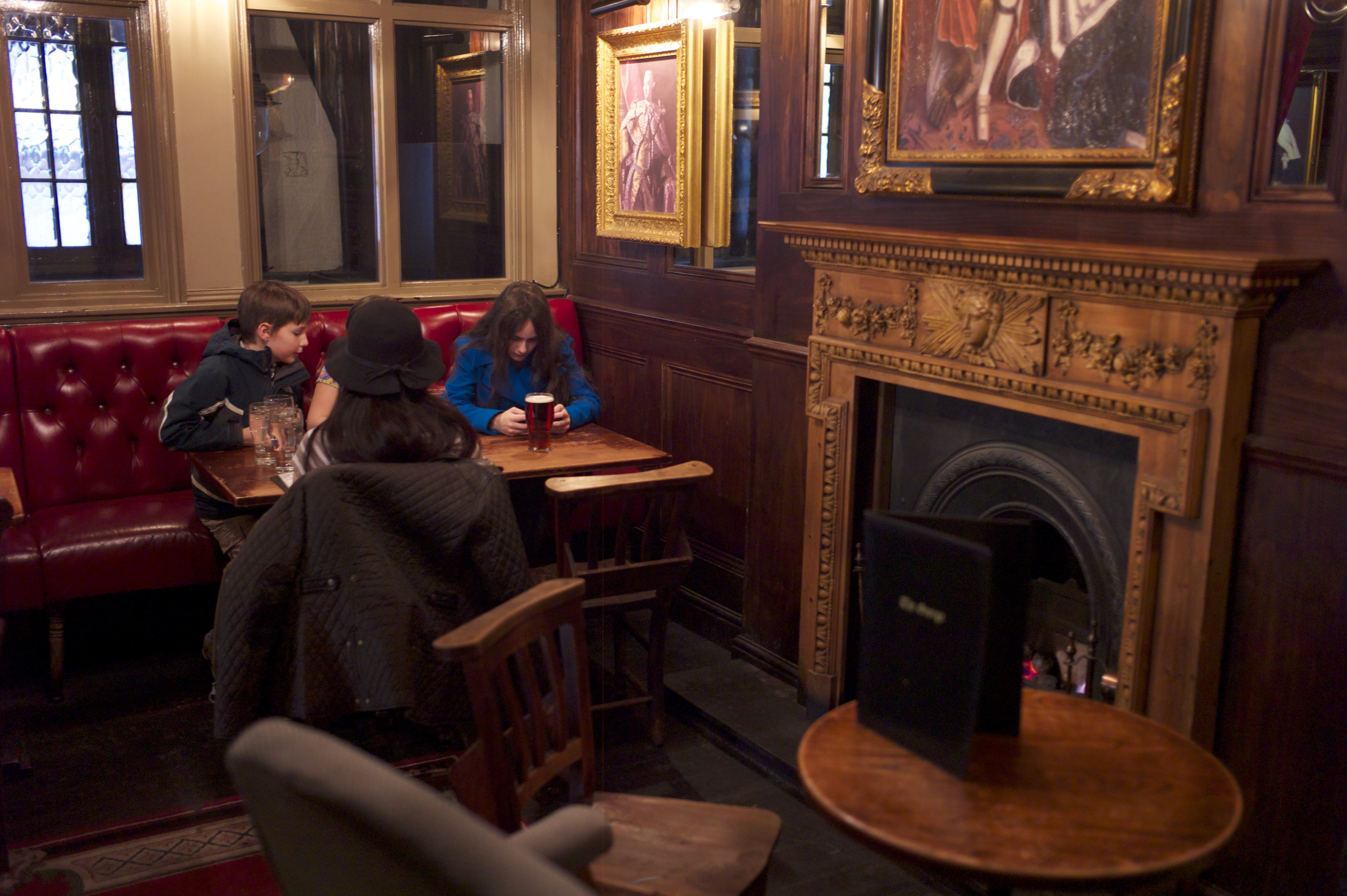
This photo of Isabella reminds me of the painting “L’Absinthe” by Edgar Degas. (That’s Adam’s beer, and Isabella is texting her friends on her phone.)
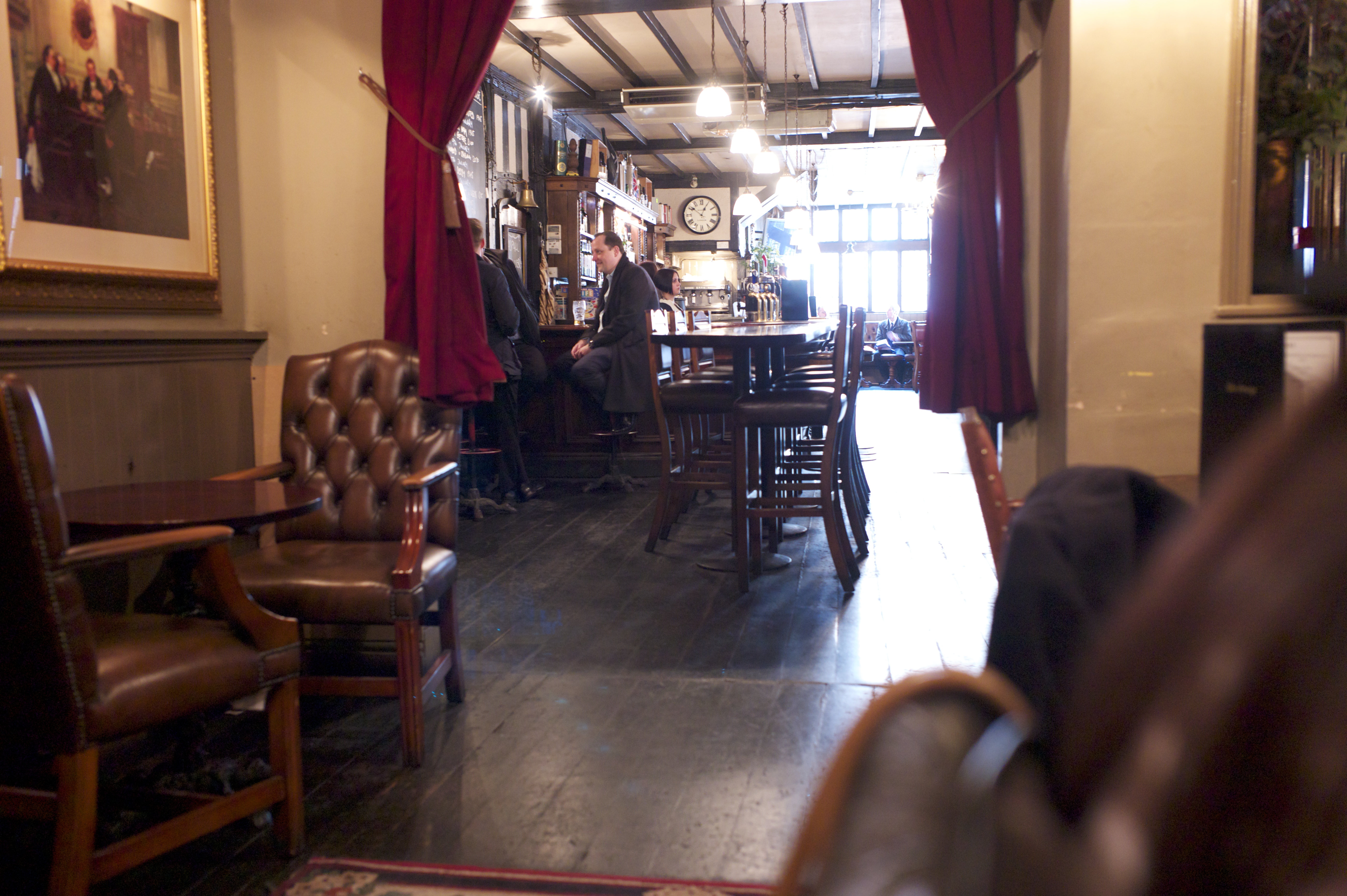
View looking out toward the front door. This place is a hopping pub now. One of their featured entertainments is to have people voluntarily read from their childhood diaries.

Josie telling a really emotional tale about how she was wronged by her brother in a Nintendo DS dispute…
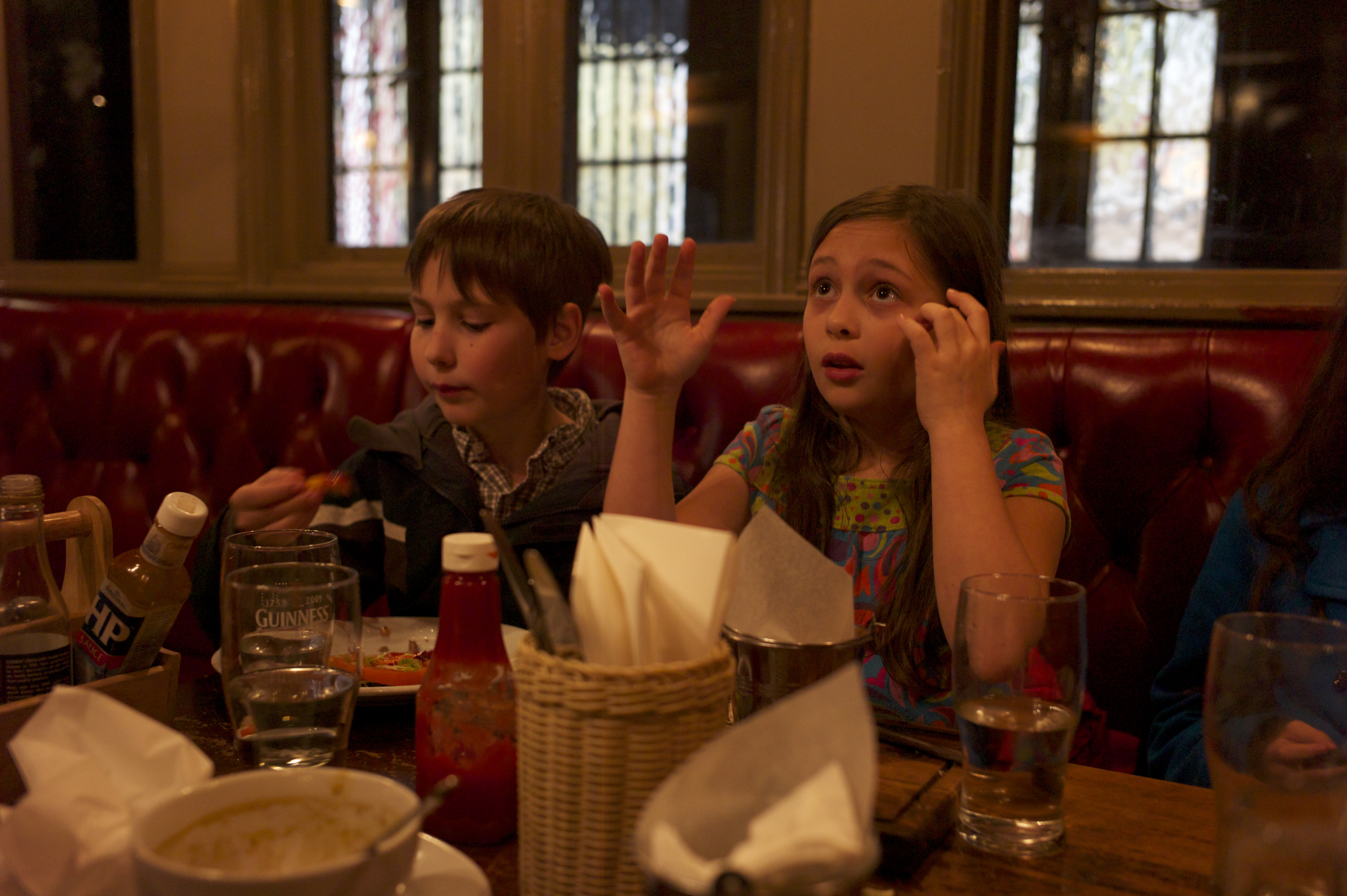
…. and then it gets even more tragic ….
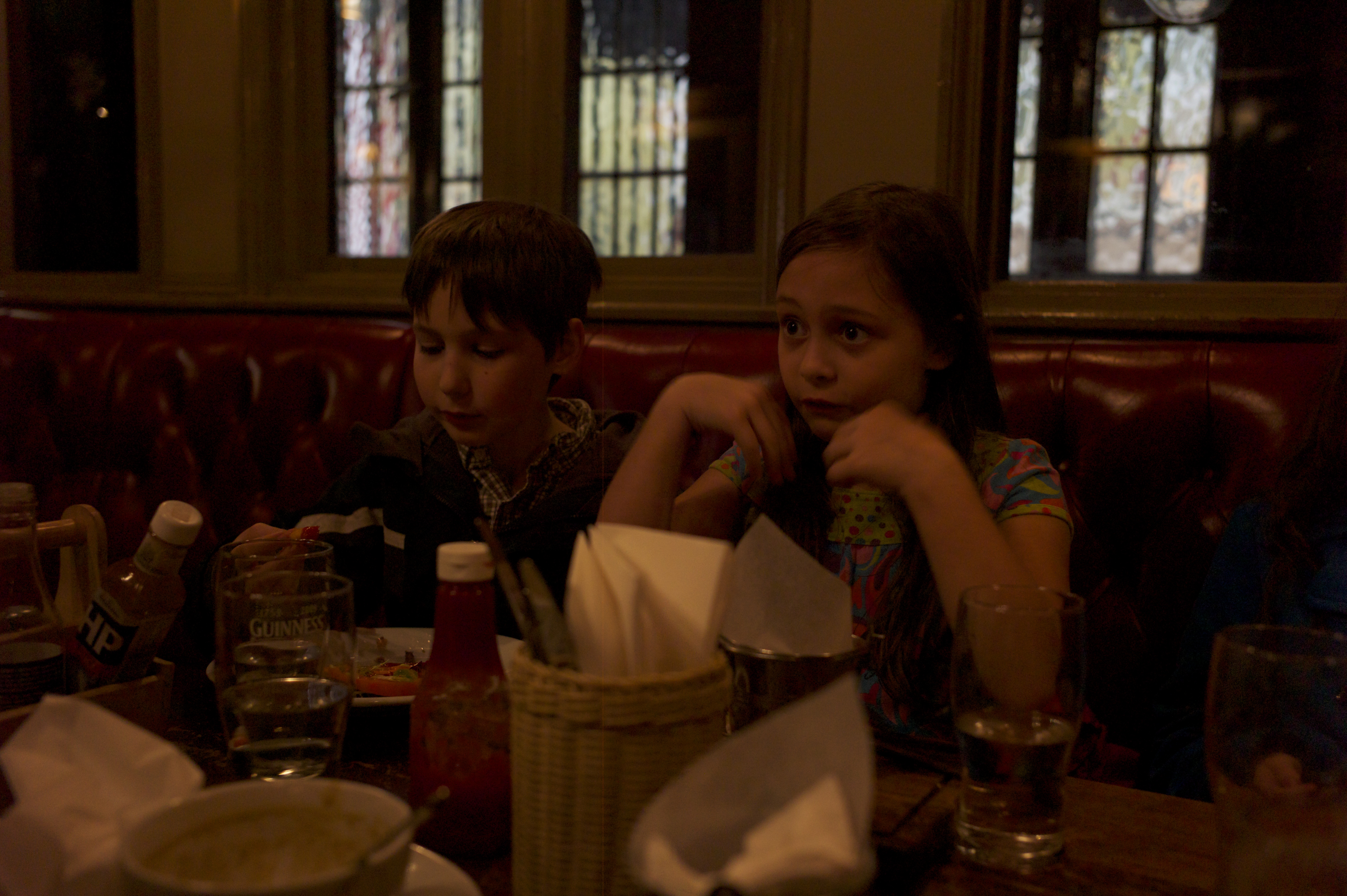
… and has a sad ending. (Note that Holden is not feeling guilty in the least.)
Last up for the day was the Grant Zoological Museum. It is part of the University College of London. Founded in 1828 as a teaching collection, it’s now open to the public. The specimens are still used by students, and the center of the room is filled with tables so people can study.
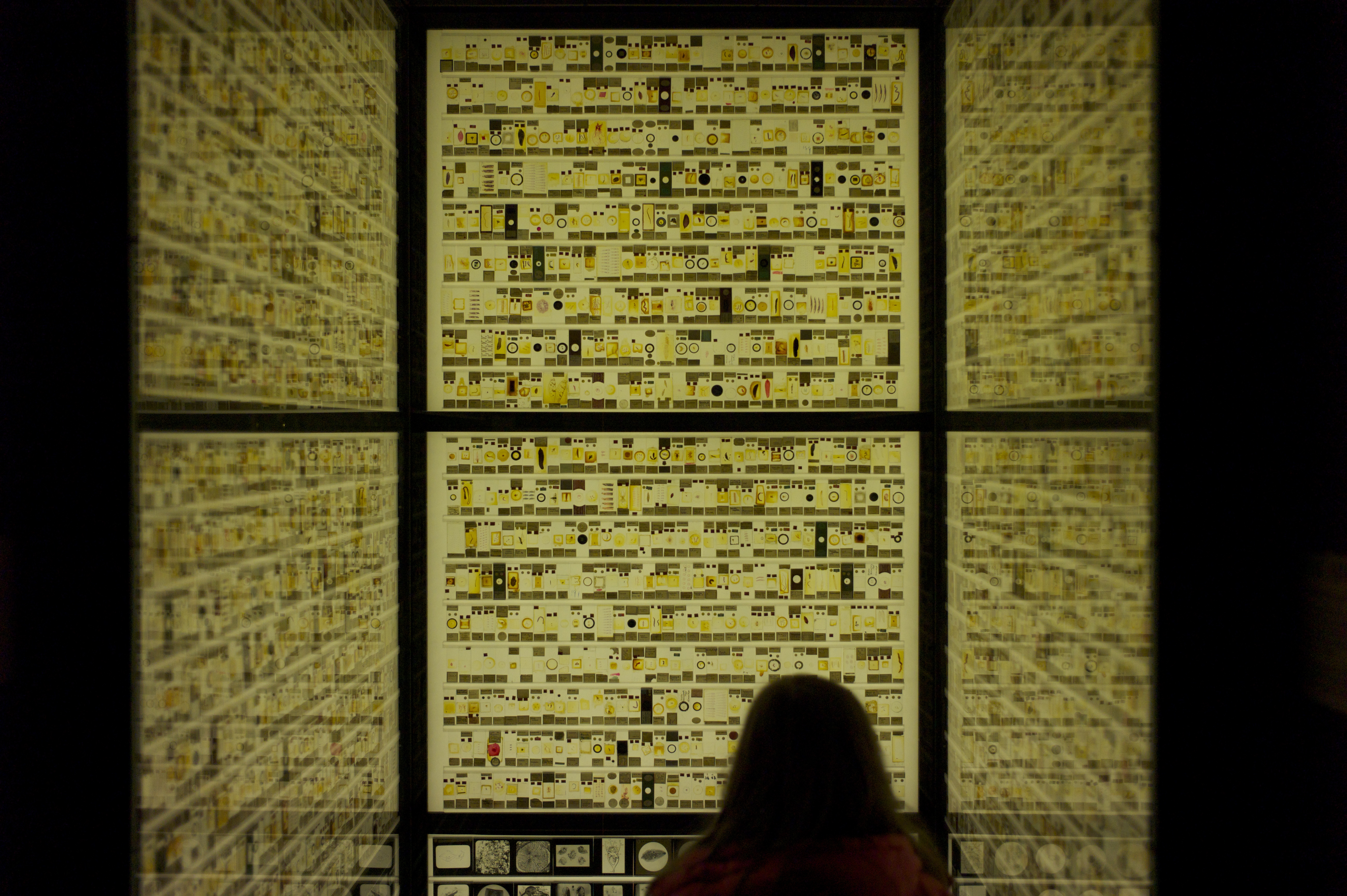
Josie reviewing the thousands and thousands of slides of little creatures – each is a different species. The point of the exhibit was to show that the vast majority of differentiation of life in this world comes from species smaller than your fingernail.
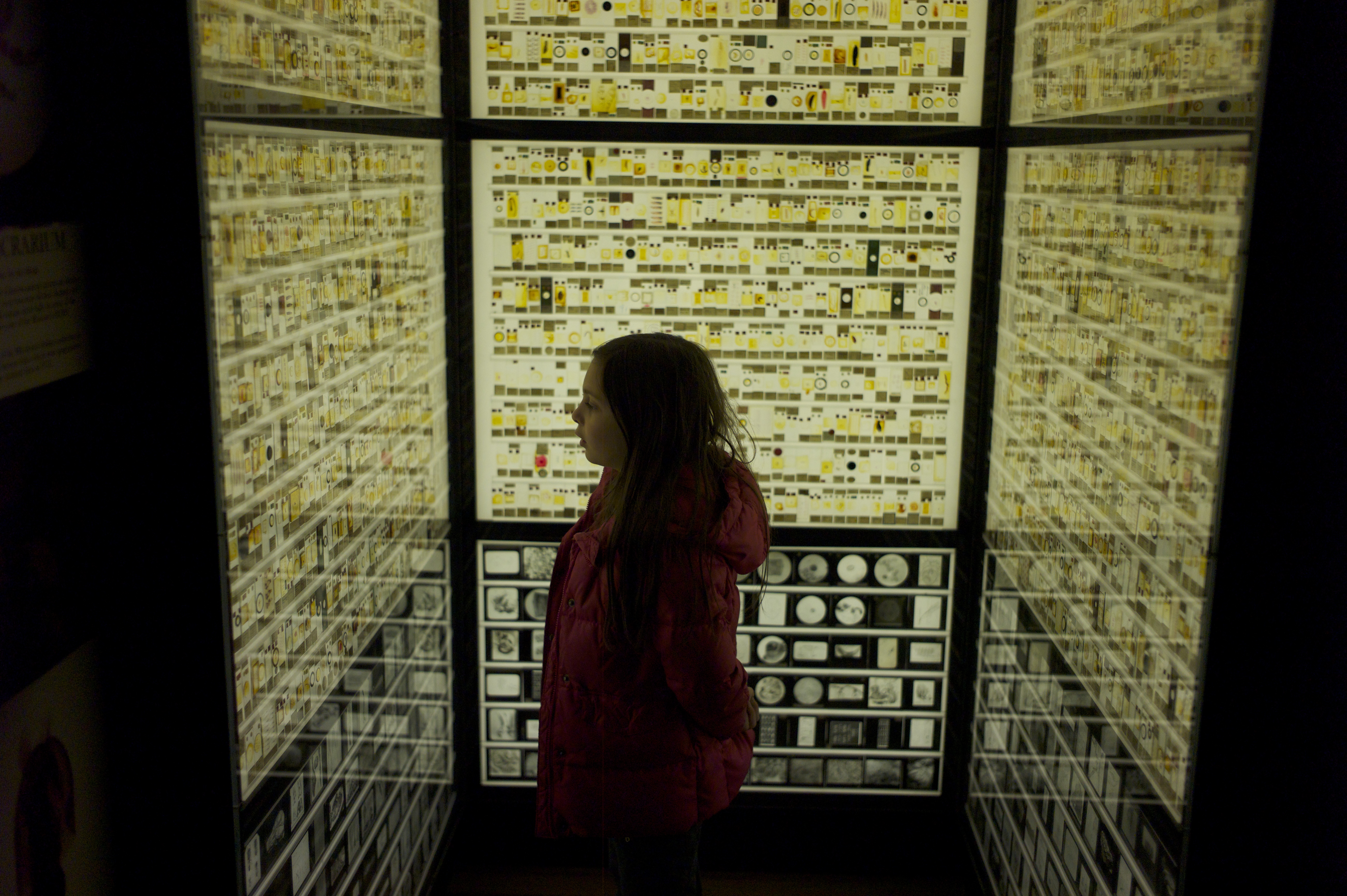
Lots to see.
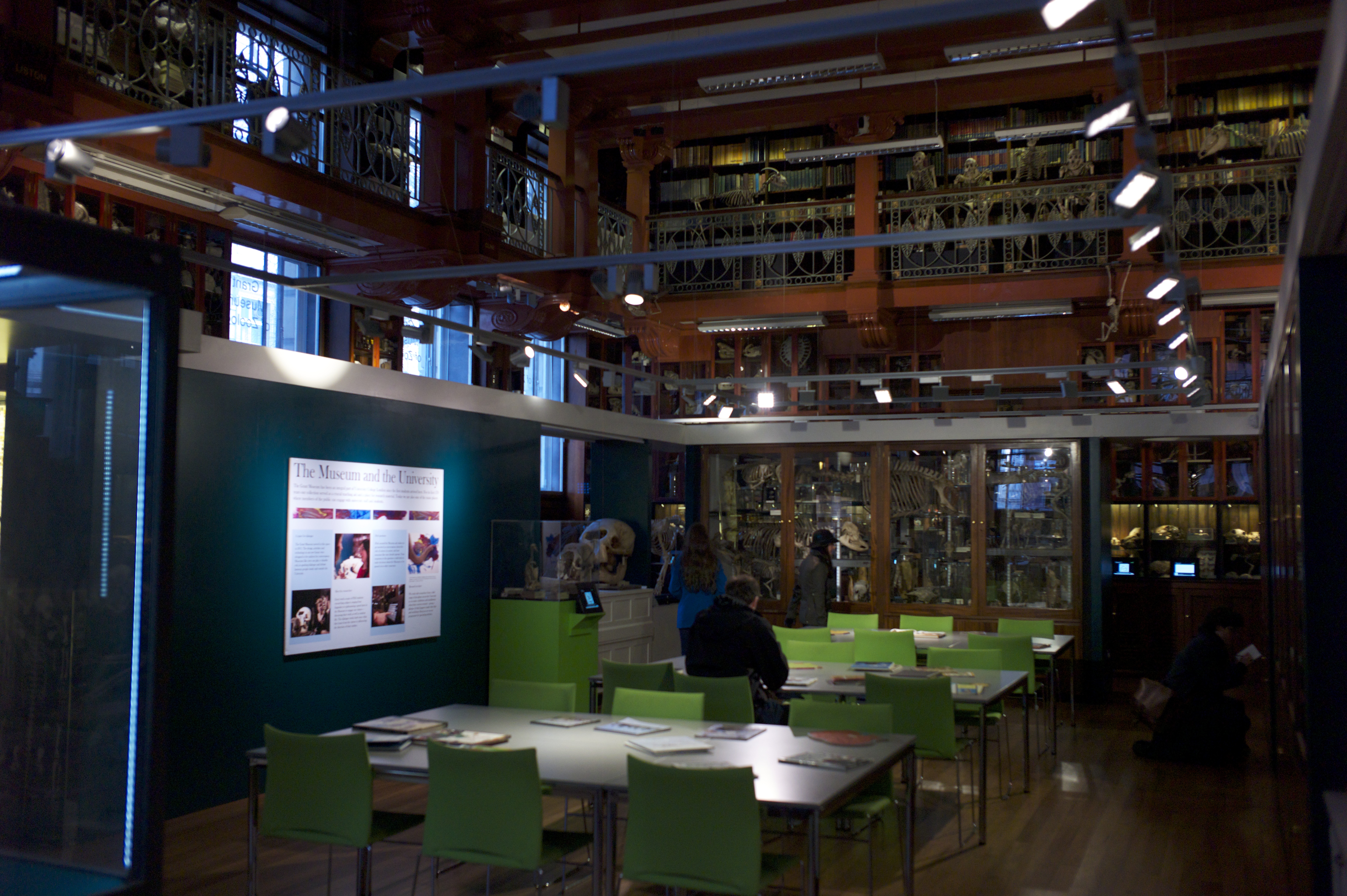
Studying area.
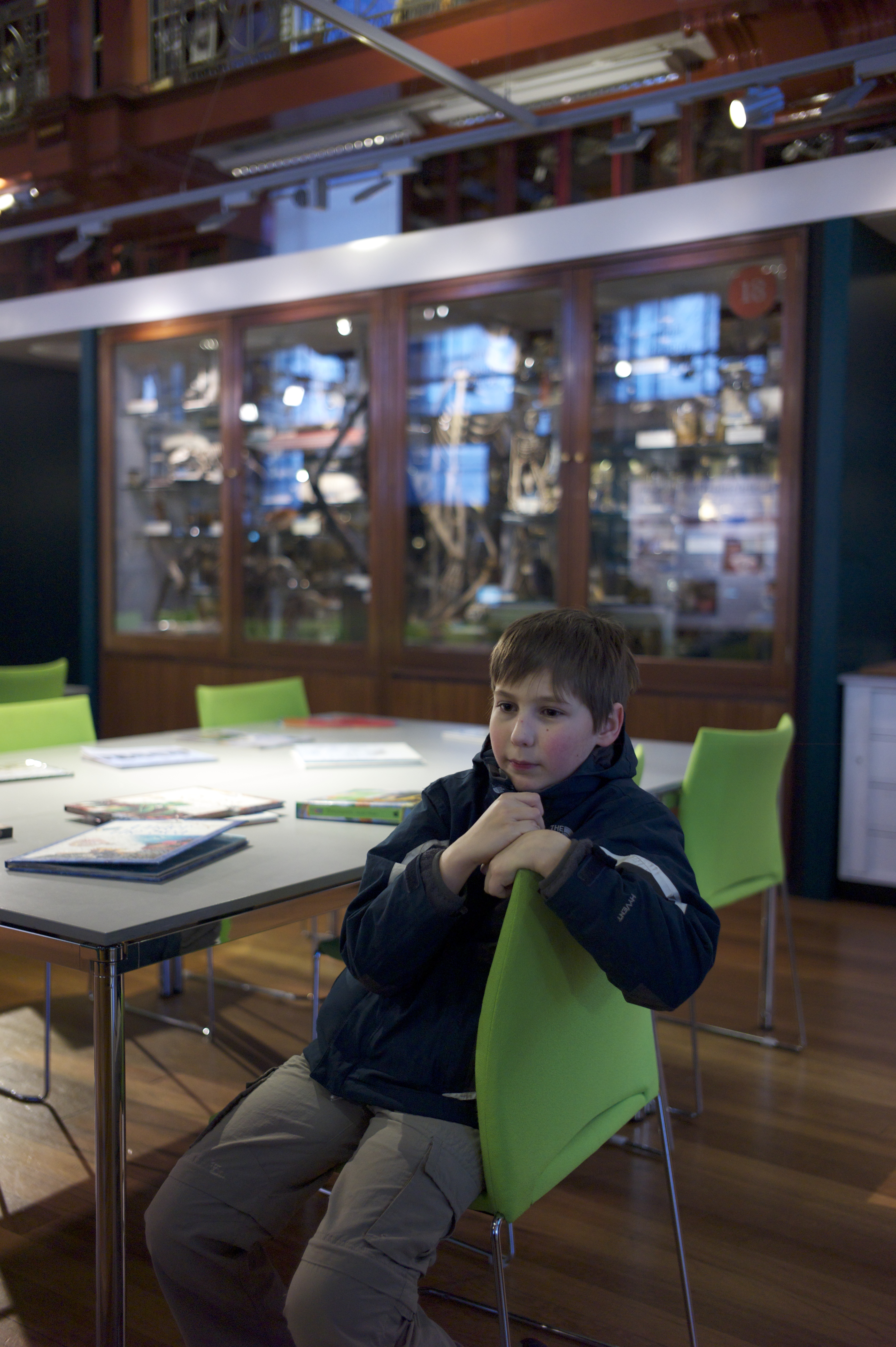
Holden contemplating skeletons. (You can see where he bonked his nose during ice skating the other day.)
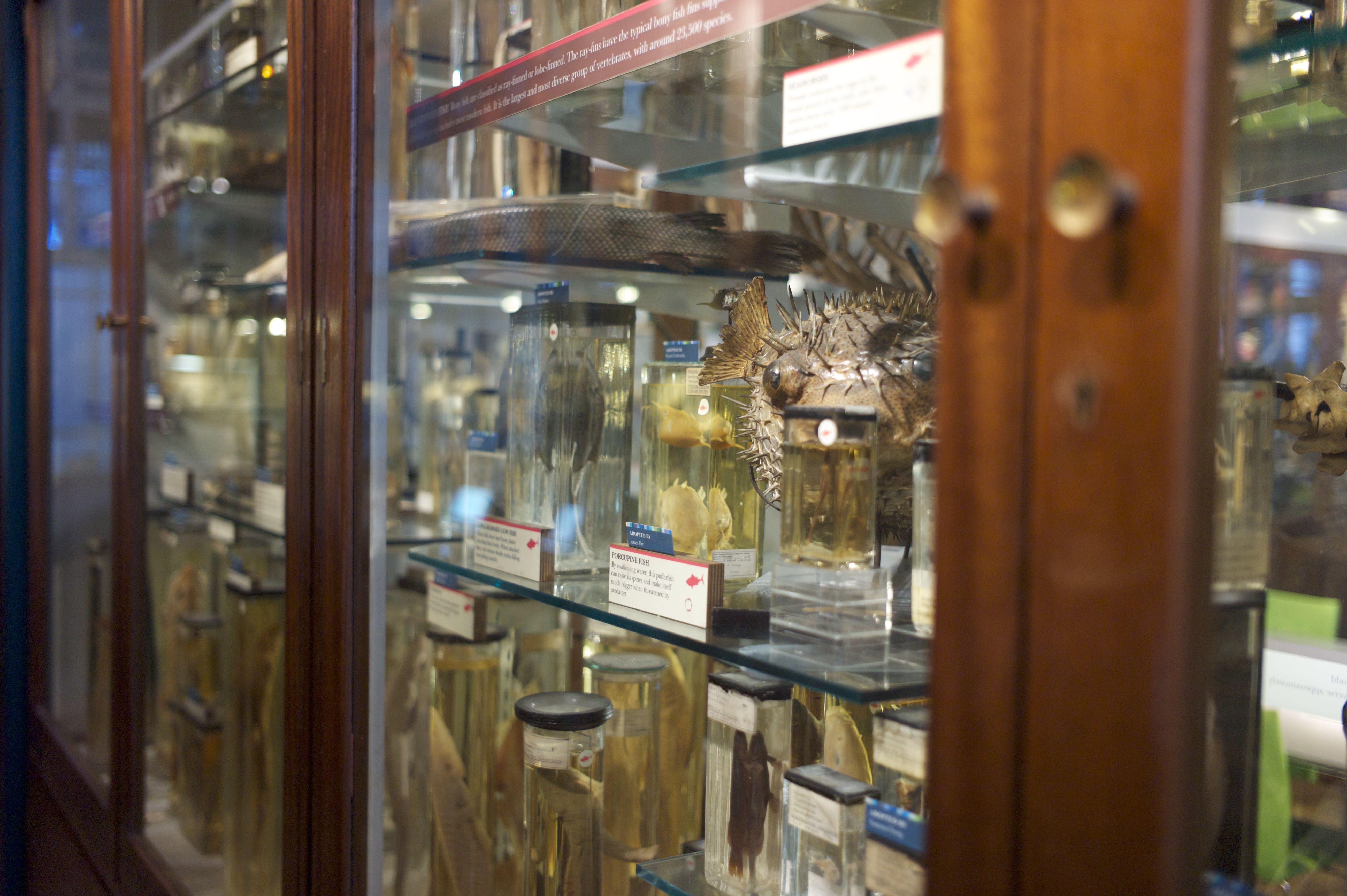
Jars and jars full of ancient preserved specimens, in various stages of dissection.
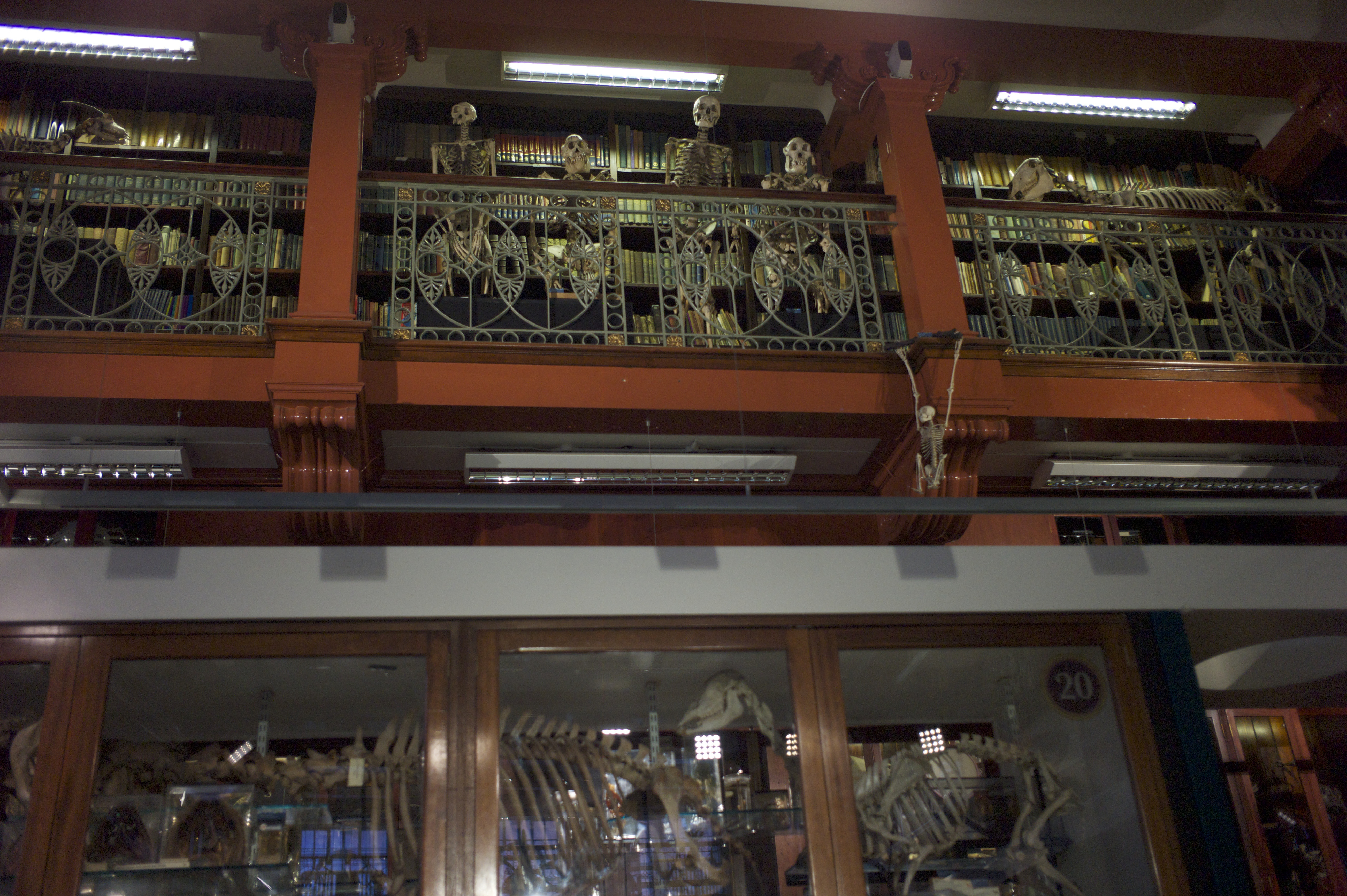
Lots of skeletons. The ones above are all ape … not human. (They are freakishly similar.)
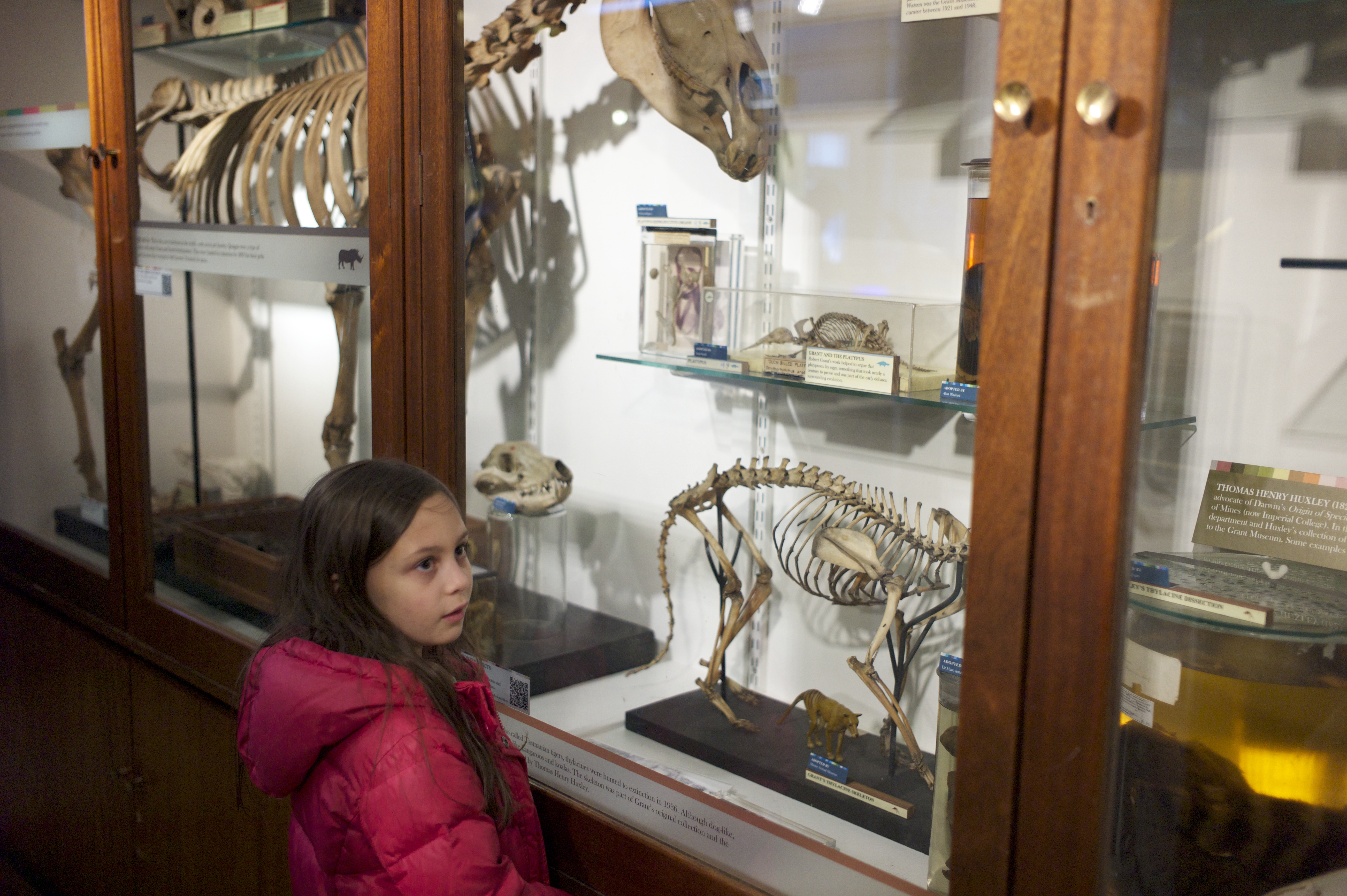
Case full of species that went extinct recently. That big skeleton is a quagga, an animal that looks a zebra/horse mix. The last one died in 1883 and only 7 skeletons exist now. The little one is a thylacine, a marsupial that looks kind of like a dog, that went extinct in 1936. They actually had real photographs of live ones next to the skeletons. It was a really neat exhibit.
January 8, 2014 (Wednesday)
Today Adam and I saw The Book of Mormon. We absolutely loved it. I enjoyed it even more than I enjoyed Wicked, which is really saying something. However, I’m not going to write about it here because of the controversial subject matter.
Isabella babysat the other two back our apartment and the kids said they had a fabulous afternoon, as well. Having mama and daddy leave them alone for a few hours gives them a sense of freedom, even if all they do is play hide and seek, eat apples, and watch TV.
Tomorrow is our last day. We’re all looking forward to going home, mostly because we miss Max, but are also a little sad about leaving. This morning Isabella said, “I think this is the best vacation we’ve ever had” and the other two kids agreed. Renting an apartment and staying in once place for a while seems to make a huge difference. We’re going to incorporate that into our summer plans as much as possible. Staying in a real house instead of a hotel provides an enormous psychological benefit.

